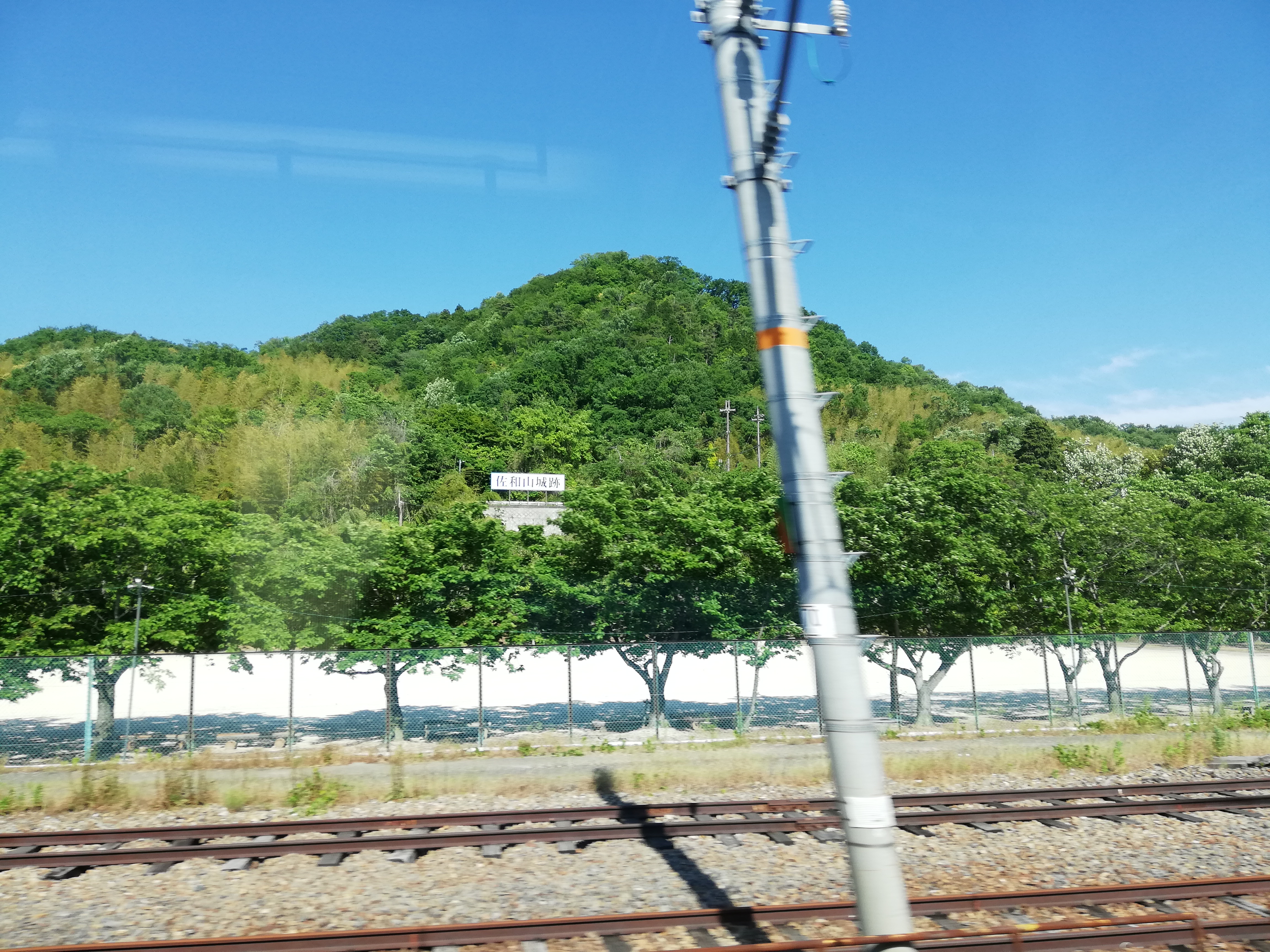
Sawayama Castle: The Fortress That Built Its Rival
The castle that stands today in Hikone was built from the bones of the one it replaced. Sawayama Castle, perched on the summit of Mount Sawayama in Shiga Prefecture, once commanded one of the most strategic positions in central Japan -- guarding the eastern approaches to Kyoto along the shores of Lake Biwa. For generations it passed through the hands of some of the Sengoku period's most powerful warlords. Then, after a single catastrophic day in 1600, its stones were pried loose, carried down the mountain, and reassembled into Hikone Castle, which still draws visitors by the hundreds of thousands. Sawayama's reward for centuries of military service is a sign at the trailhead reading "The Site of Sawayama Castle" and a hiking path through the forest to its empty summit.
A Stronghold Between Empires
Sawayama Castle's power came from geography. Sitting in what was once Omi Province, the castle controlled the narrow corridor between Lake Biwa and the mountains to the east -- the route any army marching on Kyoto from the eastern provinces had to pass through. The Azai clan held the fortress during the chaos of the Sengoku period, when Japan fractured into dozens of warring domains. The castle's position made its lord a kingmaker. Whoever held Sawayama could block or permit the flow of armies, trade, and messengers between the capital and the eastern heartland. After the Azai clan fell, the fortress passed to Niwa Nagahide, one of Oda Nobunaga's most trusted generals, and eventually to Ishida Mitsunari, the bureaucrat-turned-warlord who would stake everything on one decisive battle.
Mitsunari's Gamble
Ishida Mitsunari was not a natural warrior. He rose through administrative skill, serving as one of Toyotomi Hideyoshi's most capable civil officials. But when Hideyoshi died in 1598, Mitsunari found himself in a deadly political struggle with Tokugawa Ieyasu for control of Japan. Mitsunari made Sawayama his base, transforming it into a formidable stronghold befitting the stakes. On October 21, 1600, the two factions collided at the Battle of Sekigahara, roughly forty kilometers to the east. The battle lasted only hours. Mitsunari's Western Army was routed, in part due to the betrayal of Kobayakawa Hideaki, who switched sides at the critical moment. Mitsunari fled, but was captured days later at Hokekyo Sanju-in Temple in the hills above the battlefield. He was executed in Kyoto. Sawayama Castle's fate was sealed.
Half a Day's Defiance
Even as news of Sekigahara's outcome reached Sawayama, the castle did not fall quietly. Mitsunari's brother Ishida Masazumi and their father Ishida Masatsugu rallied the garrison and prepared for a siege. Kobayakawa Hideaki -- the same general whose betrayal had doomed Mitsunari on the battlefield -- led the assault on the castle. The defenders held out with fierce determination, but the outcome was never in doubt. Within half a day, Sawayama Castle surrendered. The brief defense became a footnote to the larger drama of Sekigahara, but it captured something essential about the castle's character: even in its final hours, it demanded to be taken by force.
Stones Reborn as Hikone
The victor at Sekigahara, Tokugawa Ieyasu, rewarded his loyal general Ii Naomasa with control of the region. Naomasa occupied Sawayama Castle but quickly decided it would not serve his purposes. Rather than restore the old fortress, he ordered it dismantled. The stone walls, timber beams, and architectural elements were carried down Mount Sawayama and used as raw material for a new castle on a neighboring hill. Hikone Castle rose from Sawayama's remains, its walls incorporating the very stones that had once defended Mitsunari. Today, Hikone Castle is one of only twelve original castles remaining in Japan and a designated National Treasure. The irony is visible from the summit of Mount Sawayama: hikers who climb the old castle trail are rewarded with a panoramic view that includes Lake Biwa stretching to the horizon and, on the neighboring hill, Hikone Castle -- Sawayama's direct descendant, built from its own body.
The Ghost on the Mountain
Today, Mount Sawayama is a quiet hiking destination. A trail begins at Ryutan-ji Temple at the base and winds upward through forest to the honmaru -- the main keep's foundation -- where scattered stone walls are the only physical evidence of the fortress that once controlled central Japan. The climb takes roughly thirty minutes. At the summit, the view is extraordinary: Lake Biwa dominates the western horizon, Japan's largest freshwater lake shimmering below, while Hikone Castle's white walls and distinctive tower stand out clearly on the adjacent hill. The contrast is stark. One castle was erased; the other endures. But standing on the empty summit, surrounded by the remnants of stone foundations slowly being reclaimed by moss and tree roots, the story of Sawayama feels more present than any restored keep could make it.
From the Air
Located at 35.28°N, 136.27°E on Mount Sawayama in Hikone, Shiga Prefecture. The mountain rises just east of Hikone Castle, which is clearly visible from altitude as a white-walled complex on a neighboring hill. Lake Biwa, Japan's largest lake, stretches to the west and north. Best viewed at 3,000-5,000 feet AGL from the west to see both Sawayama and Hikone Castle against the mountain backdrop. Nearest airport is Chubu Centrair International Airport (RJGG), approximately 90 km to the south. Osaka Itami (RJOO) lies roughly 120 km to the southwest.