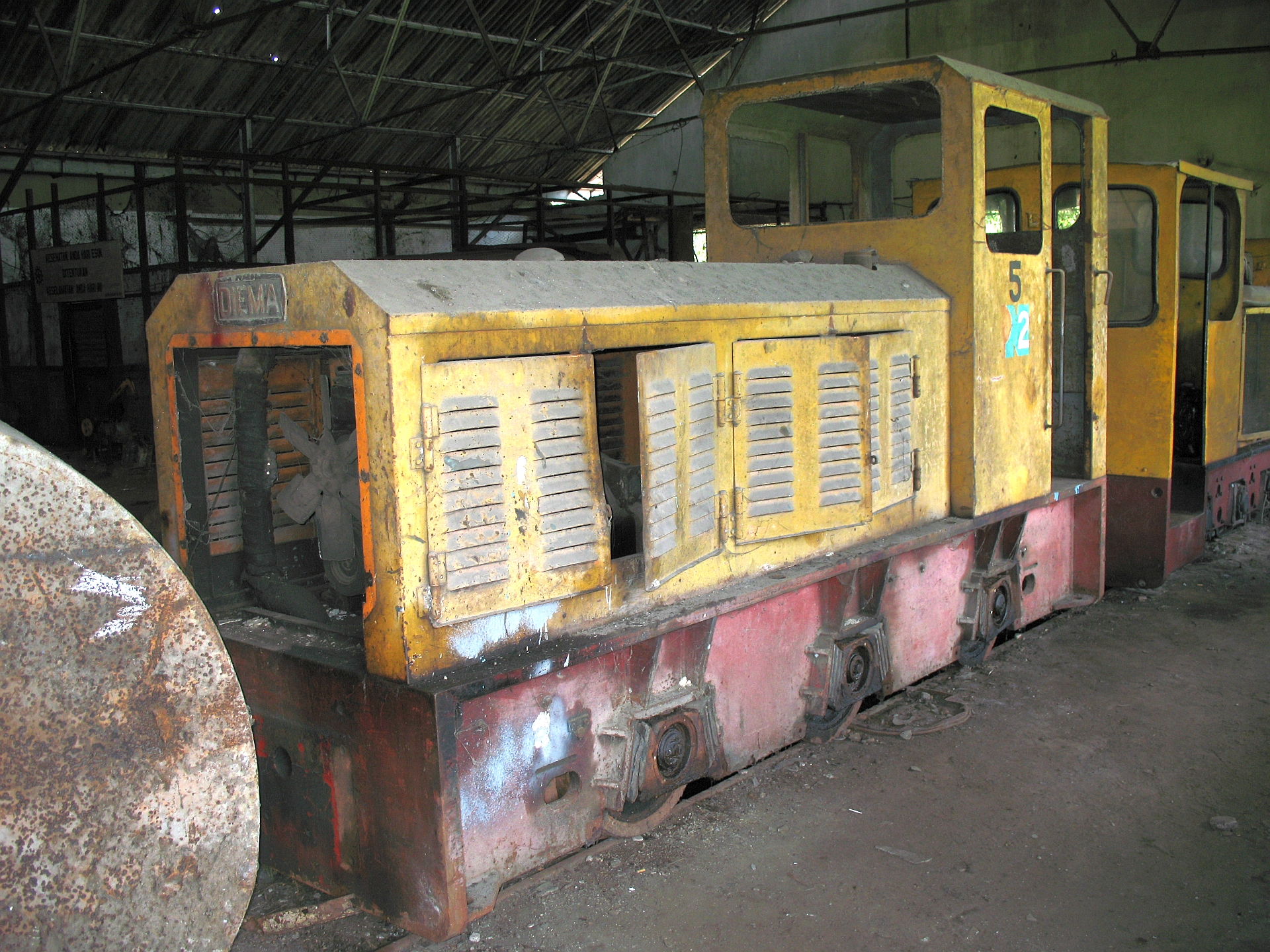
Sawit Seberang Factory Railway
By July 2008, only two locomotives still worked the line. Built in Japan by Hokuriku Juki Kogyo of Niigata, they would trundle out each morning into the palm oil plantations of Langkat Regency, collect wagons loaded with fresh fruit bunches, and rattle back to the little factory by afternoon. Every other diesel in the shed was already derelict. Within a few years, the tracks themselves would be pulled up, ending a narrow-gauge railway tradition that had begun with German steam engines in the 1920s.
A Village Named for Its Trees
The railway takes its name from the village of Sawit Seberang in Langkat Regency, the northernmost regency of North Sumatra. The factory sits near the village's northeast border, north of the provincial capital Medan and roughly 30 kilometers northwest of Stabat, the seat of Langkat. During the colonial era, Dutch-managed plantations expanded from Sawit Seberang southeast toward Gohor Lama, about 13 kilometers away, growing the catchment area that the railway served. The factory became part of PT Perkebunan Nusantara II (PTPN II), a state-owned agricultural conglomerate formed in March 1996 that manages palm oil, sugar, rubber, and tobacco across more than 117,000 hectares of North Sumatra. Its headquarters sit in Tanjung Morawa, about 10 kilometers south of Medan.
Steam from Europe
The plantation's locomotive roster reads like a catalog of early 20th-century European industrial engineering. The first recorded delivery was a 0-6-0 tank locomotive from Orenstein & Koppel, serial number 11119, dispatched to C. Schlieper for the plantation in the mid-1920s and numbered '11.' A second Orenstein & Koppel machine, serial number 12247, arrived in 1933 via N.V. Spoorijzer of Delft, becoming number '7' before eventually being renumbered '6.' In the late 1930s, the German builder Jung supplied a heavier 0-8-0 tank engine, serial number 8467, delivered through P. Jemun of Amsterdam as number '5.' Du Croo & Brauns, based in Weesp in the Netherlands, contributed additional rolling stock in the same period. All ran on 700-millimeter gauge track, narrow enough that the little engines could wind through dense palm groves where standard-gauge rail would never fit.
The Diesel Decades
Dieselization began in the early 1950s with machines from the British firm Ruston Hornsby, but the real transformation came through German builders Schoma and Diema, who delivered locomotives between 1963 and 1981. Running numbers were recycled as new engines replaced old ones, creating a genealogy that rewards careful record-keeping. By the 1980s, more than two dozen diesels were on the books, though many of the older units sat derelict. One locomotive deserves special mention: D 05, a Diema type DFL90/1 D, believed to be the only unit ever built to that specification. The 'D' in the designation probably stands for 'drei' -- three -- referring to its three axles, though even this remains uncertain. A separate Schoma engine, builder number 4240, was delivered in 1978 for a feeder line connecting to the state railway between Binjai and Tanjung Pura, running on the wider Cape gauge.
Last Runs and Lifted Rails
The final chapter of the Sawit Seberang railway was written in increments. By the time of a documented visit in July 2008, trucks were already hauling the majority of palm fruit from the fields. The fruit would arrive by road and be reloaded onto light railway wagons at the factory, pushed and pulled the final distance by capstans and forklifts rather than locomotives. The two Japanese-built engines from 1985 -- Hokuriku Juki Kogyo HDB-6LS models that had also supplied Indonesian sugar factories -- soldiered on as the last working pair. By 2012, one of them sat parked beside tracks that were already disappearing. Railway transport of palm fruit was formally abandoned in the early 2010s, and the rails were lifted entirely. What remains is an industrial ghost story: a landscape shaped by rail that has forgotten it.
An Archipelago of Lost Lines
Sawit Seberang was hardly unique. Across Indonesia, plantation railways once stitched together the colonial economy, connecting rubber estates, sugar mills, and palm oil factories to port towns and mainline railheads. Most are gone now, victims of the same economics that killed the Sawit Seberang line: trucks are cheaper to operate, more flexible in routing, and require no dedicated infrastructure. But for nearly a century, these narrow-gauge systems defined the rhythm of plantation life. The morning departure of locomotives, the clanking of loaded wagons, the afternoon return to the factory -- these were the sounds of an entire agricultural world. At Sawit Seberang, the silence where those sounds used to be is the most telling artifact of all.
From the Air
Coordinates: 3.80°N, 98.28°E, in the lowland plantation country of Langkat Regency, North Sumatra. At 5,000-8,000 feet the orderly grid of palm oil plantations is clearly visible, contrasting with pockets of remaining jungle. The former railway alignment may still be traceable as a cleared corridor through the palms. Nearest major airport is Kualanamu International Airport (WIMM) southeast of Medan. The town of Stabat and city of Binjai are visible landmarks to the southeast and south respectively.