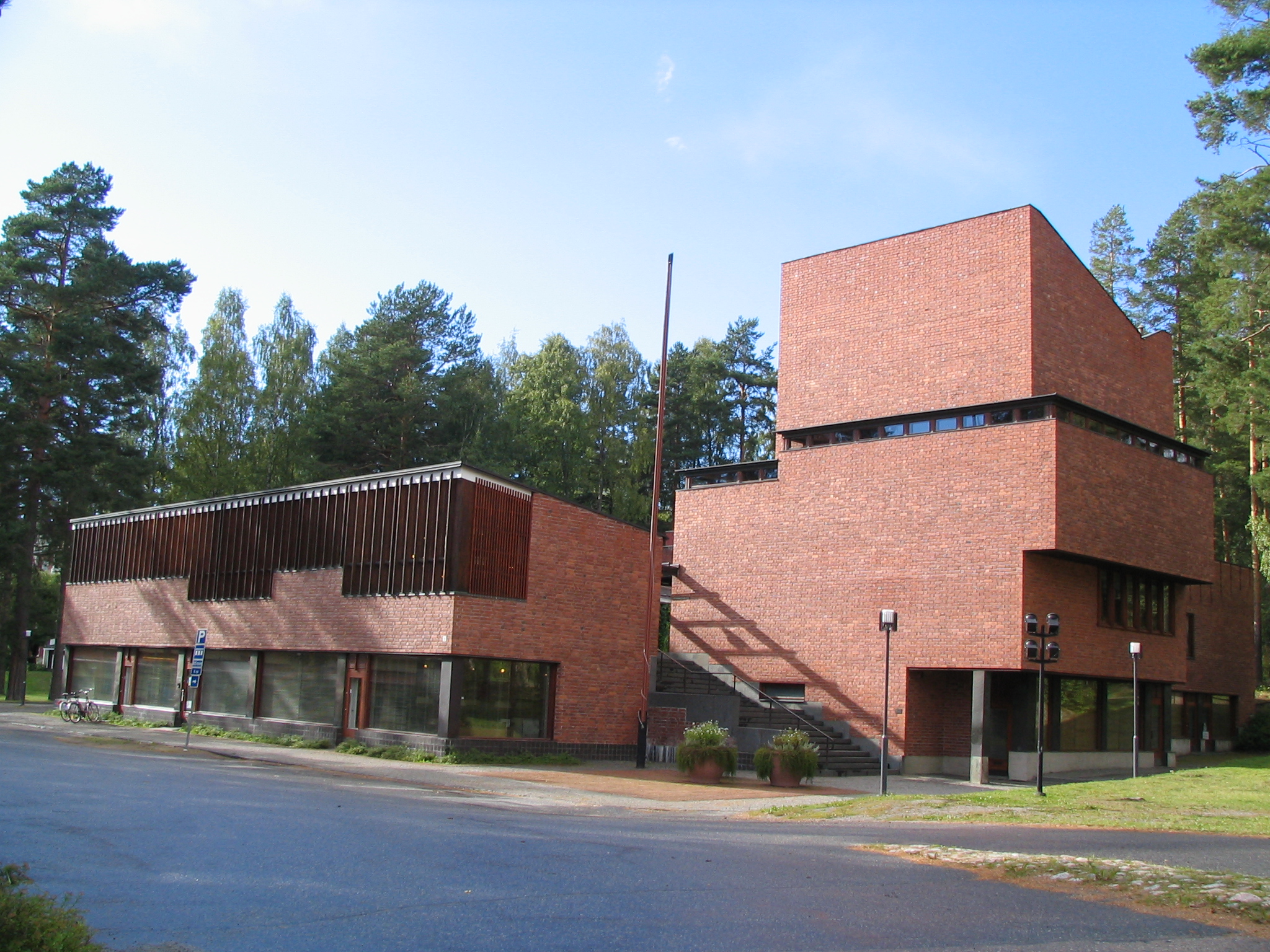
Saynatsalo Town Hall
The bricks are deliberately crooked. Alvar Aalto insisted on it. At Saynatsalo Town Hall, completed in December 1951 on a small island in central Finland's lake district, the masons were instructed to lay their bricks slightly off-line -- not from carelessness, but from conviction. The shadows that play across those uneven surfaces were the whole point. Where his contemporaries Le Corbusier and Mies van der Rohe pursued machine-precision surfaces, Aalto wanted buildings that felt alive. Saynatsalo was where he proved that a municipal building for a tiny factory town could be as architecturally significant as any cathedral.
A Factory Town's Ambition
Saynatsalo was not an obvious place for a landmark. The island community had grown up around Johan Parviaisen Tehtaat, a wood-processing mill later operated by Enso-Gutzeit (now Stora Enso). In 1944, Aalto was commissioned to design a town plan for the settlement. The town hall came later, after he won a government-mandated design competition in 1949. His winning entry bore the title "Curia" -- a reference to the meeting houses of ancient Rome -- and that classical ambition carried through to the finished building. Aalto set the structure into a wooded hillside, creating a three-story complex that wraps around an elevated courtyard. The municipality of Saynatsalo eventually merged with Jyvaskyla in 1993, but the building endures as one of the most studied works of twentieth-century architecture.
Italy Reimagined in Brick
The courtyard is the key to understanding Saynatsalo. Aalto drew explicitly on Italian Renaissance piazzas, enclosing the raised central space with a glass-bordered circulation corridor that echoes an arcade. But where an Italian courtyard might be paved in stone under a warm sun, this one sits among birch trees in a climate that drops well below freezing. The tension between Mediterranean form and Nordic reality gives the building its character. Alongside a conventional staircase, Aalto built grass-covered steps that rise toward the courtyard like a miniature amphitheater -- another nod to classical precedent, softened by Finnish turf. Inside, timber columns punctuate the brick walls, evoking the surrounding forest. Aalto constrained his palette to brick, timber, and copper, rejecting the steel and glass that defined the International Style.
The Butterfly Chamber
The council chamber crowns the building. It is a double-height space capped by Aalto's signature "butterfly" trusses -- structural members that simultaneously support the roof and ceiling while creating airflow channels to manage condensation in winter and heat in summer. The design eliminates the need for multiple intermediate trusses, opening up the space beneath. Approaching the chamber from the entrance hall below, visitors ascend a ramp that wraps around the main tower under a row of clerestory ribbon windows, the light shifting with each step. For Aalto, this was architecture as democratic expression. He believed the design should embody the people's relationship with their government, and he included generous public spaces to make that relationship tangible. The council chamber was not an afterthought tucked into a corridor -- it was the building's reason for being.
Organisms, Not Machines
Aalto saw his buildings as organisms composed of individual cells, and brick -- cellular by nature -- was the perfect expression of that philosophy. As architectural historian Winfried Nerdinger observed, Aalto deliberately avoided a "too perfect mechanical appearance," insisting that the slightly irregular brickwork produce "a lively, natural-looking surface that acquires a sculptural quality in the light." The result is a building that changes character with the seasons and the hour. Morning sun rakes across the eastern facade, throwing every imperfection into relief. Under snow, the warm red-brown brick stands out against the white landscape like something ancient and permanent. The building originally housed civic offices, apartments, shops, a bank, and a library -- an entire community compressed into one structure. Today, most of the mixed-use spaces have been converted to offices, but the essential character of Aalto's design persists.
From the Air
Located at 62.14N, 25.77E on the island of Saynatsalo in Lake Paijanne, near Jyvaskyla in central Finland. The building sits on a wooded hillside and is difficult to spot individually from altitude, but the island itself is clearly visible in the lake district landscape. Nearest airport is Jyvaskyla Airport (EFJY), approximately 20 km to the northwest. Best viewed at 2,000-4,000 feet to appreciate the island setting within the lake system. The distinctive courtyard layout may be visible in very clear conditions at lower altitudes.