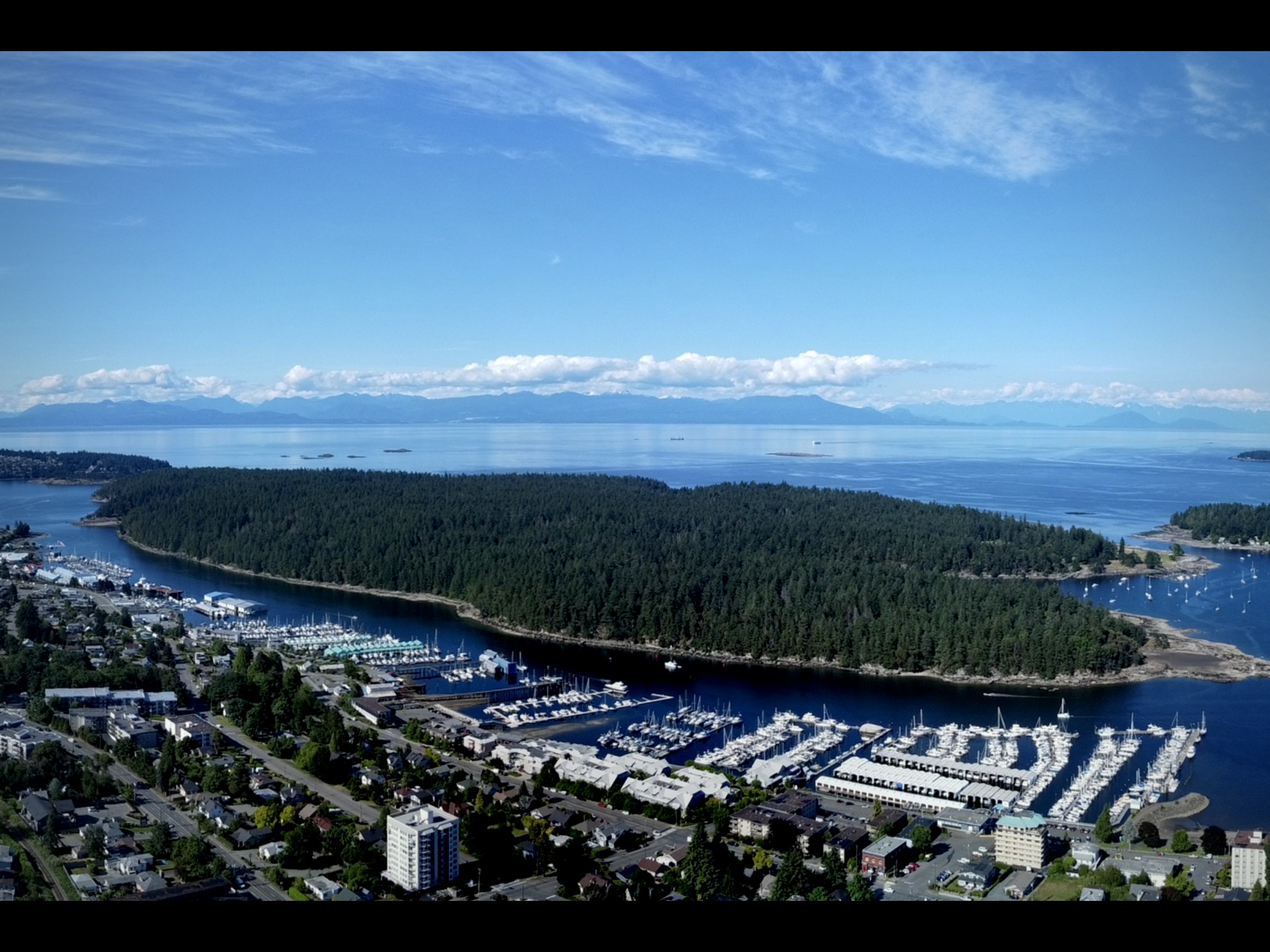
Saysutshun (Newcastle Island Marine) Park
Six columns of white-grey sandstone hold up the facade of the Old San Francisco Mint, a building that has survived two major earthquakes. Those columns were quarried from a small island off the coast of Nanaimo, British Columbia -- an island the Snuneymuxw people call Saysutshun, and which the Hudson's Bay Company named Newcastle after the English coal town. In the century and a half since Europeans arrived, this unassuming patch of land has cycled through more identities than most cities: Indigenous fishing ground, coal mine, sandstone quarry, herring saltery, shipyard, luxury resort, and finally, provincial park.
The Herring Calendar
Long before any colonial name was attached to it, Saysutshun anchored the Snuneymuxw year. From January through April, families lived at the seasonal village of Saysetsen on the island's east side, where herring spawned in dense schools through the narrow gap between Newcastle and Protection Island. Fishermen harvested them with ingenious tools -- hardwood sticks inlaid with sharp whalebone teeth that could spear ten or twelve fish in a single strike, filling canoes in short order. When the herring run ended, the Snuneymuxw moved to Gabriola Island until August, then crossed the Strait of Georgia to the Fraser River mouth for the sockeye and humpback salmon runs, returning to Vancouver Island for the chum salmon before beginning the cycle again in January. Every season had its place, and Saysutshun was where the year began.
Coal Tyee and the Black Rock
The island's colonial history started with a canoe full of coal. Around 1849, a Snuneymuxw man named Ki'et'sa'kun saw a blacksmith using coal at Fort Victoria and told him he knew where to find more. Given a bottle of rum and the promise of free gun repair, Ki'et'sa'kun paddled back fifteen months later with proof. Hudson's Bay Company clerk Joseph McKay investigated and confirmed the coal was superior to anything being mined at Fort Rupert. The English dubbed Ki'et'sa'kun 'Coal Tyee' -- Great Coal Chief -- and by 1852 the first mine was sunk on the island, producing 50 tons in a single day. Two mines operated over the following decades: the Newcastle Mine from 1853 to 1856 and the Fitzwilliam Mine from 1872 to 1882. Tunnels eventually ran beneath the seabed to Protection Island and beyond. Miners underground could tell time by the rumble of different steamships passing overhead, each hull producing its own distinctive sound through the rock.
Stone for San Francisco, Salteries for Japan
In 1869, Joseph Emery arrived from San Francisco seeking quality sandstone for the new United States Mint. Newcastle's stone was ideal: white-grey, strong against weathering, and easy to quarry in large blocks thanks to its sparse fracture lines. Over five years, 8,000 tons were shipped south. The Mint was meant to have eight columns, but two were lost when the barque Zephyr struck bottom at Mayne Island in 1872, drowning its captain and mate. The surviving six columns still stand. Meanwhile, Japanese-Canadian families built herring salteries on the island's northwest shore, shipping salted fish to buyers in Japan, Hong Kong, and China. T. Matsuyama and the Ode brothers founded Nanaimo Shipyards Limited on the island in 1918, growing it into a thriving operation. In 1941, all of it -- the salteries, the shipyard, 4.18 acres of island -- was seized when Japanese-Canadians were forced into internment camps in British Columbia's interior.
Floating Hotels and a Spring-Loaded Dance Floor
The Canadian Pacific Railway saw something different in Newcastle Island: a playground. In 1930, the CPR's steamship service bought the island for $30,000 and spent another $100,000 building a resort centered on a pavilion with a soda fountain and a spring-loaded dance floor. A retired steamship, the Charmer, was converted into a floating hotel moored in Mark Bay -- a week's stay cost $7.50. The resort opened on July 20, 1931, and drew over 14,000 visitors in its first season alone; on busy days, 1,500 picnickers crowded the grounds. World War II ended the party when the Princess ships were conscripted for military service. The pavilion survives today as the only structure of its kind remaining from the island resort era between the two world wars, restored in 1984.
Saysutshun Reclaimed
After the CPR gave up on the resort, Nanaimo bought the island in 1955 for $150,000 but struggled to maintain it. A 1959 referendum passed with 86.8 percent approval to sell Newcastle to the provincial government for one dollar plus the outstanding mortgage. The park that resulted has been co-managed since 2003 through a tripartite agreement between BC Parks, the City of Nanaimo, and the Snuneymuxw First Nation. In 2021, the park was officially renamed Saysutshun (Newcastle Island Marine) Park -- an acknowledgment, long overdue, of who was here first. Today the island is reachable only by water: a ten-minute ferry from downtown Nanaimo, or by kayak if you prefer. Hikers, campers, and birdwatchers share trails that wind past old quarry faces, the restored pavilion, and the quiet waters of Mallard Lake, an artificial reservoir now at the center of a wildlife sanctuary.
From the Air
Saysutshun (Newcastle Island) sits at 49.19N, 123.93W in Nanaimo Harbour, clearly visible as a forested island just offshore from the city of Nanaimo. Protection Island lies immediately to the southeast. The nearest major airport is Nanaimo Airport (CYCD) approximately 15 km south. Nanaimo Harbour Water Aerodrome (CAC8) serves floatplanes in the immediate area. The island is best viewed from 2,000-3,000 feet on approach from the Strait of Georgia.