Sbeitla
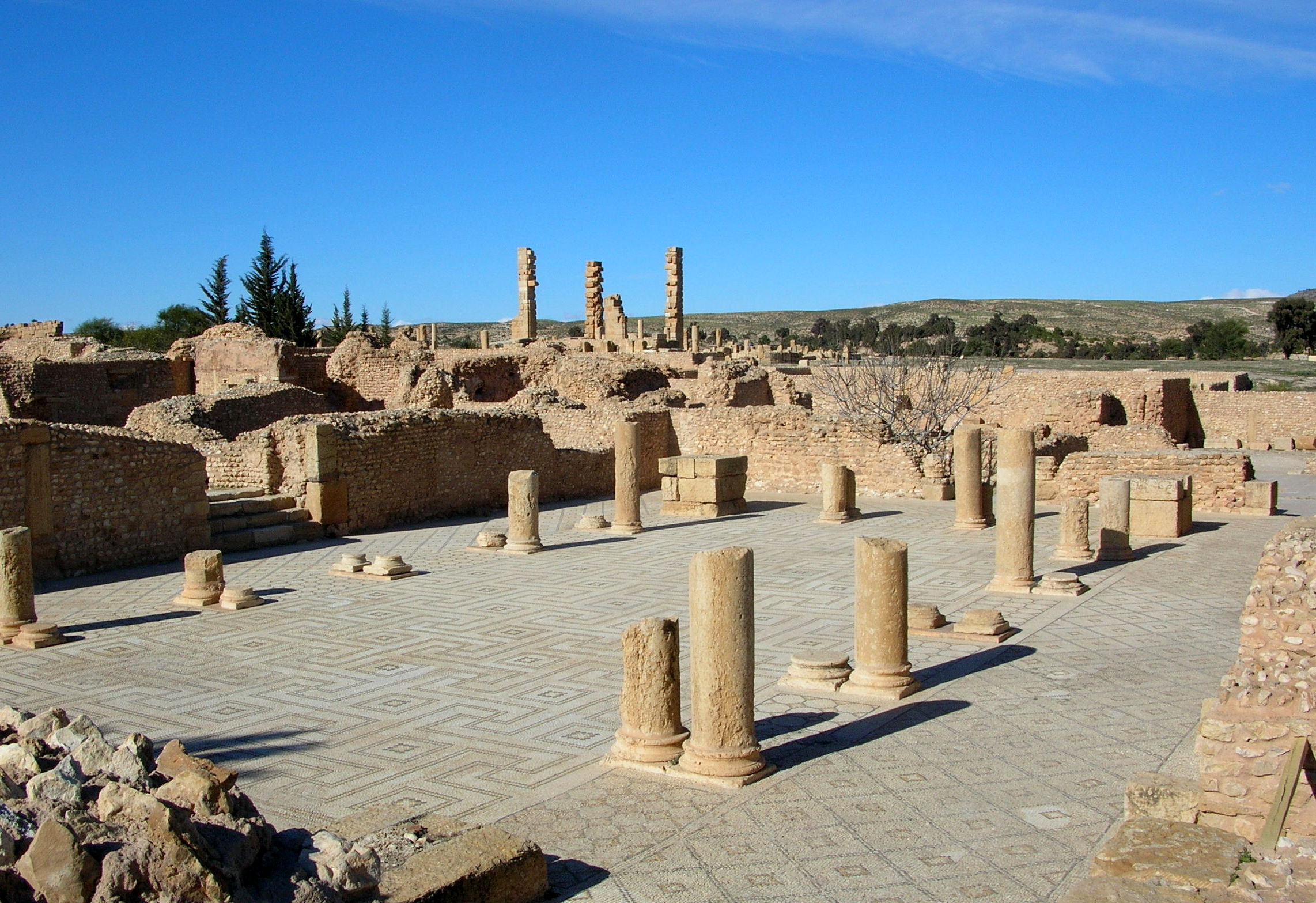
Three temple facades stand side by side, their honey-colored stone glowing against the Tunisian sky. They are the Capitol temples of ancient Sufetula, and they are the finest surviving forum temples in all of Tunisia. The small town of Sbeitla, which grew up beside these ruins, lives a double life: modern agricultural center and custodian of a Roman city where the trajectory of an entire continent changed in 647 AD.
Where Empires Collided
Sufetula was never the largest Roman city in North Africa, but its forum complex achieved a rare completeness that larger, more contested cities could not preserve. The three capitoline temples -- dedicated to Jupiter, Juno, and Minerva -- stand as separate structures rather than sharing a single building, an unusual arrangement that gives the forum its distinctive silhouette. When the Rashidun Caliphate's armies arrived in 647, it was here that Byzantine Exarch Gregory the Patrician made his stand. His defeat at Sufetula became the entry point of the Muslim conquest of North Africa, a hinge event that reshaped the Mediterranean world. The temples survived the battle and the centuries that followed, sheltered by their remoteness from the coast where conquering powers typically concentrated their attention.
Between the Olive Groves and the Oil Fields
Modern Sbeitla is the capital of the largest delegation in Kasserine Governorate, covering over 1,133 square kilometers with a population of roughly 24,000. The town sits 264 kilometers from Tunis and 33 kilometers west of the governorate capital. Its economy balances the ancient and the modern in a way that mirrors its landscape. Olive and almond groves surround the town, fed by 919 shallow wells and 137 deep wells. Meanwhile, the Douleb oil field, explored since April 12, 1968, produces around 230,000 barrels per year -- a modest output by global standards, but enough to anchor the local petroleum economy managed by Tunisia's state oil company, ETAP. The field reached peak productivity in 1974 at 1,200 cubic meters per day.
Wool, Festivals, and Football
The craft tradition here centers on wool processing, particularly the Tunisian burnous -- the hooded cloak that has been worn across North Africa for centuries. Sbeitla's international festival, founded in 2000 and achieving international status in 2013, draws visitors to performances staged among the Roman ruins. The local football club, Union Sportive Sbeitla, made its mark in 2013 by advancing to the quarter-finals of the Tunisian Cup for the first time, defeating Stade Tunisien before falling to CA Bizertin. The town has also produced notable figures: Ali Ben Ghedhahem, the 19th-century revolutionary, and Mongi Soussi Zarrouki, who represented Tunisia at the 1960 Summer Olympics.
A Crossroads Preserved
Sbeitla's relative remoteness -- the quality that kept it from becoming a major modern city -- is precisely what preserved its ancient inheritance. Unlike Carthage, which was pillaged and rebuilt so many times that its original fabric was consumed, Sufetula's temples and forum survived because no one needed the land badly enough to tear them down. Today that remoteness is an asset of a different kind: visitors who make the journey from the coast find ruins that reward the effort with a sense of unmediated contact with antiquity. The forum temples catch the light differently at every hour, their shadows stretching across stone that Roman masons cut nearly two millennia ago.
From the Air
Located at 35.23°N, 9.13°E in west-central Tunisia. The Roman ruins are clearly visible from the air as a geometric pattern distinct from the surrounding modern town. Recommended viewing altitude: 3,000-5,000 feet AGL. Nearest major airport: Tozeur-Nefta International (DTTZ) approximately 130 km southwest. The terrain is semi-arid steppe with scattered olive groves.