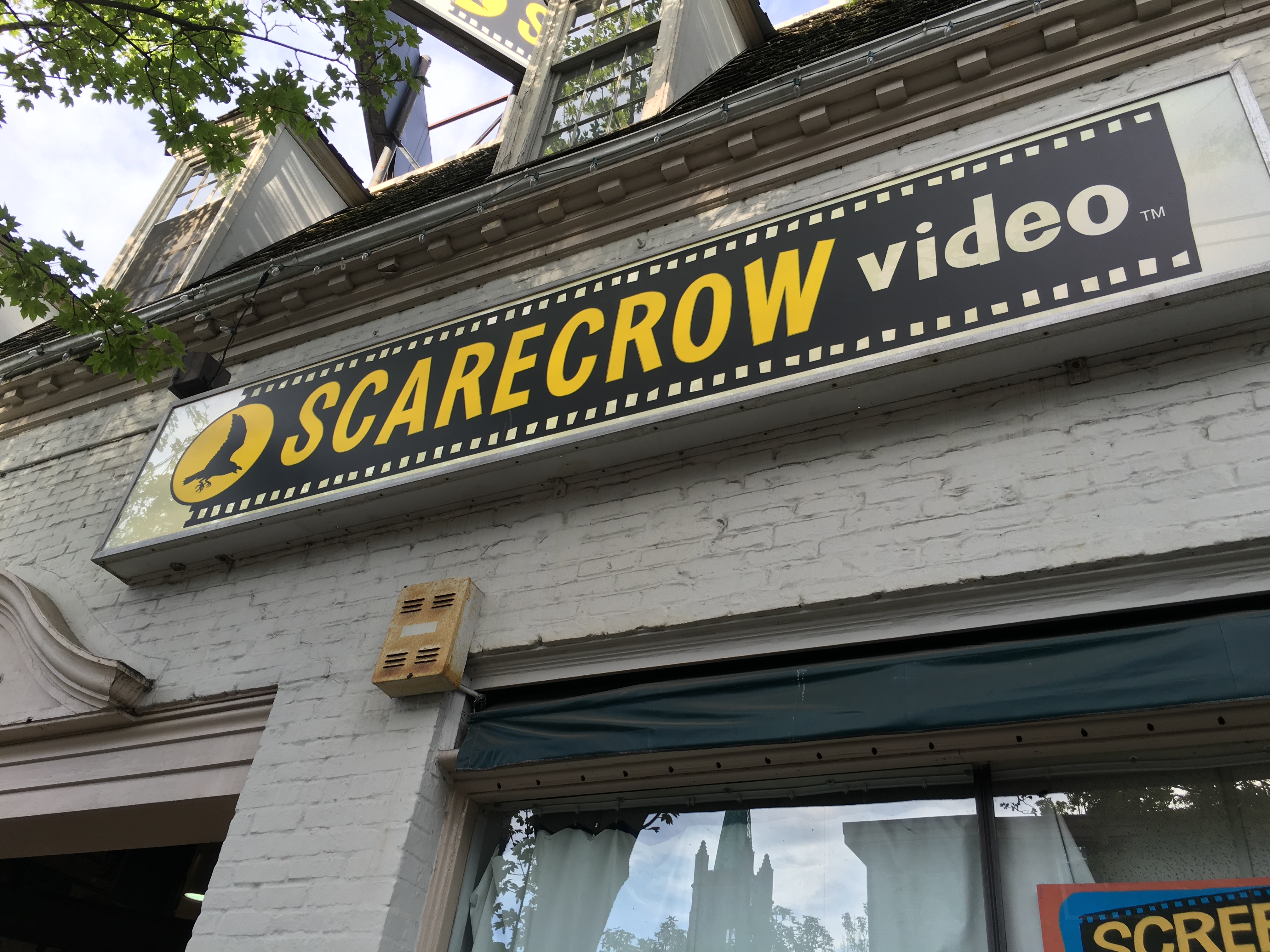
Scarecrow Video
Of the top 100 rarest films cross-checked against institutional holdings worldwide, 88 are not held by the Library of Congress. Seventy-seven of those may be publicly accessible only at a single location: a two-story building on Roosevelt Way in Seattle's University District, where hand-lettered section dividers organize 129 foreign-country sections spanning 126 languages. Scarecrow Video is the last video rental store operating within Seattle city limits, and it is also, improbably, one of the most significant film archives in the United States. The collection stretches back to an 1891 release date and forward through every format the medium has known, from VHS and laserdisc to DVD and Blu-ray. It is the kind of place where Quentin Tarantino and Roger Ebert once browsed the shelves, and where a teenager from Wallingford can still check out a Senegalese film from the 1960s on a Tuesday afternoon.
Six Hundred Titles on Latona Avenue
Rebecca and George Latsios opened Scarecrow Video in 1988 on Latona Avenue in Seattle's Ravenna neighborhood with a starting inventory of 600 titles. John McCullough co-founded the store with them. From the beginning, the operation distinguished itself by stocking films that mainstream chains ignored: obscure international cinema, silent-era oddities, underground horror, deep anime catalogs. By 1993, the collection had outgrown its original space, and Scarecrow relocated to a larger two-story building on Roosevelt Way in the University District, occupying 8,300 square feet. The move cemented its reputation. Celebrity patrons reportedly included directors John Woo and Bernardo Bertolucci, actors Bridget Fonda, Courtney Love, and Winona Ryder, and the legendary film critic Roger Ebert. George Latsios died in 2003 at just 44 years old, but the store he built endured.
An Archive Disguised as a Rental Counter
The numbers tell an astonishing story. As of 2025, Scarecrow held more than 150,000 titles. Some 14,676 items exist only on VHS, and 263 only on laserdisc. Many are out of print, with deposit requirements ranging from $150 to $1,000 for the rarest. The earliest original release date in the collection is from 1891, predating the motion picture industry as most people understand it. Scarecrow is not just large; it is irreplaceable. The collection functions as a de facto public archive, holding films that no university library, no national institution, and no streaming platform makes available. In 2004, the staff distilled some of this expertise into The Scarecrow Video Movie Guide, published by Sasquatch Books. The store now rents roughly 1,800 titles per month, both in person and through a DVD-by-mail service launched nationwide in 2021 after a successful trial during the COVID-19 pandemic.
The Kickstarter That Saved Cinema's Attic
By 2014, the streaming revolution had thinned the herd of American video stores almost to extinction. Scarecrow was no exception. Facing closure, owners Carl Tostevin and Mickey McDonough donated the entire catalog to the Scarecrow Project, a nonprofit formed by current and former employees and longtime patrons. A Kickstarter campaign raised over $100,000, and Scarecrow reopened as a 501(c)(3) nonprofit dedicated to preserving what it called "one of the world's largest publicly available libraries of film and television." The conversion worked, at least for a while. Seattle's other holdouts were not so fortunate: the 32-year-old Video Isle closed in January 2019, and Reckless Video followed in July 2021, leaving Scarecrow as the last store standing within city limits.
Five and a Half Million Reasons to Stay
Survival kept demanding new acts of reinvention. In June 2024, the Scarecrow Project launched a Save Our Scarecrow campaign with a goal of raising $1.8 million to sign a new lease and continue operating. The campaign succeeded, reaching its $1.8 million target by the end of 2024 through nearly 7,600 individual contributions. Then, in January 2026, SV Archive, the nonprofit managing the store, announced something nobody had expected: it had purchased the building Scarecrow occupies for $5.5 million, securing the store's physical home for good. The weekly YouTube show "Viva Physical Media" carries on, employees still host free community screenings and film classes, and visitors still walk the aisles where physical media refuses to die. In a city that has reinvented itself several times over since 1988, Scarecrow Video endures as a monument to the stubborn conviction that some things are worth holding in your hands.
From the Air
Scarecrow Video sits at 47.666N, 122.317W on Roosevelt Way NE in Seattle's University District, roughly 0.5nm east of Interstate 5. The two-story commercial building is not visually distinctive from altitude, but the University District is identifiable by the University of Washington campus immediately to the south and east, with the distinctive Husky Stadium and the Montlake Cut connecting Portage Bay to Lake Washington. Nearest airports: Boeing Field (KBFI) 7nm south, Kenmore Air Harbor (S60) 6nm north, Renton Municipal (KRNT) 11nm southeast. Best viewed below 3,000 feet when approaching from the west over Lake Union, using the UW campus as a landmark.