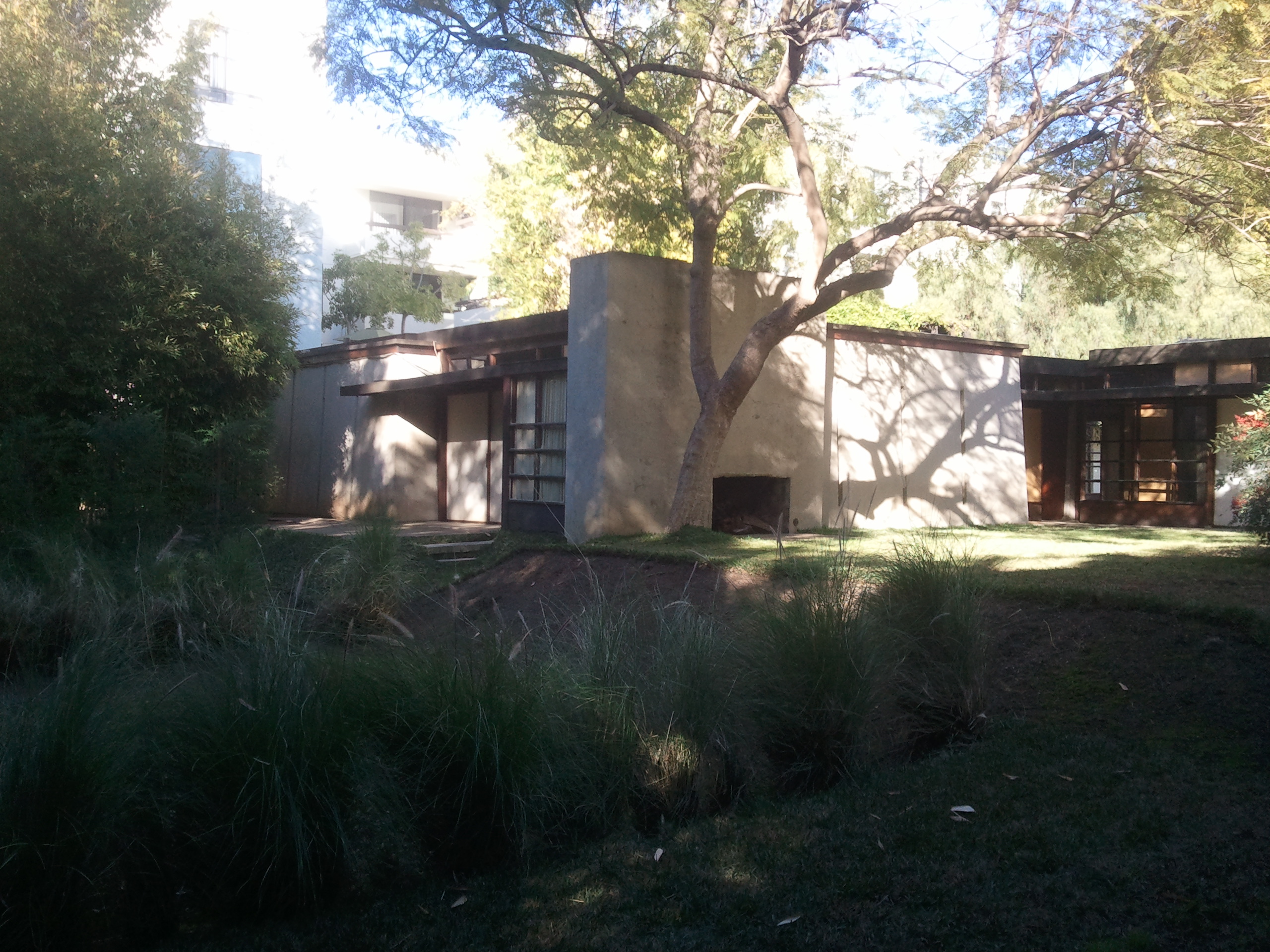
Schindler House
There is no conventional living room. No dining room. No bedrooms in the traditional sense. When Rudolf Schindler broke ground in November 1921 on the house he was building for himself and his friend Clyde Chase, he was not simply designing a dwelling — he was proposing a new way of living, one organized around shared space, natural light, and the dissolution of the walls that separated inside from outside.
A House Without Precedent
Schindler had come from Vienna, where he had trained in the tradition of Adolf Loos and Otto Wagner, and had recently worked for Frank Lloyd Wright in Chicago and Los Angeles. But the house he built at Kings Road in 1921-1922 was not derivative of Wright or of European modernism: it was its own thing, arrived at through a combination of theory, pragmatism, and the particular possibilities of Southern California.
The construction method was genuinely experimental. Schindler used tilt-up concrete slab construction — panels poured flat on the ground and then tilted upright to form walls. The building authority initially denied the permit; the technique was too unusual to fit existing codes. When the house was completed in June 1922 at a cost of $12,550, it represented a synthesis of ideas that had no American equivalent.
The inspiration, Schindler wrote, came partly from Yosemite Valley — from camping there and feeling the direct connection between a human shelter and the natural world. The house was meant to bring that experience into daily life: studio rooms open to sleeping baskets on the roof, fireplaces replacing central heating, canvas partitions replacing solid walls.
A Laboratory of Modernity
For two decades after its completion, the Schindler house was a hub for the Los Angeles avant-garde. Richard Neutra, who would become the other great figure of California modernism, lived there from 1925 to 1930, collaborating with Schindler and receiving clients in the shared studio spaces. The Chace apartment — the other half of the house, designed for Marian Chace — became home, at various points, to composer John Cage, novelist Theodore Dreiser, photographer Edward Weston, and art patron Galka Scheyer.
This was not incidental. The house was designed for a community of people who worked creatively, who believed that how you lived shaped what you were capable of producing. The lack of conventional rooms was a statement about the creative life: it could not be neatly divided into sleeping and eating and working.
Pauline Schindler, Rudolf's wife, was an intellectual force in her own right and a central node in the social network that animated the house. She lived there until her death in May 1977, long after her marriage to Rudolf had ended, maintaining the space as a living artifact of the ideas that had produced it.
A Monument in Use
The Schindler House is now operated by the MAK Center for Art and Architecture, a partnership formed in 1994 between the building's American stewards and the Austrian Museum of Applied Arts in Vienna — a recognition that Schindler's work belongs to an international conversation about what architecture can do.
The house remains open to the public, not as a static museum but as an active space for exhibitions, lectures, and events. The Los Angeles Times ranked it among the top ten most significant houses in the city in its 2008 survey — a list that is itself a remarkable document of what Los Angeles has produced.
To stand inside the Kings Road house is to experience something that has not been diluted by a century of imitation. The spaces still work the way Schindler intended: they ask you to rethink what a room is for, what a wall needs to do, what it might feel like to live without the architecture of convention pressing in from every side.