Schinkel (Osnabrück district)
Locals do not say Schinkel. They say der Schinkel - the Schinkel - as if the district deserved a definite article. Everyone here can correct you on the other persistent error too: no, the neighborhood is not named for Karl Friedrich Schinkel, the great Prussian architect who designed half of Berlin. The name probably refers to the flank-like shape - Schenkel in old German - of the Schinkelberg, the local hill. Probably. The truth has been lost to thirteen centuries of speech, but the district was first written down in 1332 and incorporated into Osnabrück on April 1, 1914.
What the Bombers Wanted
Schinkel was a working district built around heavy metal. The Osnabrücker Kupfer- und Drahtwerk - the Osnabrück Copper and Wire Works, today KM Europa Metal - drew Allied bombers from the war's earliest months. The first raid on Schinkel came on June 23, 1940, aimed squarely at the copper works. By May 1945, sixty-five percent of the OKD plant lay in ruins, and most of the district's residential housing had gone with it. Two bunkers still stand on Oststraße. One is round and sits on the site of the old railway repair yards. Locals call it the Otto Bunker - the name is painted on the side.
A Pastor Who Said No
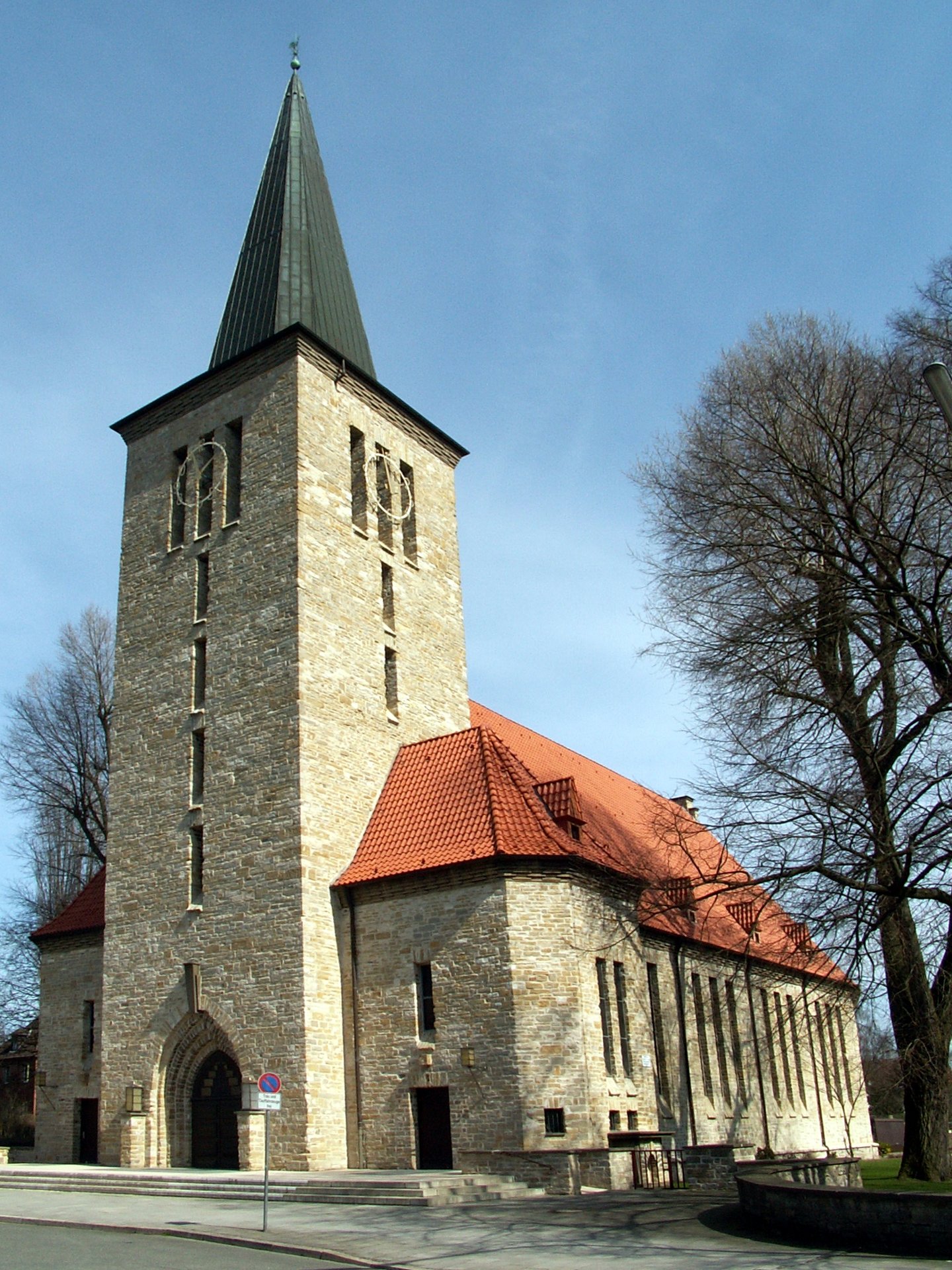
During the Nazi years, Richard Karwehl served as pastor at the Schinkel Pauluskirche. He read his Bible carefully enough to conclude that National Socialism was incompatible with Christianity, and he acted on the conclusion - joining the Confessing Church, the breakaway movement of Protestant clergy who refused to subordinate their faith to the regime. Karwehl preached against the Nazis from his pulpit at a time when other pastors were welcoming brownshirts into their pews. The square in front of the Pauluskirche today bears his name: Richard-Karwehl-Platz. It is a small recognition for a kind of courage that was very rare in Germany in those years.
Beating Heart on Schützenstraße
Modern Schinkel is one of the most internationally mixed parts of Osnabrück, home to about 13,300 people. The center of gravity is Schützenstraße - shops, pharmacies, doctors, banks all clustered along it. On Wednesdays the Wochenmarkt sets up on Ebertallee between the Catholic Heilig-Kreuz-Kirche and the Protestant Pauluskirche. The district has Catholic and Protestant churches, two mosques - Fatih Camii and Takwa - and a Reformed Protestant church whose congregation outgrew its building so completely that they tore it down except for the bell tower to make room for a children's day care. The local library closed in 2010 when the city's finances soured.
Match Day on Bremer Brücke
Schinkel is also where Osnabrück goes to watch football. The Stadion an der Bremer Brücke stands beside the Bremer bridge, home of VfL Osnabrück, the club founded in 1899 that has rattled around Germany's second and third tiers for decades. Match days fill the streets. The district has its own neighborhood sports clubs - VfB Schinkel, Blau-Weiß Schinkel, Sportfreunde Schinkel-Ost - alongside the city-wide VfL and a Turkish-rooted SC Türkgücü. The Schinkelbad indoor pool draws swimmers from across the city. The 1. Osnabrücker Nachbarschaftsverein, the city's First Neighbourhood Association, is headquartered here, which is roughly the official confirmation of what locals already feel: Schinkel is the kind of place where people know each other.
Green Belts and Vanished Trams
Two green belts give the district its breathing room: the Schinkelberg itself and the Gartlage, the stretch of parkland that hugs the old KM Europa Metal site. Until 1958, tram line 3 ran into Schinkel from the city center, terminating at a stop on the corner of Schützenstraße and Bremer Straße. The line is long gone; bus routes 11, 12, 13, 71, 72, 91 and 92 carry that traffic now, at ten-minute frequencies. The old railway depot - established in 1876 and colloquially nicknamed Kamerun, presumably after the German colony - was demolished in April 2009 and replaced by a discount store. Some traces survive. Some get paved over. Schinkel keeps both.
From the Air
Schinkel lies at 52.28°N, 8.08°E in the east of Osnabrück, just across the Hase river from the city center. Recommended viewing altitude: 2,500-4,000 ft AGL. The osnatel-Arena stadium is the most visible landmark from the air, beside the Bremer bridge. The Schinkelberg hill and Gartlage parkland give the district its green corridors. Nearest airport: Münster Osnabrück International (EDDG / FMO), about 32 km southwest.