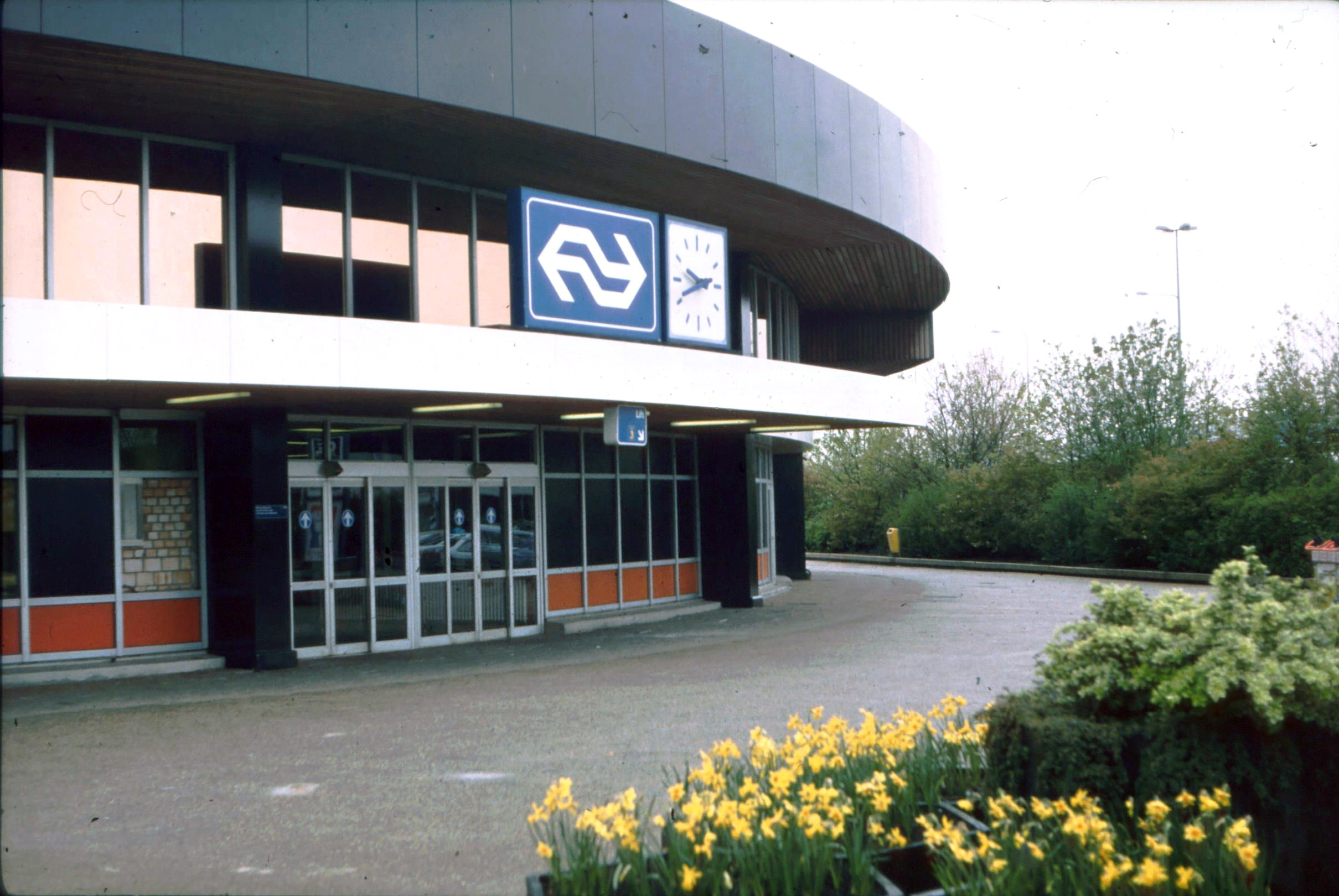
Schiphol Airport station
Step off a plane at Schiphol and the rail platforms are directly beneath your feet. Twelve escalators and three elevators connect them to Schiphol Plaza, the cavernous shopping concourse that doubles as the airport's main hall. The arrangement is so seamless that travelers often catch a train before they realize they've left the airport. Six tracks, three island platforms, and a connection to every major city in the Netherlands - plus Brussels, Antwerp, and Paris-Nord on the Eurostar. The original station opened above ground in 1978. The current underground version replaced it in 1995 and was renamed Schiphol Airport in December 2015, in part to make it more legible to international travelers who had been arriving at a place called "Schiphol" and wondering whether that was a city.
Before There Was a Tunnel
The first Schiphol station was partly at street level and opened on 21 December 1978. It was useful but limited. Trains could carry you south to Leiden, The Hague and Rotterdam, or as far as the Amsterdam Zuid WTC and RAI stations - but not, at first, to Amsterdam Centraal. To reach the main station in the capital, passengers got off at RAI and transferred to a local train. The Amsterdam-Schiphol railway link, completed in 1986, finally bypassed that detour. The old station building came down in 1995, replaced by the underground complex that still serves the airport today. The new station was built into the foundations of the terminal complex, with the platforms sitting beneath the main check-in hall.
Ramps for Trolleys That Don't Exist Anymore
Each platform has three escalators, fixed stairs, an elevator, and four ramps. The ramps were not for accessibility - they were built for luggage trolleys. The idea was that air passengers, pushing carts piled with suitcases, would wheel them straight from the concourse down onto the platform and into the train. The rolling suitcase changed all that. As travelers shifted to wheeled bags they could lift themselves, the trolleys became less essential, and eventually they were prohibited on the platforms entirely. Poles at the top of each ramp now block carts from coming down. The ramps remain, useful for travelers with mobility aids, parents with strollers, and anyone who finds escalators stressful at the end of a long flight.
Flexible Tracks
Since 2006 the station has done something unusual with two of its three platforms. Tracks 1 and 2 share a platform, and so do tracks 5 and 6. Rather than fixing which side a train will arrive on, the dispatchers decide just a few minutes ahead of time. A train scheduled to leave from platform 1-2 might pull in on either side, depending on what's happening elsewhere on the network. The departure boards update in real time. It is the kind of operational flexibility that makes sense at a station where 50 million-plus airline passengers move through every year and where any one of the six tracks might be feeding an international train to Brussels or a sprinter to Hoofddorp.
From Domestic to Eurostar
From the platforms here, passengers can reach Leiden, The Hague, Rotterdam, Utrecht, Eindhoven, Amersfoort, Almere, Lelystad, Apeldoorn, Deventer, Enschede, Groningen, Leeuwarden, Nijmegen and Zwolle by direct intercity service. An hourly night train links Schiphol with Amsterdam, Utrecht, Rotterdam, Delft, Leiden and The Hague between 1 and 5 a.m. The high-speed Intercity Direct uses tracks 5 and 6 for the run to Rotterdam, with a supplemental fare for the high-speed segment. Eurostar - the operator that absorbed the old Thalys service after the 2023 merger - runs trains from Schiphol to Brussels-South and on to Paris-Nord, with reservations required. Intercity Brussels services round out the international offering. For an airport without its own city, Schiphol's rail connections are unusually generous.
An Extension That Hasn't Started Yet
Schiphol Plaza is supposed to be growing. A planned extension would carve out a separate train passenger area accessible only through gates - a setup more typical of large European stations than of the open concourse Schiphol currently uses. The renovation was scheduled to begin in 2022 and finish in 2025. As of 2024 it had not actually started. In the meantime, the open layout continues: two medium-sized supermarkets, including an Albert Heijn, stay open until midnight every day. Travelers buy bread and coffee on the same floor where they catch trains. The airport above and the railway below remain effectively one building, separated only by the stretch of escalator between them.
From the Air
Schiphol Airport station sits beneath the terminal complex at approximately 52.31 N, 4.76 E, within Haarlemmermeer municipality. The station itself is invisible from the air - it is underground - but its location is given away by the unmistakable footprint of Schiphol Airport (EHAM) directly above. From altitude the airport shows as a vast complex of crossing runways set on the flat reclaimed bed of the former Haarlemmermeer lake. The terminal building is the central structure between the parallel runways; the station lies directly beneath. Approach to EHAM is typically vectored from the southwest via Spijkerboor or from the east via Sugol depending on the wind.