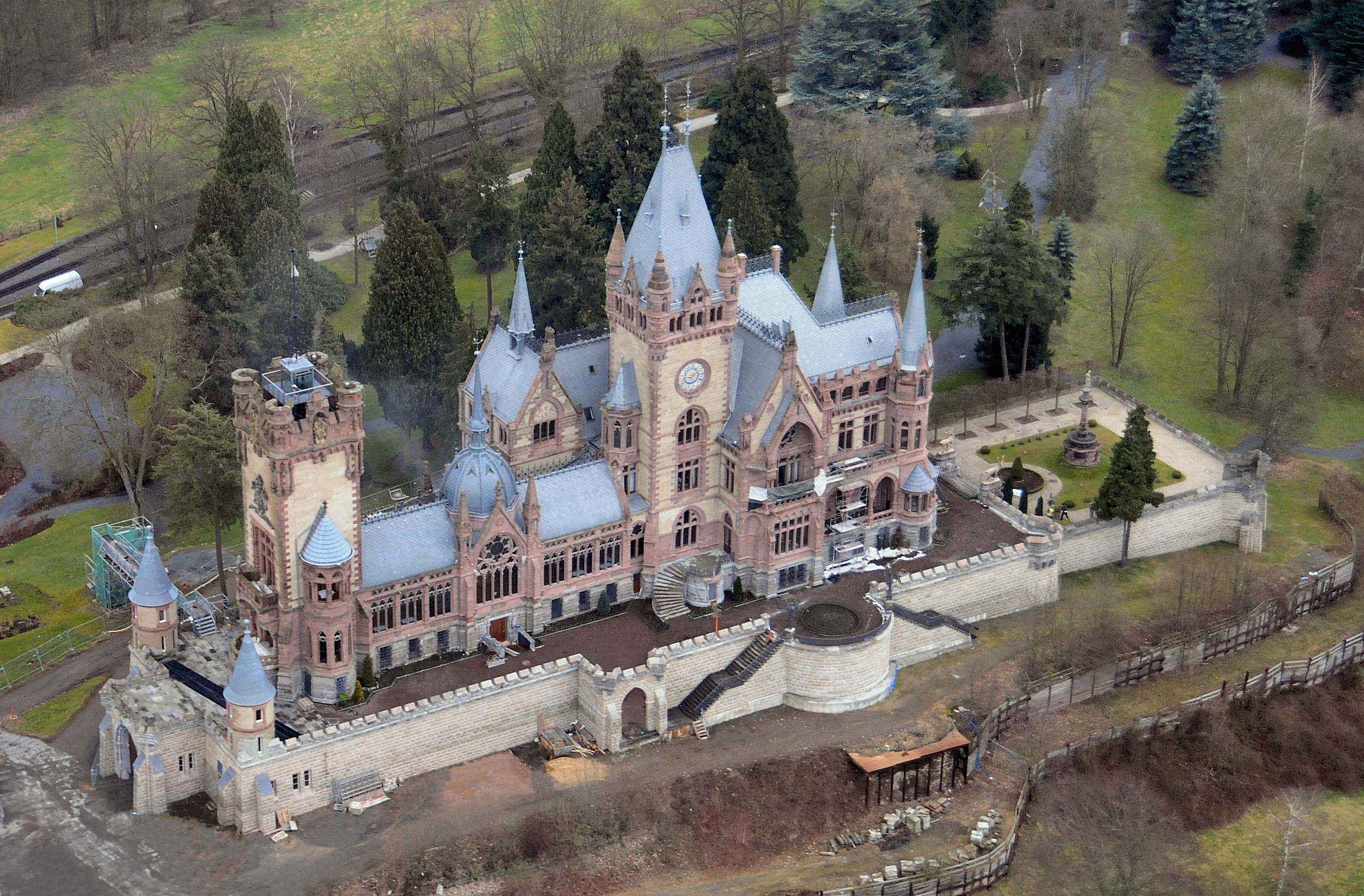
Schloss Drachenburg
Stephan Sarter spent his entire working life in a Paris bank, made a fortune trading on his own account, and in 1881 bought himself a German title from the Duke of Saxe-Meiningen. That gave him a baron's coat of arms but no baron's manor. So he commissioned one on the slopes of the Drachenfels, the most famous hill on the Rhine, and built it in two years flat between 1882 and 1884. It was a neogothic fantasy in light sandstone, all turrets and tracery and gables and gilt-edged ceilings, exactly the kind of pile a wealthy German baron should have inherited from a 14th-century ancestor. Sarter never lived there. He stayed in Paris until he died, a bachelor, in 1902. The schloss he built as a backdrop for himself never saw its baron walk through the door.
The Banker Who Bought a Title
Sarter was born in Bonn in 1833 and apprenticed early to the Leopold Seligman bank in Cologne. He moved to the larger Salomon Oppenheim house and ended up in their Paris branch as a market analyst, which in the 19th-century financial world meant a position with access to information and the latitude to trade on it. He did both, and by his forties had assembled the kind of fortune that German bankers of his generation invariably converted into respectability. In 1881 he applied for and received a patent of nobility. From that moment he was Baron Sarter, and his Paris address now needed a German country seat to match. He chose the Drachenfels not because he had any family connection to the place but because by 1881 the Rhine, and the Drachenfels in particular, were the most fashionable address in German Romanticism. The view sold itself.
Two Years, Two Architects
Construction began in 1882 with Dusseldorf architects Bernhard Tushaus and Leo von Abbema drawing up the initial plans. Within months Sarter had fallen out with both of them and brought in his own choice, the Paris-based Wilhelm Hoffman, to finish the work. The schedule was extraordinary. Most large neogothic country houses in Germany took five to ten years to complete; Sarter's contractors finished his in two. The result is a stylistic stew - neo-Gothic windows and turrets on the outside, a baronial great hall, opulent Renaissance-revival interiors, stained-glass scenes from Wagner's operas, a Nibelungenhalle on the grounds that nods at the dragon legend on the adjacent rock. Nothing about the place pretends to be authentic. Everything about it is designed to look as though it might have been, if a 19th-century Rhine banker had been a 15th-century Rhine knight. The strangest detail is that Sarter never moved in. He commissioned a stage set and then refused to act on it.
Other People's Castle
When Sarter died a bachelor in 1902, his estate was carved up among various relatives. One nephew, a Bonn lawyer named Jacob Hubert Biesenbach, recognized what the place might be worth as a tourist attraction and bought out the other heirs for 390,000 marks. Biesenbach commissioned postcards and illustrated guidebooks, opened the schloss to paying visitors, and ran it for almost a decade before income failed to cover costs. He sold to Egbert von Simon in 1910, a cavalry officer who managed the property more profitably until he was killed in action at Arras in 1916. After the First World War the schloss was acquired piecemeal at auction by Hermann Flohr, an arms dealer who lived in part of the building while leasing the rest as a women's convalescent home. In 1930 the De La Salle Brothers, a Catholic teaching order, bought it and ran St Michael's boarding school there. By 1938 the school was in open conflict with the Nazi regime and was forced to close. In 1940 the schloss was sold to the German Labour Front, which converted it into an Adolf Hitler school - one of a network of Nazi elite training academies for prospective party functionaries. The 19th-century baronial fantasy had become a 20th-century totalitarian classroom.
Decay and Rescue
After 1945 the State of North Rhine-Westphalia inherited the building and rented it out as a training facility for the Federal Railways until 1959. Empty after the railway moved its training operation to Wuppertal, the schloss began to deteriorate fast. Rain got into the gilded ceilings. Stained glass cracked. The whole structure was sliding toward collapse. In 1963 a Syndicate for the Preservation of Drachenburg formed to get the building listed as historically significant, and in 1971 a local textile merchant named Paul Spinat bought it. Spinat poured money into the place, did major restoration work, opened it to visitors, and used the great hall to throw extravagant parties. When he died in 1989 he died in debt. The state took the property back. A second wave of restoration began that stretched over the next two decades, helped enormously by the postcards and illustrated brochures that Biesenbach had commissioned for his tourism project at the turn of the century. The pictures showed exactly what the interiors had looked like when they were new. By the 2010s the schloss was open as a public monument managed by the North Rhine-Westphalia Foundation.
Cameos and Castles
Schloss Drachenburg has had a strange second life as a movie and television location. The German Weimar-era drama Babylon Berlin uses it as the home of the industrialist Alfred Nyssen, whose extravagant fascist sympathies and steel-mill fortune are visually anchored by Sarter's neogothic walls. The John Gardner James Bond novel Never Send Flowers (1993) borrows the schloss for the fictional Schloss Drache, the lair of a deranged actor turned assassin. Both choices make sense. The place looks like a castle that should belong to somebody dangerous, or somebody pretending. The thing it has never quite looked like is what it actually is, which is the unoccupied home of a Bonn-born banker who got rich in Paris, bought himself a title, and walked away from his own dream the moment the workmen finished it.
From the Air
Coordinates: 50.6687, 7.2063. Schloss Drachenburg sits on the lower slopes of the Drachenfels hill on the Rhine's east bank, directly opposite Bad Godesberg. Unmistakable from the air: a tall sandstone neogothic castle with multiple towers, set in a wooded park between river and ridge. Recommended viewing altitude 2,500-3,500 feet for the schloss itself, 4,000-5,000 feet for context with the Drachenfels ruin above and the Petersberg hotel to the north. Nearest major airport: Cologne Bonn (EDDK), 17 nm north-northwest. Watch for the EDDK Class C/D shelf.