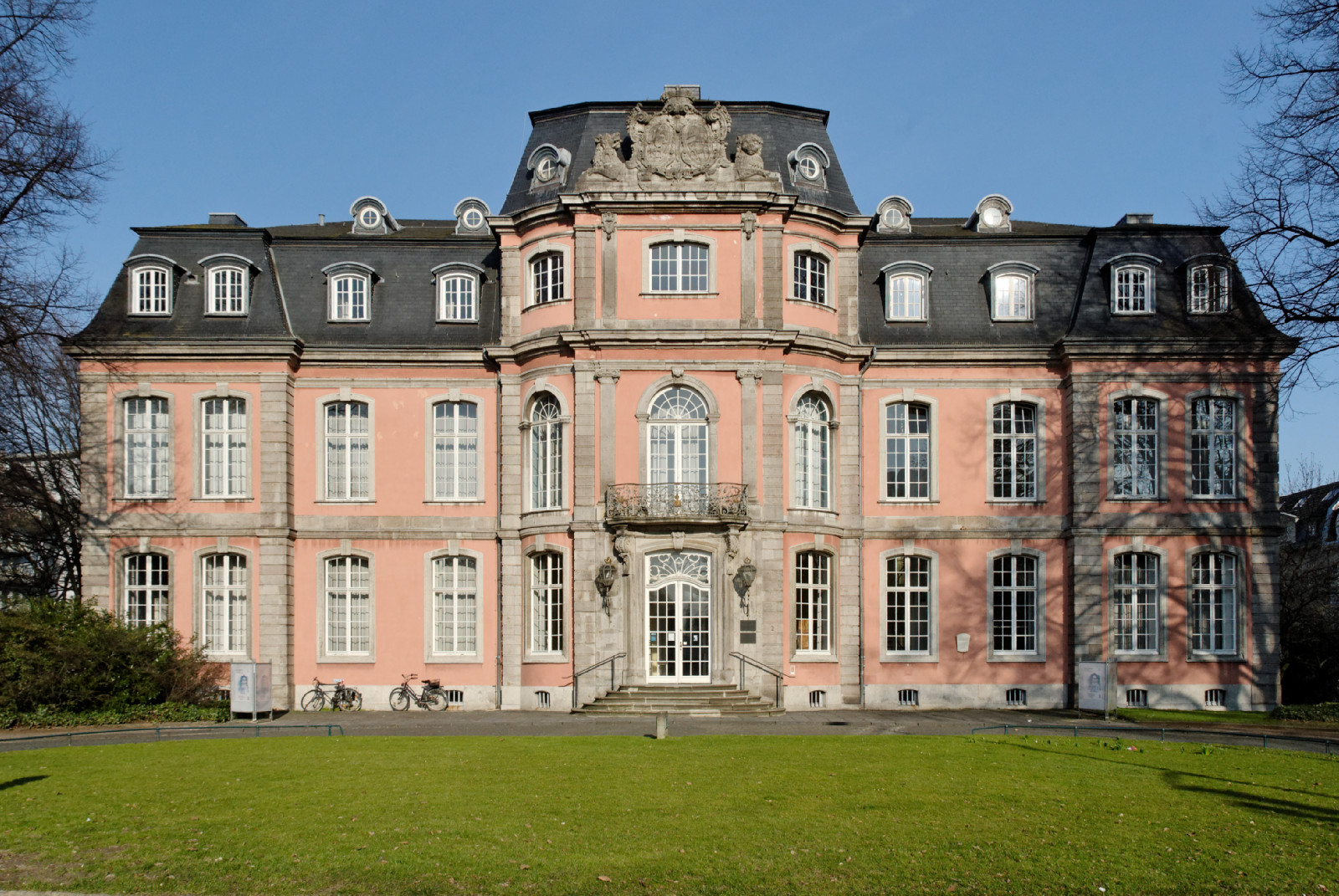
Schloss Jagerhof
In November 1811, Napoleon Bonaparte announced he would visit Dusseldorf with his new young Empress, Marie Louise of Austria. The city had four days to make itself presentable. Schloss Jagerhof - until recently a French military lazaret, before that a looted and half-ruined hunting lodge, before that the seat of the Electoral chief huntsmen - was the only building in town remotely fit for an emperor. Crews worked around the clock. They hung wallpaper, polished floors, dragged in furniture. Napoleon's Secretary of State wrote to his wife that Dusseldorf had been turned into a "little Paris." The Emperor stayed four days. The palace has been adjusting to new occupants ever since.
A Rococo Lust for Building
Charles Theodore, Prince-Elector of Bavaria, ruled the Palatinate and the Duchy of Berg from his seat in Mannheim, but he liked to think big about the provincial outposts. Dusseldorf in the mid-18th century was a city in decline - its court had moved away when the last local Elector died in 1716, and many of the great buildings had fallen into disrepair. Charles Theodore meant to fix that. In 1749 he commissioned Johann Joseph Couven, his court architect, to design a representative hunting lodge in the Rococo style on the site of an older Jagerhof outside the city walls. Construction stretched from 1752 to 1763 under the supervision of Nicolas de Pigage, the chief building director. Side wings planned by Couven were never built. The completed central pavilion served as the residence of the supreme huntsmen of the Electorate until 1795.
The French Years
The Coalition Wars came to the Rhineland hard. In 1795, French Revolutionary troops nearly blew up the Jagerhof and the adjacent court gardener's house with explosives. They settled for looting it instead, stripping the timber from the surrounding court garden for firewood and converting the palace into a lazaret - a military hospital - and night barracks. The building stayed in that deplorable state for sixteen years, until the emergency of Napoleon's planned visit in 1811 triggered the frantic refurbishment. After Waterloo, the Congress of Vienna handed the Rhineland to Prussia, and in 1821 Prince Frederick of Prussia moved into the palace as division commander. He found it too small. The old plans for the side wings were dug out, and the original Couven design was finally completed under construction management. In the 1850s the family of Karl Anton, Prince of Hohenzollern, lived here until Karl Anton became Prussian prime minister in 1858 and decamped for Berlin.
Demolition By City
By 1885 the Hohenzollerns had moved on, and in 1909 the Prussian state sold the palace to the city of Dusseldorf - reportedly grudgingly, but the alternative was selling to an unknown private buyer. The city's first instinct was to redevelop the site as building land. Public protest stopped that plan, but only partially. The garden and side wings were demolished anyway, ostensibly because they protruded 1.7 meters beyond the new building line of the widened Jacobistrasse. From 1910 onward Schloss Jagerhof was reduced to its central wing, fenced into a small forecourt - a baroque jewel marooned in a turn-of-the-century streetscape. The French occupation of the Rhineland confiscated it in 1925 for the commandant's office. In 1934 the consistory of the Evangelical Church of the Rhineland moved in - and was unlawfully evicted three years later under pressure from the NSDAP Gauleiter Friedrich Karl Florian, who installed his Gau Dusseldorf headquarters in the palace on 30 January 1937.
12 June 1943
The Royal Air Force conducted one of its largest raids on Dusseldorf on the night of 11-12 June 1943 - 783 bombers dropping incendiaries and high explosives across the city. Schloss Jagerhof was severely damaged. The Gauleitung relocated. The old Marstall - the mews building dating to 1713, decorated with carved hunting gables from the workshop of the Flemish sculptor Gabriel Grupello - was completely destroyed; parts of two gable fields were salvaged from the rubble and stored away. The palace itself sat as a shell for seven years. Reconstruction by the architect Helmut Hentrich began in 1950 and brought the building back. In its first years as a restored space, the young Federal Republic used it for state receptions. The Marstall gables, after decades in storage, were finally restored by the woodcarver Alexander Diczig at the Restoration Centre Dusseldorf in 2014.
The Goethe Museum
Since 1987, Schloss Jagerhof has housed the Goethe Museum of Dusseldorf, built around the collection of Anton Kippenberg, the Bremen-born publisher who ran the Leipzig Insel Verlag and spent his life amassing Goethe materials. After his death the collection passed to his daughter, who established the Anton and Katharina Kippenberg Foundation in 1953 with the State capital of Dusseldorf undertaking to house and develop it. Approximately 50,000 items now live in the palace: manuscripts, first editions, portraits, a death mask, personal effects, paintings by Goethe himself. The connection to the place is not incidental. Goethe himself visited Dusseldorf in 1774 and 1792, staying nearby at the house of the philosopher Friedrich Heinrich Jacobi - the same address where the Malkasten artists' association has had its headquarters since 1861. A hunting lodge for an elector, a hospital for revolutionaries, an emperor's bedroom, a Hohenzollern home, a Gauleiter's bunker, a bombed-out shell, a Goethe shrine. One small palace. Two and a half centuries.
From the Air
Located at 51.231 N, 6.788 E in the Pempelfort district of Dusseldorf, immediately northeast of the city center at Jacobistrasse 2. The palace sits on the northern edge of the historic Hofgarten - the great court park that runs from the Old Town up toward Pempelfort. Nearest airport: Dusseldorf International (EDDL), 6 km north. From cruise altitude, look for the green wedge of the Hofgarten cutting into the dense urban fabric just north of the Altstadt; Schloss Jagerhof anchors its northern end.