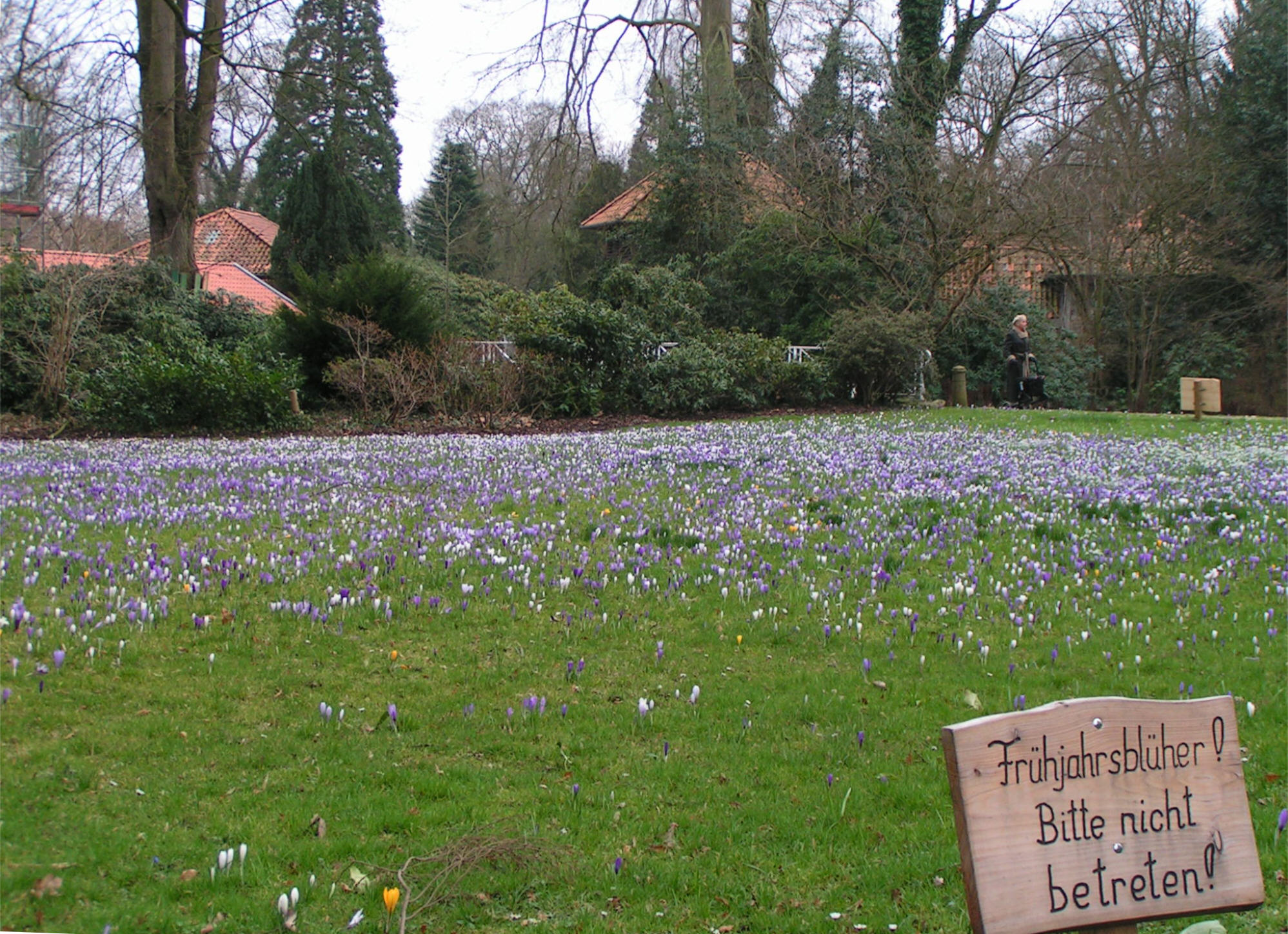
Schlossgarten Oldenburg
Until the 1950s, you could not enter the Schlossgarten without wearing Sunday clothes. The rule was unwritten but absolute, a holdover from the original opening conditions set by Duke Peter Friedrich Ludwig himself in 1809: appropriate dress and civilised behaviour. Two centuries later the dress code is gone, the dukes are gone, and the only authority left in the sixteen hectares of curving paths and rhododendrons is the colony of bats that emerges after dusk in the warm months. What stayed is what the Duke wanted from the beginning, an English landscape garden where everyone is welcome, just so long as they walk it like a garden and not like a park.
A Duke Drawing in the Margin
Peter Friedrich Ludwig of Oldenburg bought the first meadowland next to his palace in 1803 and added more in 1805. Then in 1809 he began the garden proper, with detailed plans he had drawn himself, working with the former court gardener Friedrich Wilhelm Julius Bosse. The Duke was an amateur designer with strong opinions. He stayed personally involved for forty-two years, until his death in 1851, and the shape of the garden today still reflects his decisions. The original work was almost obliterated in the Napoleonic occupation, so in 1814 Duke Julius Friedrich Wilhelm commissioned a reconstruction, and that 1814 reset is the date commonly given as the garden's true founding.
Repton, Not Capability Brown
What makes the Schlossgarten unusual among English landscape gardens of its period is what is not there. No Greek temple in the distance, no Chinese pagoda, no artificial ruin, no follies of any kind. This is genuinely strange for the genre, which on the Continent often went heavy on the picturesque ornamentation. The omission was deliberate. The Duke was following the design ideas of Humphry Repton, the English landscape designer who explicitly argued against follies and chinoiserie, preferring honest planting and water features. What you get instead are curved paths, lawns dissolving into the surrounding landscape with no clear boundary, water features tracing the contours, and trees, many of which have stood since the early nineteenth century.
Rhododendrons Older Than Germany
In 1828 the Duke planted rhododendrons in the garden. They are now among the oldest specimens of the genus in Germany, predating the founding of the country itself by more than four decades, and they have grown into the gnarled, head-high mounds that give the garden its colour in May. The Ammerland region around Oldenburg has since become one of the great rhododendron-growing centres of northern Europe, an industry the Duke's gardener Carl Ferdinand Bosse helped seed when he brought the plants here for the palace at Rastede earlier in the century. The Hofgärtnerhaus, the head gardener's house, still stands in the grounds and is still where the garden's manager lives and works.
From Duke to Public to State
Peter Friedrich Ludwig believed his subjects should enjoy his garden, and most of it was open to the public from the beginning. The garden became formal public property in 1920 and was owned by the Free State of Oldenburg until 1946. After the war, when Lower Saxony absorbed Oldenburg, the State of Lower Saxony took ownership, and the Schlossgarten has belonged to it ever since. A preservation society was founded in 1952 and the garden gained formal heritage protection in 1978. A 2007 funding agreement split the maintenance bill: the state of Lower Saxony pays two-thirds, the city of Oldenburg pays one-third. The garden suffered remarkably little damage during the Second World War. For a time during the food shortages it was even used as a kitchen garden, and some trees were cut for fuel, but the bones of the design survived.
The Centre of a Hundred Gardens
The Schlossgarten is the named centrepiece of the Route der Gartenkultur, the route of garden culture, a network of more than a hundred gardens spread across northwestern Germany. The 200th anniversary in 2014 was marked with a season of exhibitions and the planting of new oaks, mirroring a similar 100th-anniversary celebration in 1914 when the ducal family themselves had planted oaks from April to September. At the northwest end of the grounds is a lake, and on the lake stands the Elisabeth-Anna-Palais, built in 1894-1896. To the north sits the Augusteum art gallery, and beyond it the Schloss itself. Pedalos drift on the connected waters at the northeast edge of the garden. After dusk in summer, the local NABU chapter sometimes leads bat walks through the dark paths.
From the Air
The Schlossgarten lies at 53.1344 degrees N, 8.2117 degrees E, immediately south of the Schloss Oldenburg in the historic city centre. From altitude it is the unmistakable dark green block, roughly 16 hectares, between the Eversten residential quarter to the south and the pedestrianised old town to the north. Bremen Airport (EDDW) is 50 kilometres east. Hatten Airfield (EDWH) is 17 kilometres southwest. The Hunte flows nearby; the autobahn ring (A28, A29, A293) encircles the whole urban area. The Elisabeth-Anna-Palais marks the northwest corner, the lake beside it.