Schölerberg
The Schölerberg is not a mountain. At 126 meters, it is barely a hill by any honest reckoning. But this limestone ridge on the south side of Osnabrück has been doing more cultural work than most actual mountains - hosting a zoo, a natural history museum, a planetarium, a former summer toboggan run, and a judo dojo whose fighters have stood on Olympic podiums. The whole district that bears the hill's name holds about 13,900 people, draped across its slopes and around its forested crown.
A Hill That Knew the Tram
Day-trippers have been climbing the Schölerberg since the early twentieth century. Old steps, retaining walls, and small viewing platforms still hide in the woods - relics of when the hill was carefully landscaped as a forest park. In the early 1950s a summer toboggan run brought families up the slope; a string of small restaurants catered to weekend excursions. The Osnabrück tramway reached this far too: line 2 terminated at a stop called Schölerberg, running along Iburger Straße through Lutherkirche, Johannistor, Neumarkt, Nikolaiort and Hasetor up to Haste in the north. The trams are gone. The forest park's bones remain.
Zoo, Museum, Planetarium
The hill's modern signature is a cluster of attractions stacked together at the top. The nationally known Osnabrücker Zoo spreads across the Schölerberg's east flank, opened in 1936 and famous now for an underground zoo dug into the slope where visitors walk past naked mole-rats, prairie dogs and tarantulas at burrow-level. Right at the zoo gate sits the Museum am Schölerberg, the city's natural history museum, opened as part of the 1986 entrance redesign. A planetarium and the Bodenpark Expo Project - a walk-through soil science exhibit - share the immediate neighborhood. Climb the Schölerberg today and you can see African giraffes, Cretaceous fossils and the night sky simulated on a domed ceiling, all within a five-minute walk.
Where the Spring Flowers Come First
The Stadtpark Schölerberg, the city park on the hill's crown, is officially part of Osnabrück's small mountainous region. Maple and beech share the canopy with oak, ash, cherry and robinia. In April the ground beneath erupts: wood anemones first, then yellow celandine, spotted arum unfurling its strange hooded flower, melic grass nodding between trunks. The Riedenbach, the district's only stream, runs north through the Waldpark Schölerberg in a short uncanalised section before disappearing back underground toward Vila-Real-Platz. For a residential district hemmed in by Innenstadt, Fledder, Voxtrup, Nahne, Kalkhügel and Wüste, the hill provides a surprisingly intact slice of forest.
The Judo Crocodiles
On Iburger Straße sits a 600-square-meter judo hall that is, by reputation, a mecca for fighters across the wider Osnabrück region and well into North Rhine-Westphalia. The Judo Crocodiles Osnabrück were founded in 1980 by Jürgen Füchtmeyer and have never been a modest neighborhood club. Julia Matijass came out of this dojo to win a bronze medal at the 2004 Athens Olympics. Oliver Gussenberg competed at the Sydney 2000 and Athens 2004 games. Martin Matijass took bronze at the European Under-17s championship. The women's team won six championship titles in the First Bundesliga, and in 2012 the men's Under-17 squad won the German team championship. The ju-jitsu department added a runner-up European champion, Axel Walter, in 2013. None of this is what you would expect from a Schölerberg side street.
Faith in Many Shapes
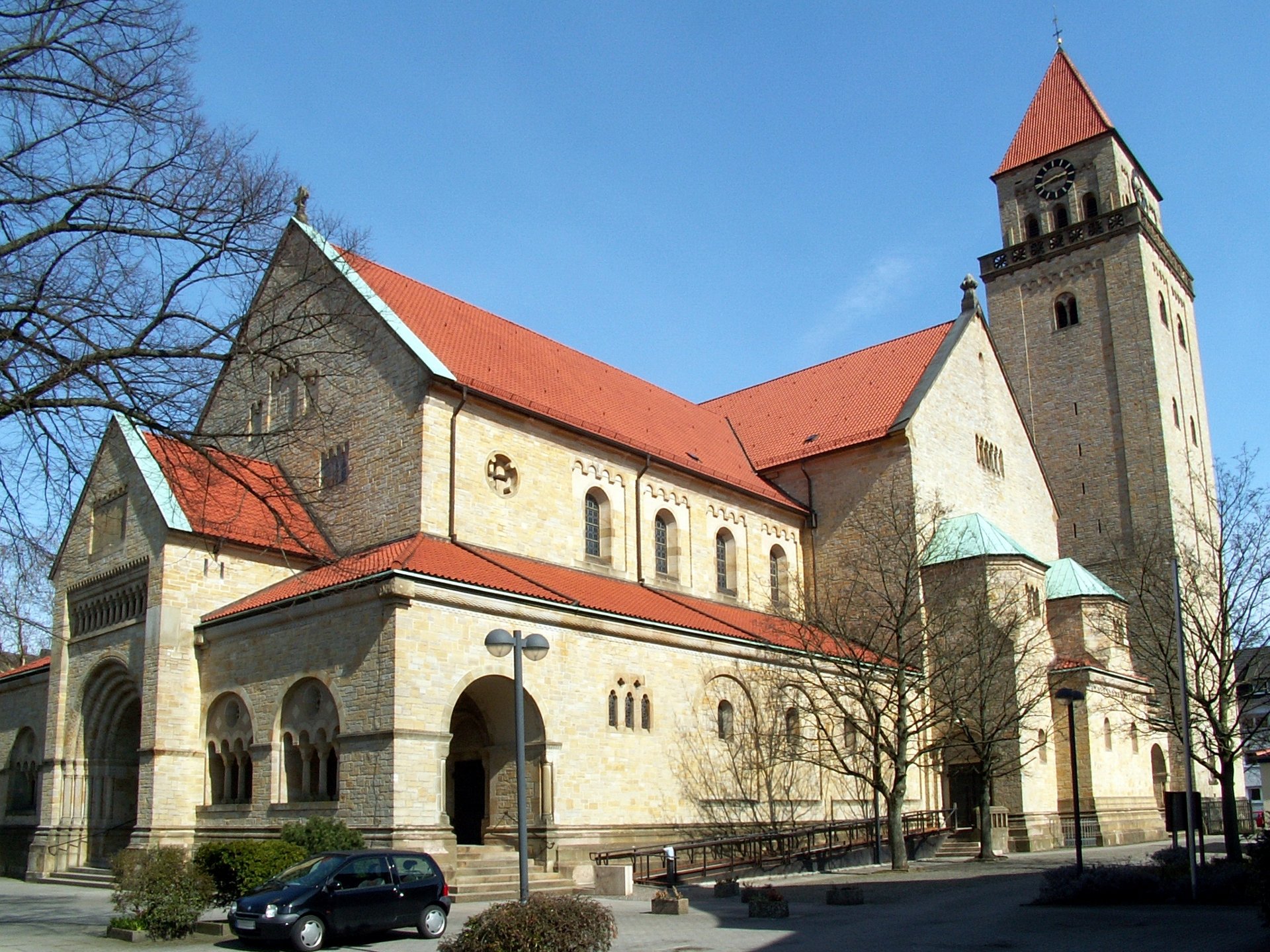
The Lutheran Lutherkirche, built in 1909, retains all its original Jugendstil furnishings - rare in a city where the bombs took so much. The Catholic Kirche St. Joseph was consecrated in 1917. The older Heilige Familie parish church was reborn between 2009 and 2011 as a columbarium - a church where the cremated ashes of parishioners are interred in the walls, a quietly modern way of staying present in the building you once worshiped in. The Reformed Evangelical Friedenskirche, the Church of Peace, runs its parish hall as a youth church. Four Muslim places of worship - the Ditib, Aya-Sofia, and Merkez mosques among them - serve the district's Muslim residents. On the Schölerberg the spiritual map has been redrawn more than once.
From the Air
Schölerberg lies at 52.26°N, 8.06°E on the south side of Osnabrück. Recommended viewing altitude: 2,500-3,500 ft AGL. The 126-meter limestone ridge is visible as a forested green wedge between the southern districts and the Autobahn 30. The zoo and its adjoining museum sit on the east slope. Nearest airport: Münster Osnabrück International (EDDG / FMO), about 30 km south.