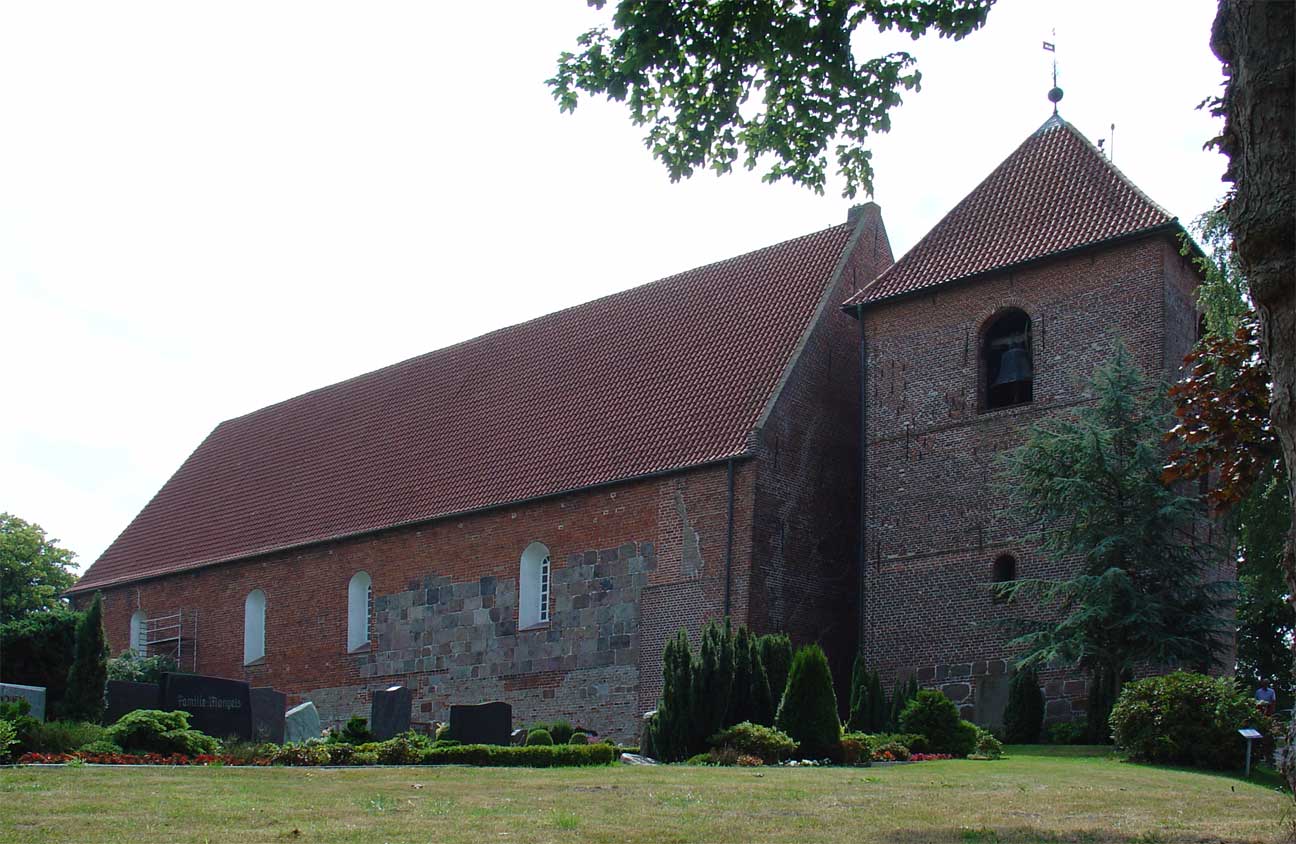
Schortens
At its peak around 1969, the Olympia typewriter factory in Roffhausen employed roughly 20,000 people. The plant sat on the western edge of Schortens, a town with maybe a fraction of that population on its books, and for two decades it absorbed almost every working hand in the region. When Olympia finally shut its doors in 1992, an entire way of life folded with it. Walk through Schortens today and the buildings are still there - converted, repurposed, quiet - and the town has spent the years since learning what comes after the keys stopped clicking.
Scrotinh, Scrotinghe, Schortense
The name has been wrestled with for nearly nine centuries. In 1158 a document signed by Pope Adrian IV - the only Englishman ever to sit on the throne of St. Peter - referred to the settlement as Scrotinh. Later scribes softened it to Scrotinghe, and by 1400 the town was being written as Schortense. Graves unearthed during 1970s excavations push the human story back even further, to the fifth century, when small bands of Frisians worked the marshy edges of what would become a coastline anchored against the North Sea. The St. Stephan Church, built shortly after 1153 to commemorate an Östringer victory over a larger army, still stands as the oldest witness to those long centuries of becoming.
A Town of Twelve Villages
Schortens is not really one place. It is twelve - Schortens proper, plus Heidmühle, Grafschaft, Accum, Sillenstede, Schoost, Roffhausen, Middelsfähr, Addernhausen, Oestringfelde, Ostiem, and Upjever. Heidmühle long ago grew into something close to a twin of the historic core. In the Middle Ages the monastery at Oestringfelde was famous for its horse breeding and doubled as a place of asylum, a quiet promise of sanctuary in a region that often needed one. Each district carries its own church, its own farmhouse rows, its own particular dialect inflection. The town that received municipal rights only on January 21, 2005 is, in truth, a federation as much as a city.
The Olympia Years
After the Second World War, refugees streamed into northern Germany looking for work and a place to start over. Schortens was ready for them in a way few towns could match. The Olympia-Werke factory in Roffhausen opened soon after the war, producing typewriters that became fixtures in offices from Hamburg to Hanover to Stuttgart. By 1970 the plant was the largest single employer in the entire Friesland district. Electric models arrived, then word processors, and for a while it seemed the future might be made of clicking metal keys forever. The shift to personal computers proved unforgiving. When Olympia closed in 1992, the silence in Roffhausen was its own kind of news.
The Base That Stayed
In 1936 an air force base opened in Upjever, on the eastern fringe of what is now Schortens borough. It has outlasted regimes, wars, and reorganizations. Today the field is one of the bases used by the Bundeswehr, and the low scream of jets on approach is woven into the soundscape of the surrounding villages. Just to the south, the naval city of Wilhelmshaven shaped Schortens for the entire twentieth century - drawing workers in, then leaving them stranded when warship construction halted after the First World War, then drawing them back again. A rail link to Jever, opened in 1871, made the whole pattern possible. The trains still run.
From the Air
53.53N, 7.95E. Cruise at 3,000-5,000 ft for the clearest look at the patchwork of village cores connected by hedgerows and canals. Jever Air Base (ETNJ) sits at the eastern edge of the borough; military flying ceased there in 2013 and the field is now decommissioned. Wilhelmshaven (EDWI) lies 12 km south; Bremen (EDDW) is the nearest major civil field, about 60 km southeast. Best visibility in spring and early autumn; coastal fog is common.