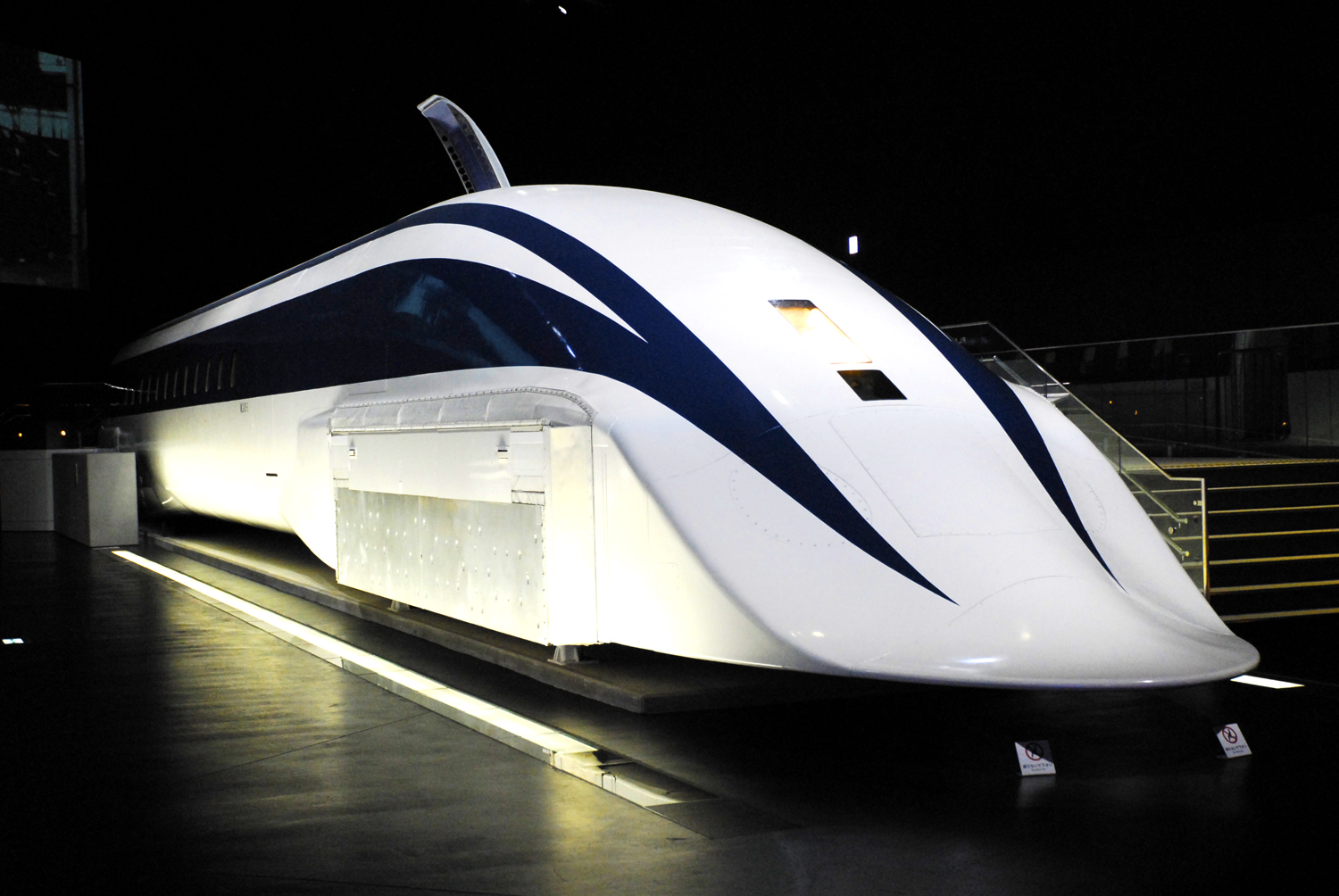
SCMaglev: The Train That Floats at 603 km/h
On April 21, 2015, a seven-car train entered a concrete guideway tunneled through the mountains of Yamanashi Prefecture and accelerated past 600 kilometers per hour. For a little over ten seconds, the L0 Series prototype floated above its track on nothing but magnetic force, traveling faster than any crewed rail vehicle in history: 603 km/h, or 375 miles per hour. There were no wheels touching the ground. There was no friction to overcome. The superconducting magnets aboard the train, cooled to near absolute zero with liquid helium, generated fields so powerful that aluminum coils in the guideway walls pushed back with equal force, lifting the entire vehicle ten centimeters into the air and propelling it forward. This was not a stunt. This was a rehearsal. Central Japan Railway Company has been building toward this moment since 1972, and the commercial line it will serve -- the Chuo Shinkansen between Tokyo and Nagoya -- is already under construction.
Sixty Years of Levitation
Japan's superconducting maglev program began in the late 1960s, shortly after Brookhaven National Laboratory patented superconducting magnetic levitation technology in the United States in 1969. Japan National Railways announced its own SCMaglev development program and made its first successful test run at the Railway Technical Research Institute in 1972. By 1977, testing had moved to a dedicated 7-kilometer track in Hyuga, Miyazaki Prefecture. The track's cross-section was redesigned from a T-shape to the U-shape still used today by 1980. When Japan National Railways was privatized in April 1987, Central Japan Railway Company -- JR Central -- inherited the project and its ambitions. By 1989, JR Central decided the Miyazaki track was too limited and began planning a longer, more realistic test facility with tunnels, steep gradients, and curves: the Yamanashi test line that would eventually produce the world record.
The Physics of Floating
The SCMaglev uses electrodynamic suspension, a system fundamentally different from the electromagnetic suspension used by Germany's Transrapid. The train's bogies carry superconducting magnets that generate intense, stable magnetic fields. As the train moves along the guideway, these fields interact with two sets of aluminum coils built into the guideway walls. Levitation coils, wound in a figure-eight pattern and cross-connected beneath the track, generate lift and lateral guidance simultaneously -- when the train drifts to one side, the asymmetry in the figure-eight creates a restoring force that centers it again. Separate propulsion coils, powered from wayside stations, create a traveling magnetic wave that pulls the train forward. Below about 150 km/h, the magnetic forces are too weak for stable levitation, so the train rolls on rubber tires during low-speed operation and gently lifts off as it accelerates. The transition is nearly imperceptible to passengers.
A Mountain Corridor Takes Shape
In 2009, Japan's Ministry of Land, Infrastructure, Transport and Tourism declared the SCMaglev system ready for commercial operation. Two years later, JR Central received permission to build the Chuo Shinkansen, a new trunk line that will run largely underground through the mountains between Tokyo and Nagoya, with an extension planned to reach Osaka. The Tokyo-Nagoya segment is scheduled to open in 2034, after delays pushed back the original 2027 target. The Osaka extension is planned for 2037. The Yamanashi test line, where the 603 km/h record was set, has been extended and will be incorporated into the commercial route. Since 1997, SCMaglev test vehicles have logged over 2,044,000 miles on this track, averaging roughly 2,000 kilometers of running per day. On one record-setting day, the prototype covered approximately 4,062 kilometers -- more than the distance from Tokyo to Bangkok.
Ambitions Beyond Japan
JR Central has not kept the technology to itself. Since 2010, the company has pitched the SCMaglev for international markets, with the Northeast Corridor of the United States as a primary target. The proposed Northeast Maglev would connect Washington, D.C. and Baltimore as a first phase. In 2016, the Federal Railroad Administration awarded $27.8 million to Maryland's Department of Transportation for preliminary engineering and environmental analysis of the route. Meanwhile, in Australia, JR Central joined with Mitsui and General Electric in 2015 to form Consolidated Land and Rail Australia, a venture proposing an SCMaglev line linking Sydney, Canberra, and Melbourne, with plans to develop eight new inland cities along the corridor. Whether these international ambitions materialize remains uncertain, but the Yamanashi test track keeps running -- proof, measured in millions of miles, that superconducting levitation works.
From the Air
Located at 35.583°N, 138.933°E in the mountains of Yamanashi Prefecture, west of Tokyo. The Yamanashi SCMaglev test line runs largely through tunnels but portions of the elevated guideway are visible from the air as a distinctive concrete trough cutting through mountainous terrain. Best viewed at 3,000-5,000 feet AGL. The test track parallels the Chuo Expressway in several sections. Nearest significant airport is Tokyo Haneda (RJTT), approximately 65 nautical miles east. Chofu Airport (RJTF) is closer at roughly 40 nautical miles. Mount Fuji dominates the skyline to the south.