SCMaglev and Railway Park
Walk into the main hall of the SCMaglev and Railway Park in Nagoya, and the first thing you see is a bullet-nosed maglev prototype positioned nose-to-nose with a gleaming Shinkansen and a coal-black Class C62 steam locomotive. The three machines face each other like contestants from different centuries, which is precisely the point. Opened on March 14, 2011, by the Central Japan Railway Company -- JR Central, the operator of the Tokaido Shinkansen -- this museum doesn't just display old trains. It traces the entire trajectory of Japanese rail engineering, from a 1913 steam railcar to the superconducting maglev technology that JR Central is betting its future on. The 39 full-size vehicles assembled here tell that story not as a timeline on a wall, but as a walk through a century of machines that reshaped a nation's geography.
The Machines That Shrank Japan
The Shinkansen gallery reads like a family tree of the world's most famous train. A 0 Series car from 1971, with its rounded nose and cream-and-blue livery, represents the fleet that launched high-speed rail in 1964 and permanently collapsed the distance between Tokyo and Osaka. Nearby sit examples of the 100 Series and the 300 Series -- the generation that pushed speeds to 270 km/h and cemented the bullet train as both an engineering benchmark and a cultural icon. Prototype cars from the 700 and N700 Series chronicle the incremental gains that brought the Tokaido Shinkansen to its current cruising speed of 285 km/h. Then there is the Class 955 "300X," a test vehicle that reached 443 km/h in 1996 and briefly held the world speed record for conventionally wheeled rail vehicles. Each generation is sleeker, lighter, and quieter than the last -- a physical record of engineers solving the same problem faster, again and again.
Iron Horses on Narrow Gauge
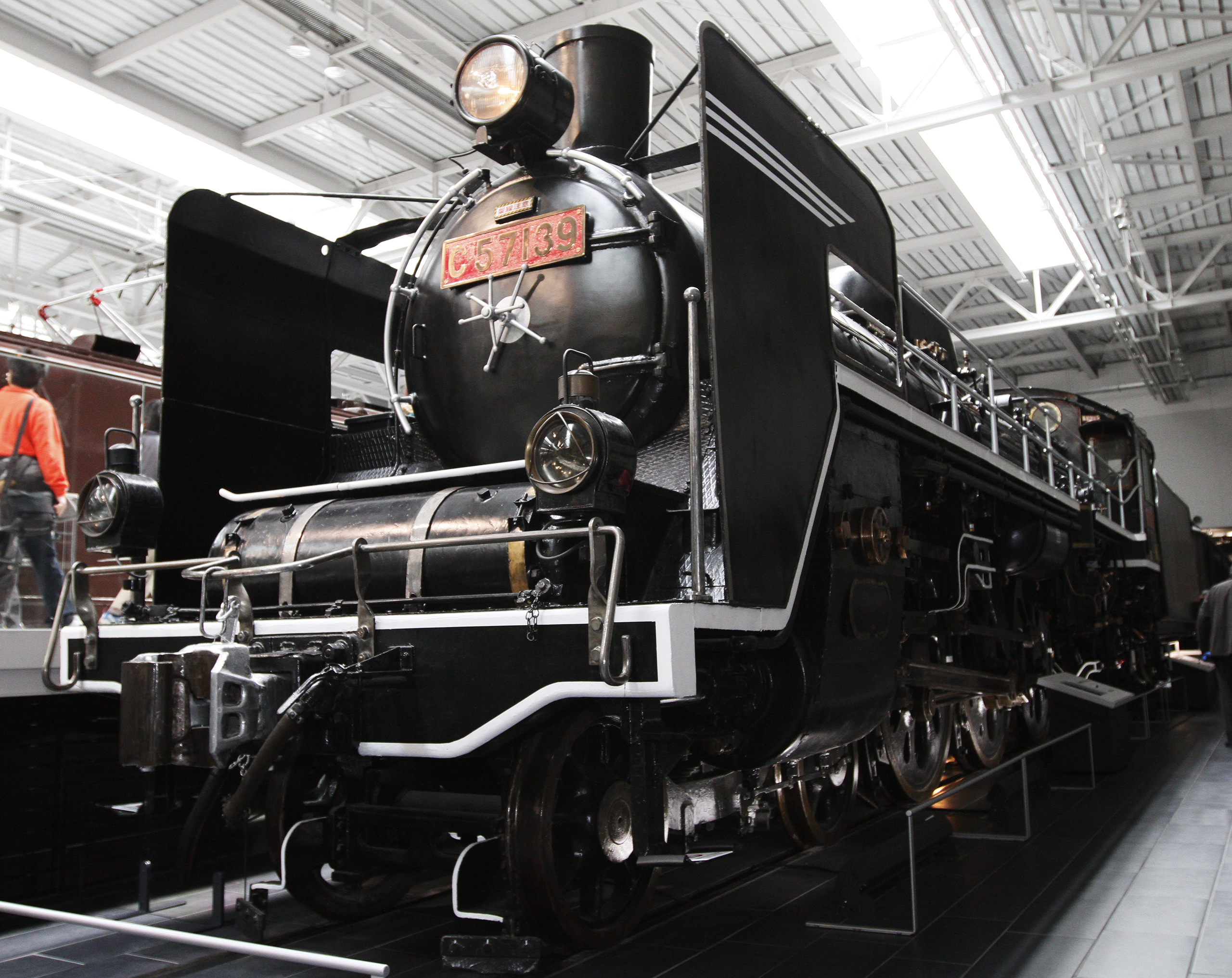
The museum's steam and electric locomotive collection reaches back to the years when Japan was still building its modern railway network on narrow 1,067-mm gauge track. A Class C62 locomotive, the largest and most powerful passenger steam engine Japan ever produced, anchors this section. C62 17 was built by Hitachi in 1948, part of a class that hauled express trains across Honshu in the final years before electrification made steam obsolete. Opposite it stands a General Electric-built ED11 from 1922, one of the earliest electric locomotives to operate in Japan, imported wholesale from America when Japanese manufacturers had not yet mastered the technology. A 1923 English Electric ED18 sits alongside, representing the British contribution to Japan's electrification. Together, these machines chart the moment Japan transitioned from importing foreign technology to developing its own -- a pattern that would repeat spectacularly with the Shinkansen four decades later.
The Doctor Will See You Now
Among the Shinkansen fleet sits an oddity that draws knowing smiles from Japanese visitors: the Class 922 "Doctor Yellow," a diagnostic inspection car painted in a distinctive bright yellow livery. Doctor Yellow cars patrol the Shinkansen network at full operating speed, using sensors mounted throughout the train to measure track geometry, overhead wire condition, and signal systems. Spotting a Doctor Yellow in regular service is considered good luck in Japan -- a piece of modern railway folklore that the museum preserves alongside its more conventional exhibits. The car on display, No. 922-26, was built by Hitachi in 1979 and served for decades monitoring the very tracks the museum celebrates. It represents a quieter kind of engineering excellence: not speed records, but the obsessive maintenance culture that gives the Shinkansen its legendary punctuality and safety record.
Floating on Magnets
At the far end of the museum stands the MLX01-1, a test car from JR Central's SCMaglev program -- the technology the museum is named for. Built in 1995 by Mitsubishi Heavy Industries, this vehicle ran on the Yamanashi Maglev Test Line, where a later iteration of the design reached 603 km/h in 2015, the fastest speed ever achieved by a crewed train. The SCMaglev uses superconducting magnets cooled to near absolute zero to levitate the train 10 centimeters above a guideway, eliminating wheel-on-rail friction entirely. JR Central is building the Chuo Shinkansen, a maglev line that will connect Tokyo and Nagoya in approximately 40 minutes -- a journey that currently takes about an hour and forty minutes by conventional Shinkansen. The MLX01-1 is not a historical artifact so much as a promise: the museum's final exhibit is also its vision of the future.
More Than Metal
Beyond the vehicles themselves, the museum offers train cab simulators that let visitors operate a Shinkansen, a conventional train, and a commuter line. A massive model railway diorama recreates the landscape between Tokyo and Osaka in miniature, complete with day-and-night lighting cycles. But the real power of the place is in the juxtaposition of machines. Standing between a 1913 steam railcar and the maglev prototype, the distance is not just 82 years of engineering -- it is the story of a nation that channeled its postwar ambition into rail technology and, in doing so, invented the modern idea of high-speed ground transportation. Every subsequent bullet train system in the world descends from the concept proven on the Tokaido line. The SCMaglev and Railway Park preserves that lineage, from the first tentative puffs of steam to the silent, frictionless glide of the future.
From the Air
Located at 35.047N, 136.849E in the Minato ward of Nagoya, along the shores of Nagoya Port. The museum's large rectangular building sits adjacent to the Aonami Line tracks and is identifiable from the air by its proximity to the port facilities and the distinctive outdoor display of N700 Series prototype cars. Nearest airport: Chubu Centrair International Airport (RJGG), approximately 20nm south across Ise Bay. Nagoya Airfield / Komaki (RJNA) lies about 10nm to the north. Best viewed at 2,000-3,000 feet AGL. The Nagoya urban area spreads to the north and east, with the port and industrial waterfront immediately to the south and west.