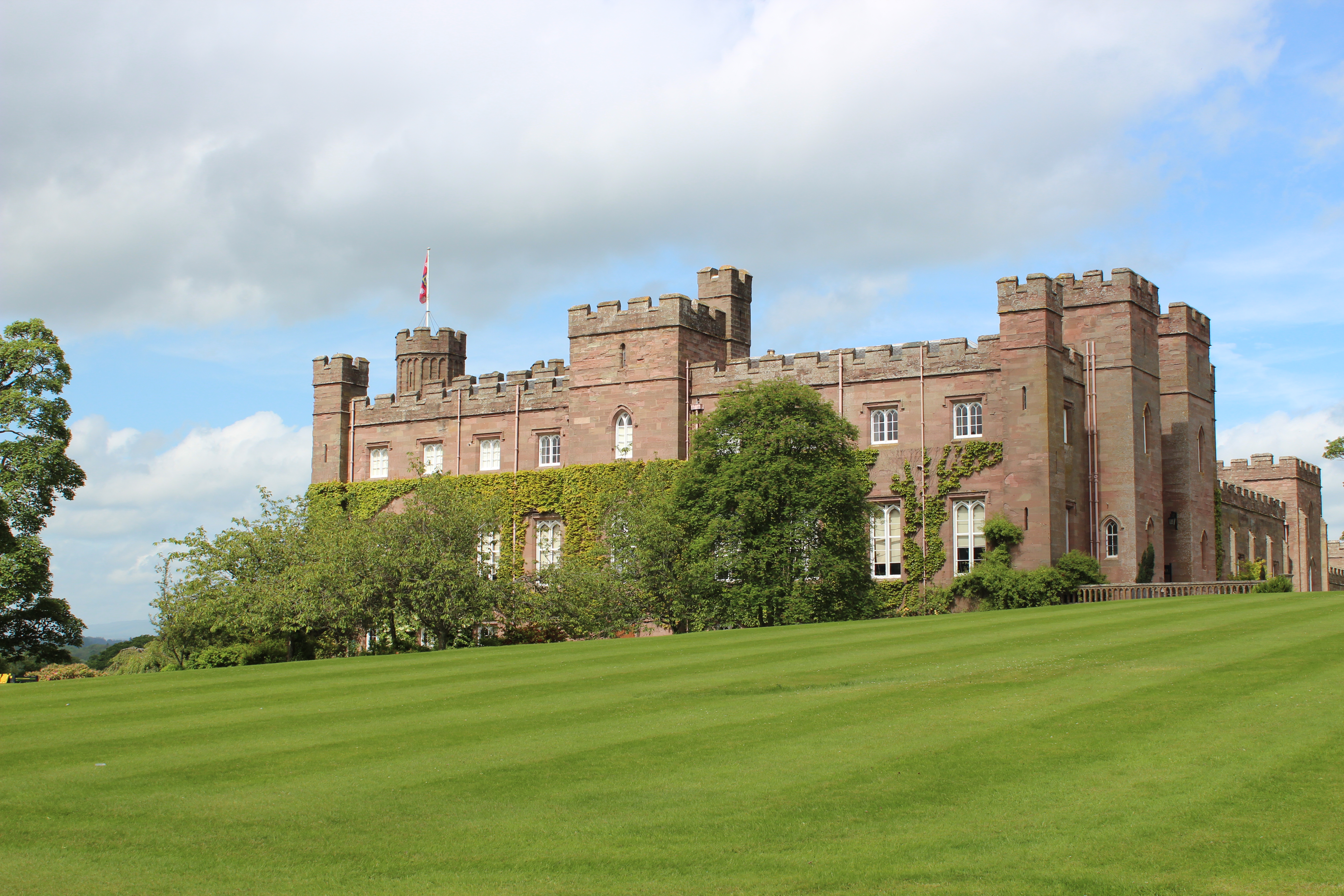
Scone Palace
There is an old Gaelic saying: 'When the Bell of Scone tolls, the law of the land has been made.' For a place that now presents itself as a stately home with fine porcelain and a star-shaped hedge maze, Scone carries an extraordinary weight of national memory. Forty-two kings of Scotland were crowned here, from Kenneth MacAlpin in the ninth century to Charles II in 1651. The Stone of Destiny -- the most potent symbol of Scottish sovereignty -- resided here for centuries. The first recorded Scottish parliament met here in 906. Before it was a palace, before it was an abbey, before any written record mentioned it at all, Scone was the place where Scotland made its kings.
The Hill Where Kings Were Made
At the heart of the Scone site is the Moot Hill, a low grassy mound also known as Boot Hill, from a tradition in which nobles attending a coronation would carry soil from their own lands in their boots and deposit it on the hilltop. The story -- almost certainly folklore rather than fact -- carries a powerful symbolic charge: the king was crowned atop a hill composed of earth from every corner of his kingdom, making his oaths while standing symbolically upon all of Scotland. Whether or not anyone actually carried soil in their boots, the Moot Hill was undeniably the inauguration site for Scottish kings across centuries. The oldest recorded event at Scone is a gathering called by King Constantine II in 906, documented in the Chronicle of the Kings of Alba, in which the king and Bishop Cellach met at 'the Hill of Belief near the Royal City of Scone' and pledged to uphold the laws of the Christian faith. Gaelic poets gave Scone honorific epithets: Scoine sciath-airde, 'Scone of the High Shields,' and Scoine sciath-bhinne, 'Scone of the Noisy Shields,' referring to a ceremony in which assembled magnates would hang their shields on the Great Hall walls and beat their weapons against them.
The Stone That Edward Stole
The most famous object associated with Scone was the Stone of Scone, also called the Stone of Destiny -- a block of sandstone upon which Scottish kings were traditionally seated during their inauguration. The stone resided at Scone Abbey, which served as the repository of royal authority from at least the twelfth century. In 1296, Edward I of England invaded Scotland and carried the Stone to Westminster Abbey, where it was fitted beneath a specially built Coronation Chair. For seven centuries it remained in London, a trophy of conquest and a source of enduring Scottish resentment. On Christmas Day 1950, four Scottish students broke into Westminster Abbey and stole the Stone, smuggling it back to Scotland in an act of nationalist bravado that captivated the public. The Stone was eventually recovered and returned to Westminster, but in 1996 the British government formally returned it to Scotland. It is now housed in Perth Museum, not far from where it spent its first several centuries. Robert the Bruce was crowned at Scone in 1306 despite the Stone's absence, and Charles II's coronation there in 1651 was the last -- the last Scottish king crowned on Scottish soil before the union of the crowns made such ceremonies redundant.
Abbey, Reformation, Ruin
From 1114, Scone was the site of a major Augustinian monastery that grew into one of Scotland's most important abbeys. Between 1284 and 1402, the Scottish Parliament frequently met within the abbey precincts. The Romanesque church, known from its depiction on the abbey seal, had a central tower crowned with a spire. Nothing of it survives above ground. In 1559, during the early violence of the Scottish Reformation, a mob from Dundee -- incited by the preaching of John Knox -- descended on Scone and largely destroyed the abbey buildings. The vandalism was swift and thorough: a four-hundred-year-old monastic foundation was reduced to fragments in a matter of days. The abbey estates passed through several hands, from the Ruthven family (later the Earls of Gowrie, who were charged with treason in 1600) to Sir David Murray of Gospetrie, who rebuilt the Abbot's Palace as a grand residence. The Murray family has held Scone since 1604, and the present palace is their creation.
The Palace of Red Sandstone
The modern Scone Palace, completed in 1807, was designed by William Atkinson in the Gothic Revival style for the third Earl of Mansfield. Built in red sandstone with a castellated roofline, it deliberately echoes the medieval abbey it replaced. The Earl spent sixty thousand pounds on the project -- a vast sum at the time -- and pronounced himself pleased with the result. The interiors house an exceptional collection: Rococo chairs by Pierre Bara, a writing desk given to the second Earl by Marie Antoinette, Dresden and Sevres porcelains, and paintings by Reynolds, Ramsay, and de Laszlo. The Lennox Room contains bed hangings stitched by Mary Queen of Scots. In the grounds, the Murray Star maze -- planted in copper and green beech to resemble the family tartan -- covers sixteen hundred square metres. The palace grounds were also the first place in Britain where the Douglas fir was planted, introduced by the botanist David Douglas, who worked as a gardener at Scone before his famous collecting expeditions in the Pacific Northwest. The Moot Hill still stands in the grounds, a grassy mound with a small chapel on its summit, quiet now, bearing no outward sign of the forty-two coronations and centuries of lawmaking that once took place upon it.
From the Air
Scone Palace stands at 56.42°N, 3.44°W near Perth in central Scotland. The red sandstone palace and its extensive grounds, including the Moot Hill, are visible from the air on the east bank of the River Tay. Perth city centre lies approximately 2 nm to the south. Nearest airport: Dundee (EGPN) approximately 15 nm to the east, or Perth (EGPT) nearby.