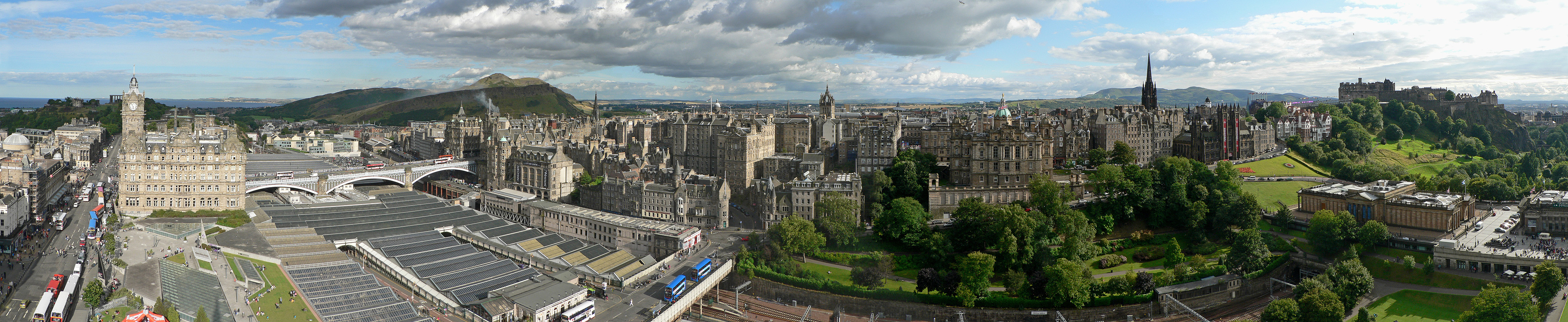
Scott Monument
George Meikle Kemp was a joiner, a draftsman, and a self-taught architect. He was forty-one years old and had no formal architectural qualifications. When a competition was held in 1836 to design a monument to Sir Walter Scott, Kemp entered under the pseudonym John Morvo -- the name of the medieval architect of Melrose Abbey. He feared that his real identity would disqualify him. It did not. The judges liked his Gothic design, and in 1838 he was awarded the contract. Construction began in 1841 and ran for nearly four years. On the foggy evening of 6 March 1844, with the monument nearly complete, Kemp fell into the Union Canal while walking home from the site and drowned. His son placed the finial in August. The monument was inaugurated on 15 August 1846. Its architect was not there to see it.
A Tower for a Writer
The Scott Monument stands 200 feet high in Princes Street Gardens, making it the second-largest monument to a writer in the world, after the Jose Marti monument in Havana. It is placed on axis with South St David Street, large enough to screen the Old Town behind it, and dominates the eastern section of the gardens. The tower is built from Binny sandstone quarried near Ecclesmachan in West Lothian. Viewing platforms are reached by a series of spiral staircases -- 287 steps to the highest gallery. At the base, John Steell's marble statue shows Scott seated with a quill pen, his deerhound Maida at his side, carved from white Carrara marble. The monument carries 64 figures of characters from Scott's novels, sculpted by a roster of Scottish sculptors including the otherwise unknown Katherine Anne Fraser Tytler.
The Cost in Stone Dust
The monument's construction came at a terrible human price. The hewing masons who prepared the blocks worked in closed sheds, cutting and carving the hard Binny sandstone in conditions that filled the air with fine silica dust. Building masons who worked in the open, placing the finished blocks, fared better. But the hewing masons breathed the dust daily. One contemporary observer recorded that the monument killed twenty-three of the finest hewers in Edinburgh. Another estimated that half of all the masons employed on the project died of phthisis -- the term then used for silicosis. The monument was built from sandstone so hard it destroyed the lungs of the men who shaped it.
Sixty-Eight Statues and Sixteen Heads
Scott's fictional creations populate the monument in stone. There are 68 statues in all, not counting Scott and Maida, with 64 visible from the ground and four placed above the final viewing gallery, visible only by telephoto lens or at a distorted angle from the platform itself. Eight kneeling Druid figures support the upper gallery. Thirty-two niches at the higher levels remain unfilled. Sixteen heads of Scottish poets and writers appear on the lower faces: Robert Burns, James Hogg, Lord Byron, Mary Queen of Scots, and others. The foundation stone was laid on 15 August 1840 by Sir James Forrest in his capacity as both Lord Provost and Grand Master Mason of Scotland. Parliament passed a specific act -- the Monument to Sir Walter Scott Act -- to authorize the construction.
Black and Clean
Edinburgh's coal smoke blackened the monument within decades of its completion, turning its pale sandstone nearly black. The darkened spire became so familiar that many assumed the monument was meant to look that way. A major restoration in the early 2000s cleaned sections of the stonework, but the contrast between the cleaned and uncleaned stone proved so jarring that the project became a matter of public debate. The overall cost of the restoration was 2.36 million pounds, funded by the Heritage Lottery Fund, Historic Scotland, and the City of Edinburgh Council. In 2016, a new LED lighting system was installed, designed to highlight the monument's architectural features with a soft warm glow. The total cost of the original construction, by contrast, was just over 16,154 pounds -- the price of a monument that took a man's reputation, his life's work, and finally his life.
From the Air
The Scott Monument is at 55.952N, 3.193W in Princes Street Gardens, Edinburgh, a distinctive dark Gothic spire rising 200 feet from the gardens between Princes Street and the Old Town. It is one of Edinburgh's most recognizable landmarks from the air. Nearest airport: Edinburgh (EGPH), approximately 6 nm west. Best viewed at 1,500-3,000 ft.