Scottish Parliament Building
The budget was supposed to be 40 million pounds. The final bill came to 414 million. By the time the Scottish Parliament Building opened in 2004, three years late and roughly ten times over budget, it had become the most controversial construction project in modern British history. And yet the building that Catalan architect Enric Miralles designed at the foot of Edinburgh's Royal Mile, wedged between Holyrood Palace and the dramatic cliffs of Arthur's Seat, has since earned recognition as one of the most important works of contemporary architecture in the United Kingdom.
A Nation's Home, Reimagined
When Scotland's Parliament reconvened in 1999 after nearly three centuries of absence, it needed a physical home to match the weight of the moment. The last Scottish Parliament had met in 1707 before the Acts of Union dissolved it into Westminster. Choosing Holyrood over several competing sites was itself contentious, but the selection of Enric Miralles and his firm EMBT/RMJM proved even more so. Miralles envisioned a building that would grow from the landscape itself, drawing inspiration from upturned boats on the Scottish shore, the forms of Edinburgh's flower paintings, and the surrounding Holyrood geology. He wanted to blur the boundary between architecture and the Scottish land. Tragically, Miralles died of a brain tumor in July 2000, at age 45, before seeing his vision realized. His wife and partner Benedetta Tagliabue continued the work.
The Reckoning
The cost overruns became a national scandal. Initial estimates ranged between 10 and 40 million pounds. As construction dragged on, the projected cost climbed past 100 million, then 200 million, then further still. Lord Fraser's public inquiry, published in 2004, examined how the budget spiraled so far beyond control. The inquiry found failures at nearly every level: the decision to begin construction before design was complete, the complexity of Miralles' vision, changes to security requirements after the September 11 attacks, and a construction management approach that allowed costs to accumulate without clear accountability. Politicians, the media, and the public were furious. For a newly devolved parliament trying to prove its competence, the building had become an embarrassment before its doors even opened.
Architecture Against the Grain
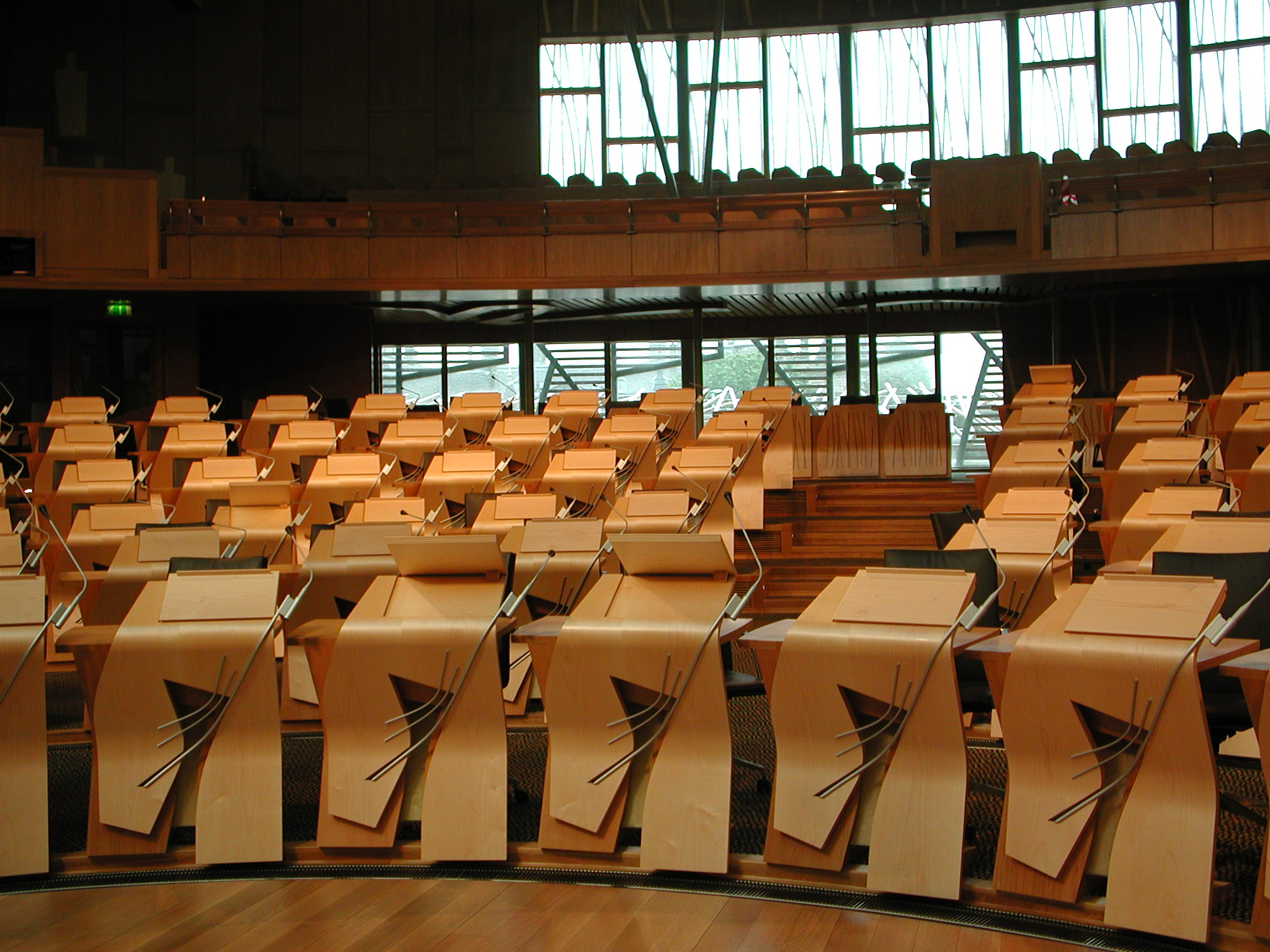
Whatever the controversy over cost, the architecture itself is extraordinary. The building rejects the classical grandeur typical of parliamentary buildings in favor of something deliberately unconventional. The debating chamber sits beneath an oak-beamed ceiling inspired by the hull of a boat, with light filtering through distinctive leaf-shaped windows. The MSP office block features projecting window bays shaped like contemplation pods, cantilevered outward so that each of the 129 members has a personal space framed by views of Edinburgh. Landscaping incorporates pools and native plantings that anchor the complex to its site at the base of Salisbury Crags. In 2005, the building won the Stirling Prize, the United Kingdom's most prestigious architecture award, with the judges calling it a bold and ambitious work of originality. The RIBA also honored it with its highest recognition.
Where Democracy Meets the Land
Miralles was emphatic that the building should belong to the Scottish people rather than to the institution of government. He placed the public entrance at the heart of the complex, making the approach feel welcoming rather than imposing. The building steps down the hillside in a series of cascading forms, deliberately avoiding the monumental facades that characterize most seats of power. Inside, materials shift from concrete and steel to Scottish oak and granite, mixing the industrial with the natural. The effect is a parliament that feels rooted in the landscape of Scotland rather than imposed upon it. Whether that vision justified the cost remains a question Edinburgh still debates, but the building has become inseparable from the identity of devolved Scotland. More than 1,000 staff and civil servants work alongside 129 MSPs within its walls, debating the future of a nation in a space designed to challenge every assumption about what a parliament building should look like.
From the Air
Located at 55.95°N, 3.17°W at the eastern end of Edinburgh's Royal Mile, at the foot of Arthur's Seat. The distinctive angular roofline and leaf-shaped window bays are visible from lower altitudes. Adjacent to Holyrood Palace. Nearest airport: Edinburgh (EGPH), approximately 6 nm west. Best viewed from the east, where the building's relationship to Arthur's Seat and the Royal Mile is most apparent.