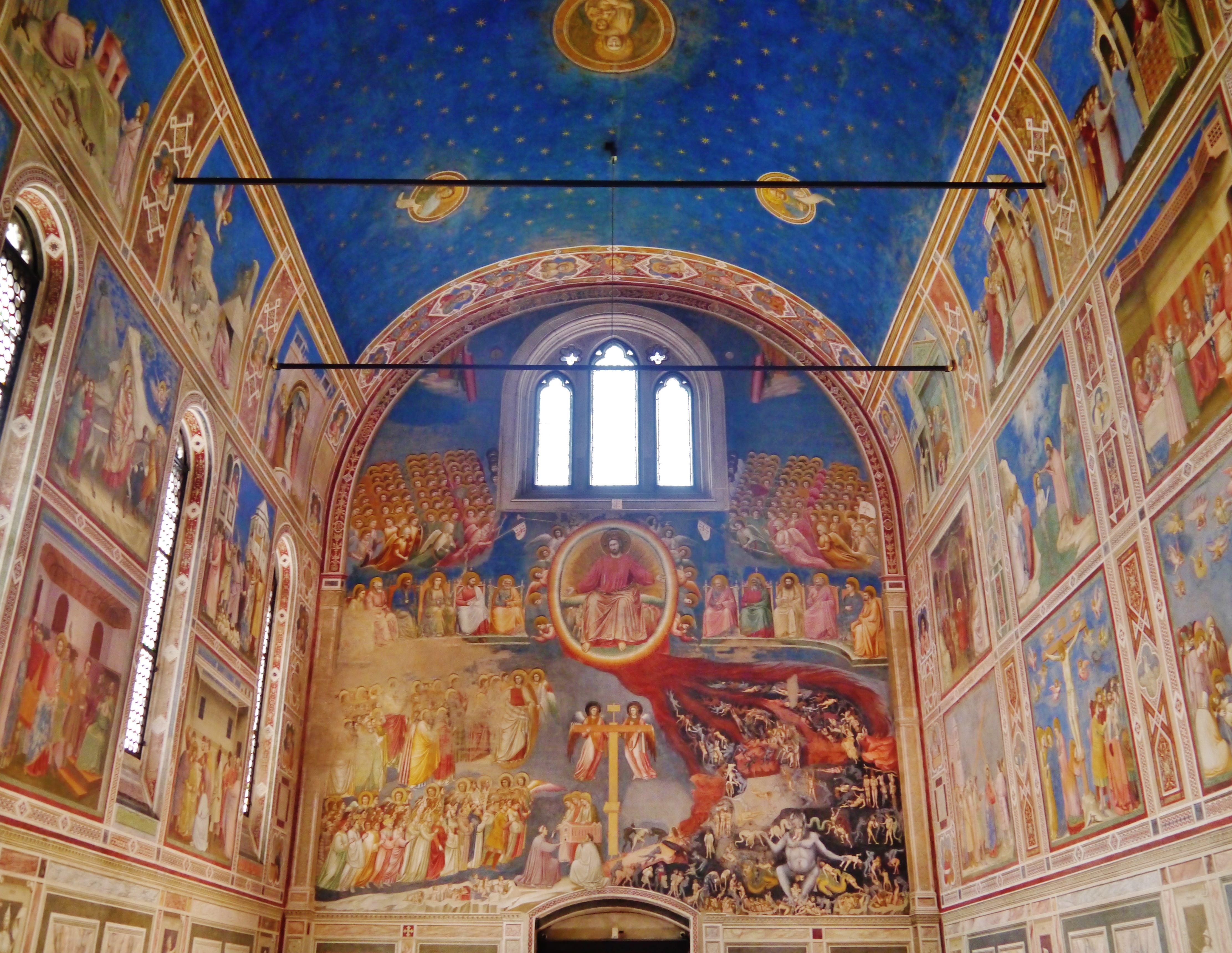
Scrovegni Chapel
A wealthy banker with a guilty conscience hired the greatest painter of his age to cover a chapel in images of salvation. The result changed the course of Western art. Enrico Scrovegni commissioned Giotto di Bondone to decorate the interior of his private chapel in Padua sometime around 1303, and by 1305 the work was complete. The chapel is small — the nave measures just 20.88 meters long, 8.41 meters wide, and 12.65 meters high — but every inch of wall and ceiling is painted. What Giotto accomplished in this confined space launched a revolution in European painting that would not fully play out for another century.
A Son's Atonement
Enrico Scrovegni's father, Reginaldo, was a moneylender whose reputation was severe enough that Dante placed him among the usurers in the seventh circle of the Inferno. Whether or not Enrico felt the weight of that condemnation — scholars debate the timeline, since Dante's verses may postdate the chapel's completion — the younger Scrovegni clearly intended his chapel to serve a redemptive purpose. In the early 1300s, he purchased the land where Padua's Roman arena had once stood, built a grand palace, and annexed a chapel dedicated to Santa Maria della Carità. The project was twofold: a private oratory for his family and a funerary monument for himself and his wife. The chapel received its first consecration on March 25, 1303, the Feast of the Annunciation. Pope Benedict XI granted an indulgence to visitors on March 1, 1304. A year later, on March 25, 1305, the definitive consecration took place. Giotto, already celebrated for his work at the Basilica of Saint Francis in Assisi, was at work on the interior throughout this period.
Painting as Drama
Before Giotto, medieval painting depicted sacred figures as flat, iconic presences floating against gold backgrounds. At the Scrovegni Chapel, Giotto gave them weight, emotion, and space to move in. His figures stand on solid ground. They turn toward one another. Their faces register grief, anger, tenderness, and surprise. The fresco cycle tells the story of salvation from top to bottom across the chapel's walls, beginning with scenes from the lives of Joachim and Anne — Mary's parents — on the upper tier, continuing through the life of Christ in the middle registers, and culminating in a monumental Last Judgment that covers the entire entrance wall. The asymmetry of the chapel itself shaped the composition: six windows on the longer south wall determined the spacing of scenes, and Giotto calculated proportions so the north wall would mirror the rhythm. One of the cycle's most celebrated moments is the Kiss of Judas, where the betrayer's cloak wraps around Christ like a trap, and their eyes meet at point-blank range. It is a painting that audiences had never seen before — not a symbol of betrayal but the experience of it.
Virtues, Vices, and a Cosmic Ceiling
Below the narrative scenes, fourteen monochrome figures line the bottom tier of the side walls: seven Vices on the north and seven Virtues on the south. Painted in grisaille to resemble marble sculptures, each stands within a mirror-like frame, named in Latin above. The Vices — Stultitia, Inconstantia, Ira, Iniusticia, Infidelitas, Invidia, Desperatio — face their corresponding Virtues across the nave, creating a moral dialogue that the congregation walked through on their way to the altar. The ceiling above is a field of deep blue studded with eight-pointed stars, interrupted by painted roundels containing the great prophets of the Old Testament and two larger medallions showing God and the Madonna with Child. The scholar Giuliano Pisani has argued that the entire decorative program was devised by the Augustinian theologian Friar Alberto da Padova, drawing on apocryphal gospels and patristic sources. Whether or not one accepts every detail of that attribution, the intellectual ambition is undeniable: this is not decoration but a theological argument rendered in paint.
Seven Centuries of Fragile Survival
The Scrovegni Chapel was never a public church. It was a private family chapel attached to a palace, and the palace itself was demolished by 1827. The chapel survived, becoming part of the complex of the Musei Civici di Padova alongside the former Augustinian monastery, the Monastero degli Eremitani. Today it is one of the most carefully controlled exhibition spaces in the world. Visitors enter through a climate-controlled antechamber designed to stabilize temperature and humidity before they step into the frescoed interior, where groups are limited to twenty-five people for fifteen-minute visits. The precautions reflect the fragility of what Giotto created: seven hundred years of temperature fluctuations, moisture, and the simple exhalation of millions of visitors have taken their toll. In 2021, UNESCO inscribed the chapel as part of "Padua's fourteenth-century fresco cycles," a World Heritage Site that recognizes these frescoes as the most important works that marked the beginning of a revolution in mural painting. The chapel Scrovegni built to save his family's reputation ended up transforming the way humanity depicts itself.
From the Air
Located at 45.412°N, 11.880°E in central Padua, adjacent to the Eremitani church and museum complex. The chapel is a small structure not easily distinguished from altitude, but the Eremitani complex and surrounding gardens are visible from 2,000–4,000 feet AGL. Nearest airports include Padova (LIPU) approximately 3 miles southwest and Venice Marco Polo (LIPZ) about 22 miles east. The flat Veneto plain offers good visibility in clear conditions.