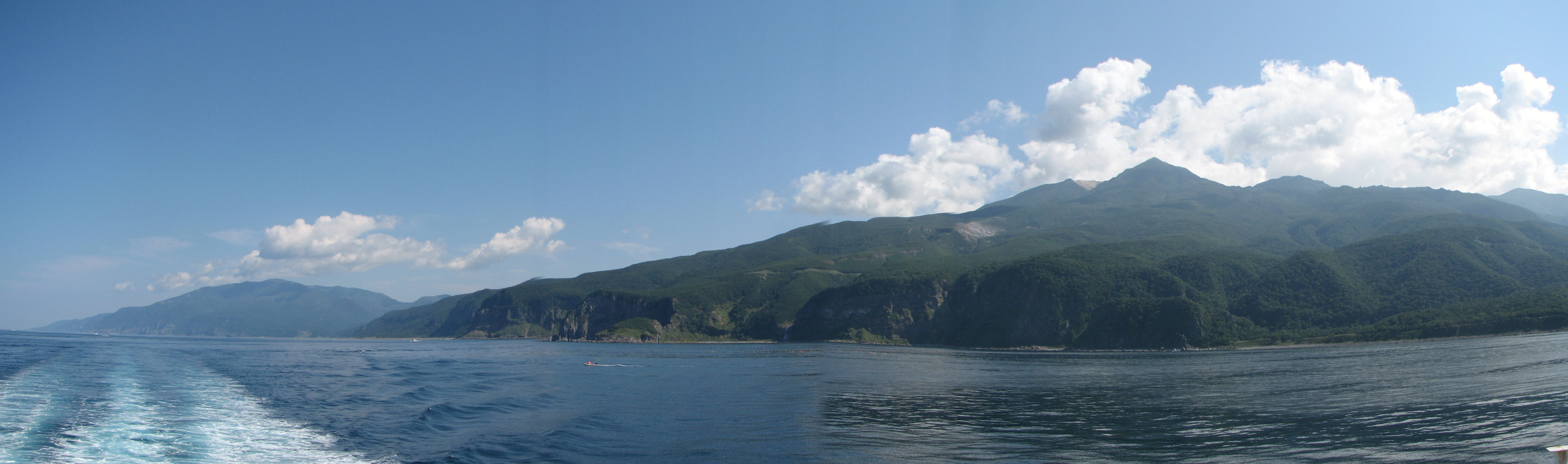
Sea of Okhotsk
Every winter, cold air pouring off the Siberian interior freezes the northwestern reaches of this 1.58-million-square-kilometer sea. As the ice forms, it expels salt into the deeper water, creating a dense, oxygen-rich current that flows east toward the open Pacific, carrying nutrients that sustain one of the most productive marine ecosystems on Earth. The Sea of Okhotsk takes its name from the port of Okhotsk, itself named for the Okhota River -- a modest origin for a body of water that has shaped the fates of indigenous peoples, imperial rivals, Cold War adversaries, and some of the planet's largest whale populations.
An Ocean Hemmed In
The Sea of Okhotsk is nearly enclosed. Russia's Kamchatka Peninsula walls it off to the east, the Kuril Islands arc across the southeast, Hokkaido closes the south, and Sakhalin Island runs along the western margin. A stretch of Siberian coastline completes the enclosure to the north and west. At its deepest point, the sea floor plunges 3,372 meters. The Amur River, one of Asia's great waterways, pours freshwater into the northwestern shallows, lowering salinity enough to raise the freezing point and encourage the formation of sea ice that can impede navigation for months. In some areas, the sea has warmed by as much as 3 degrees Celsius since preindustrial times -- three times faster than the global average -- driving fish populations northward and disrupting fisheries on both the Japanese and Russian coasts.
Charting Unknown Waters
Russian explorers Vassili Poyarkov and Ivan Moskvitin were the first Europeans to reach these waters, in the 1640s. The Dutch captain Maarten Gerritsz Vries sailed in from the southeast in 1643, charting parts of Sakhalin and the Kurils without realizing either was an island. For a time, mapmakers called it the Sea of Kamchatka. Vitus Bering's Second Kamchatka Expedition systematically mapped the entire coastline starting in 1733. By the mid-19th century, the Russian-American Company had monopolized commercial navigation, and the port of Okhotsk had yielded its primacy to Ayan. The question of whether Sakhalin was an island or a peninsula -- debated for over a century -- was finally settled by the Japanese explorer Mamiya Rinzo and the Russian naval officer Gennady Nevelskoy, who confirmed the narrow strait separating it from the mainland.
The Peanut Hole and the Whale Hunters
At the center of the Sea of Okhotsk lies the Peanut Hole, a 55-kilometer-wide, 480-kilometer-long sliver of open ocean named for its shape. Surrounded by Russia's exclusive economic zone but not part of it, this patch of international water became a free-for-all in 1991 when foreign fishing fleets moved in, hauling perhaps a million metric tons of pollock in a single year. Russia argued the fish moved freely between the Peanut Hole and its own waters, and in 2014 the United Nations ruled in Russia's favor, declaring the area part of Russia's continental shelf. Whaling, too, has a long history here. American whalers began hunting bowhead whales in 1847, and by the mid-1850s more than 160 vessels cruised the sea each season. As stocks collapsed, the fleet shifted to the Bering Strait, then returned, then shifted again -- a pattern of pursuit and depletion that took decades to play out.
Cold War Depths
During the Cold War, the Sea of Okhotsk became one of the most strategically sensitive bodies of water on Earth. The Soviet Pacific Fleet used it as a bastion for ballistic missile submarines -- a strategy Russia continues today. In one of the most audacious intelligence operations of the era, the U.S. Navy's Operation Ivy Bells tapped Soviet undersea communications cables running along the sea floor, an operation that remained secret until it was exposed by a former NSA analyst and later documented in the 1998 book Blind Man's Bluff. The sea and its surrounding airspace were also the site of the Soviet shootdown of Korean Air Lines Flight 007 in 1983, which killed all 269 people aboard. Despite its proximity to Japan, the sea carries no native Japanese name; the Japanese term is a transcription of the Russian.
Riches and Risks Below the Surface
Twenty-nine zones of possible oil and gas accumulation have been identified along the sea's continental shelf, with estimated total reserves of 3.5 billion tons of equivalent fuel. Extraction comes with extreme risk. On December 18, 2011, the Russian drilling rig Kolskaya capsized and sank in a storm while being towed from Kamchatka, killing 53 of the 67 people aboard. The platform had been subcontracted to a company working for Gazprom. Above the surface, the sea remains biologically rich -- home to crab fisheries so brutal that the Japanese writer Takiji Kobayashi made them the subject of his most famous novel, The Crab Cannery Ship, published in 1929. Crested auklets nest on the uninhabited islands, seals and sea lions breed along the coasts, and the fishing grounds continue to draw fleets despite warming waters and shifting stocks.
From the Air
The Sea of Okhotsk is centered around 55.00N, 150.00E, spanning roughly from 44N to 62N latitude and 135E to 165E longitude. Visible as a massive enclosed body of water from cruising altitude, bounded by the Kamchatka Peninsula to the east and the Kuril Islands to the southeast. Key airports along the coast include Petropavlovsk-Kamchatsky (UHPP), Magadan (UHMM), Yuzhno-Sakhalinsk (UHSS), and Sapporo/New Chitose (RJCC) on Hokkaido. Expect winter sea ice visible from altitude in the northwestern areas. Maritime weather with frequent fog and low visibility is common, particularly over the Kuril straits.