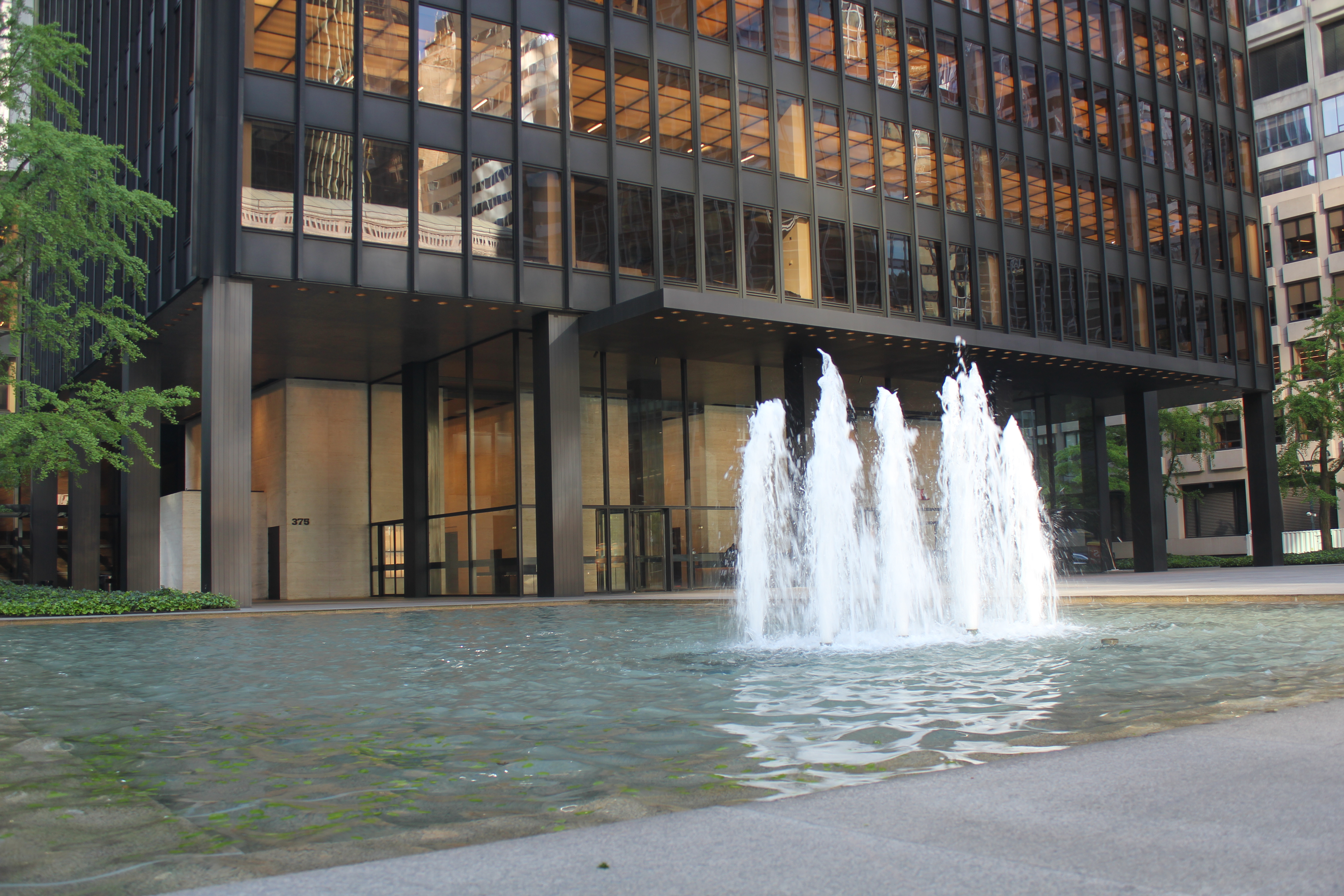
Seagram Building
Phyllis Lambert was 27 years old and living in Paris when she saw the plans for her father's new headquarters. Samuel Bronfman, CEO of the Canadian distiller Seagram, had hired the firm of Pereira & Luckman to design a conventional Park Avenue office tower. Lambert wrote her father a blistering letter, calling the design mediocre. Then she flew to New York, convinced him to hire Ludwig Mies van der Rohe instead, and refused to impose a budget. The result, completed in 1958 at 375 Park Avenue, is arguably the most copied building in New York -- a 515-foot bronze-skinned tower that redefined what a corporate skyscraper could be and altered the zoning laws of the entire city.
Less Is More, in Bronze
Mies van der Rohe, the German-born architect who had led the Bauhaus, brought his philosophy of radical simplicity to Park Avenue. The Seagram Building rises as a clean rectangular slab, 38 stories of glass and bronze mullions without a single decorative flourish. The materials alone set it apart from every building around it. Mies specified extruded bronze for the facade -- the first office building in the world to use the material this way -- and Muntz metal for the horizontal spandrels. The glass is full-height plate, another first for a New York skyscraper. Travertine lines the lobby; marble appears in the restrooms. Lambert had told Mies the building should be "the crowning glory of everyone's work," and neither architect nor patron cut corners. The building cost $41 million in 1958 dollars, making it one of the most expensive skyscrapers of its era.
The Gift of Empty Space
What made the Seagram Building revolutionary was not just what Mies built, but what he left out. The tower occupies only half its site, set back 90 feet behind Park Avenue behind a pink-granite plaza with twin fountains. In an era when developers squeezed every square foot of rentable space from their lots, this retreat from the street was almost scandalous -- and immediately beloved. Office workers ate lunch on the plaza's low walls. Pedestrians cut through on their way uptown. The space became one of the most used public areas in midtown Manhattan. City planners took notice. The Seagram plaza directly inspired the 1961 Zoning Resolution, which offered developers a trade: build a public plaza, and the city would allow additional floor area above. The result reshaped the Manhattan skyline, for better and worse, as towers with plazas -- many far inferior to Mies's -- proliferated across the city.
A Building with Its Own ZIP Code
The Seagram Building sits on land that tells its own story of New York transformation. In the late nineteenth century, the site held the original Steinway & Sons piano factory and brick tenements. The construction of Grand Central Terminal in the early 1900s catalyzed Park Avenue's transformation from a neighborhood of railroad tracks to one of the city's most prestigious commercial corridors. The Montana Apartments, built in 1914 on the piano factory site, stood until the Seagram project assembled the block in the early 1950s. The building was never officially named for Seagram -- legally, it is simply 375 Park Avenue -- but it was assigned its own ZIP code, 10152, one of 41 Manhattan buildings with that distinction. Seagram occupied it as headquarters until 2001. Today it is owned by Aby Rosen's RFR Holding LLC.
Four Seasons and After
The ground floors housed one of New York's most famous restaurants. The Four Seasons, designed by Philip Johnson with interiors that matched the building's minimalist elegance, opened in 1959 and became the city's premier power-lunch destination for nearly six decades. The restaurant's Pool Room and Grill Room were designated city landmarks in 1989 alongside the building's exterior and lobby -- a rare honor for a restaurant interior. When the Four Seasons closed in 2016, the spaces were reimagined as The Grill and The Pool, retaining Johnson's architectural framework while updating the culinary identity. Across the lobby, the Brasserie restaurant occupied another ground-floor space until it was succeeded by the Lobster Club in 1995. The building's relationship with food and socializing was no accident; Mies understood that a great building needs life at street level.
The Most Copied Building in New York
The New York Times called the Seagram Building one of "New York's most copied buildings," and the evidence is visible across the globe. The clean glass-and-steel tower set back behind an open plaza became the default template for corporate architecture in the 1960s and 1970s, from Toronto to Tokyo. In 1989, the New York City Landmarks Preservation Commission designated the exterior, lobby, and Four Seasons interior as official landmarks. The building was added to the National Register of Historic Places in 2006. Lever House, its neighbor across Park Avenue, is often paired with the Seagram as the twin anchors of postwar modernism in New York, but architecture critics consistently regard the Seagram as the finer work -- the building where Mies's maxim "less is more" found its purest expression. Standing on Park Avenue, you can trace the building's influence in every glass tower that followed.
From the Air
Located at 40.758N, 73.972W on Park Avenue between 52nd and 53rd Streets in Midtown Manhattan. The bronze-toned tower is visible among the glass skyscrapers of the Park Avenue corridor. Nearby landmarks include Grand Central Terminal (3 blocks south), Rockefeller Center (4 blocks west), and Central Park (10 blocks north). Closest airports: LaGuardia (KLGA, 7 nm northeast), JFK International (KJFK, 13 nm southeast), Teterboro (KTEB, 11 nm northwest). Best viewed at 2,500-4,000 ft AGL along the Park Avenue corridor.