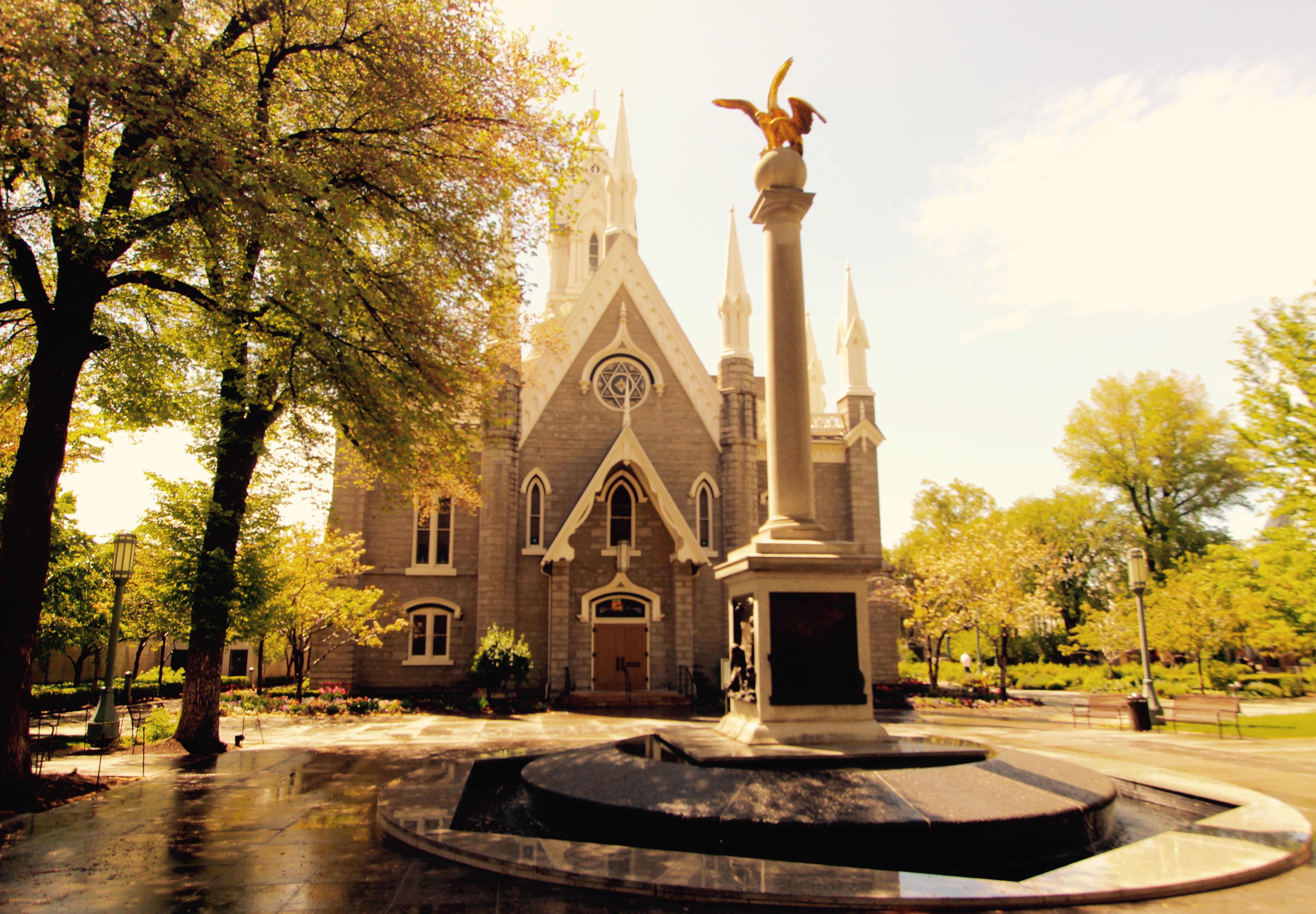
Seagull Monument
At 10:50 on the morning of October 1, 1913, Emmeline B. Wells pulled three cords, and three American flags dropped from atop a granite column on Temple Square. The crowd of 5,000 gasped. Wells, now 85 years old, had been a 21-year-old pioneer woman in 1848 when she witnessed what the flags had concealed: bronze seagulls, wings spread, commemorating the day flocks of California gulls descended on the Salt Lake Valley and devoured the Mormon crickets that were destroying the settlers' first harvest. Believers called it divine intervention. Whatever the explanation, the Seagull Monument became the first monument in the United States dedicated to birds.
Crickets, Prayers, and Wings
The spring of 1848 was the Mormon pioneers' first planting season in the Salt Lake Valley. They had arrived the previous July, following Brigham Young's declaration that this arid basin beneath the Wasatch Mountains would become their home. The crops grew. Then the Mormon crickets came. These large, flightless insects moved across the valley in waves, consuming entire fields of wheat, corn, and vegetables. The settlers fought back with fire, flooding, and beating the insects with sticks and brooms, but the swarms kept coming. According to pioneer accounts, the settlers gathered to pray. Then the gulls arrived, descending in flocks from the direction of Great Salt Lake. They ate until gorged, regurgitated, and ate again. The crickets diminished. Enough of the harvest survived to sustain the settlement through winter. Latter-day Saints remember the event as the Miracle of the Gulls.
The Artist and His Grandfather's Legacy
The sculptor who brought the story to bronze was Mahonri Young, grandson of Brigham Young himself. The idea for a monument originated with George E. Carpenter, an editor at the Deseret News, who commissioned Young to create seagull drawings for the newspaper's 1907 Christmas edition. Young built a model that appeared at that fall's Utah State Fair, sparking immediate interest. But funding proved difficult. Young approached church leadership in 1909, after completing statues of Joseph and Hyrum Smith for Temple Square, but the church was building the Hotel Utah and had no money to spare. Finally, the local Manufacturers and Merchants' Association started a subscription list in 1908, and by 1912 enough funds had accumulated. The granite came from Mount Airy, North Carolina, eight massive pieces forming base, shaft, and capital. Young arrived in September 1913 with the bronze pieces ready for installation.
Choosing the Right Sky
Church leaders initially proposed placing the monument just south of the Salt Lake Temple, but Young rejected the site. The massive temple would dwarf his sculpture, he argued. Instead, he selected a spot near the Salt Lake Assembly Hall, where the open sky could serve as backdrop. Church leaders approved. Excavation began in April 1913, with hopes of dedication on July 24, Pioneer Day. Delays pushed the ceremony to October. When the flags finally fell that morning, they revealed two bronze gulls measuring several feet from wingtip to wingtip, originally gilded with gold leaf and mounted atop a granite ball. Four bronze relief panels around the pedestal tell the story: The Founding of the Commonwealth shows oxen pulling a plow with Mount Olympus in the background. The Arrival of the Sea Gulls depicts a disheartened pioneer looking up as a woman beside him gazes hopefully toward the incoming birds. The First Harvest shows the preserved crops being gathered. A fourth panel carries the dedicatory inscription.
Gulls, Goldfish, and Trout
When first installed, the monument stood surrounded by a circular pool filled with water lilies and goldfish. There was just one problem: live seagulls. The descendants of those celebrated 1848 birds regularly visited Temple Square and discovered that the goldfish, confined to the pool, made easy meals. The church replaced the goldfish with larger rainbow trout in 1944, but an unknown perpetrator repeatedly poisoned the trout with tainted wheat. Eventually, fish were removed entirely. The pool evolved over decades, gaining circular fountains in 1968. For years, visitors tossed coins into the water, which the church periodically collected and donated to nearby Primary Children's Hospital. In 2008, a cascading water feature replaced the pool. The monument was temporarily removed in early 2024 during the multi-year renovation of Temple Square and the Salt Lake Temple. When it returned, the pool had become flower beds, and the gold leaf on the bronze seagulls had been removed, returning them to natural bronze patina.
From the Air
The Seagull Monument stands on Temple Square at coordinates 40.7697N, 111.8928W in downtown Salt Lake City. Temple Square is immediately identifiable from the air by the six-spired Salt Lake Temple and the distinctive domed roof of the Salt Lake Tabernacle. The monument sits east of the Salt Lake Assembly Hall. Salt Lake City International Airport (KSLC) lies 6 nm northwest. The downtown area sits at approximately 4,300 feet elevation. Best viewed from lower altitudes when Temple Square's layout becomes distinct from surrounding city blocks.