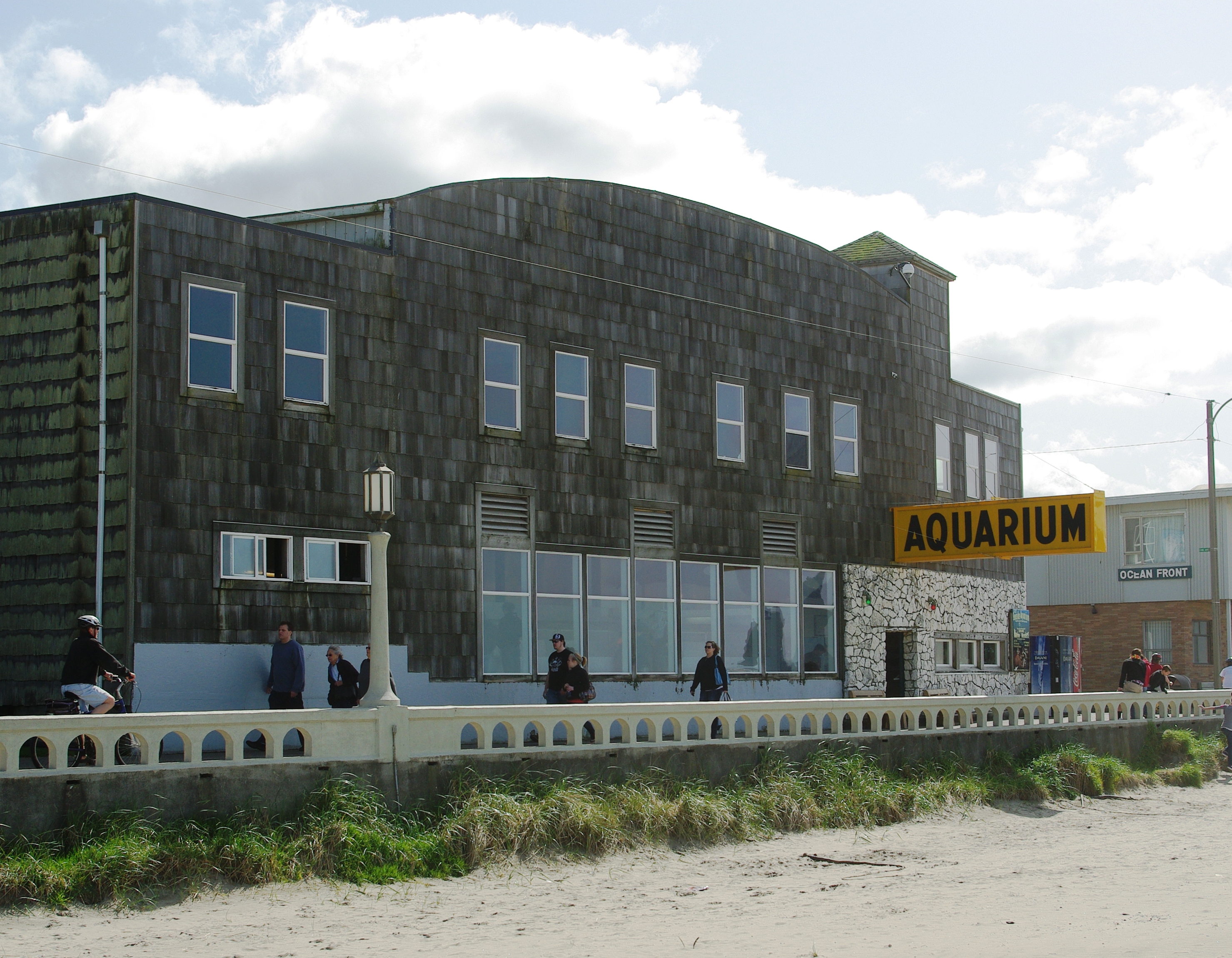
Seaside Aquarium
The pipe is still there. Walk down to the tide line at Seaside, Oregon, and you can see it - a relic of the 1920s, still drawing saltwater from the Pacific Ocean, still doing the job it was built for almost a century ago. What that job serves has changed. When the pipe was installed in 1924, it filled a natatorium - an indoor saltwater swimming pool where vacationers soaked in heated ocean water while spectators watched from balconies above. The Great Depression killed that business within a decade. The building tried on new identities: salmon rearing facility, wrestling venue. Nothing stuck until 1937, when someone had the idea to fill the old pool with marine life instead of swimmers. The Seaside Aquarium opened on May 25 of that year, making it the oldest privately owned aquarium on the West Coast. The pipe kept pumping. It pumps still.
Three Lives of One Building
The natatorium era lasted barely ten years, but it shaped everything that followed. The building's bones - its saltwater plumbing, its pool infrastructure, its proximity to the ocean - made the transition to aquarium not just possible but elegant. Where bathers once floated, tanks now hold wolf eels and moray eels, their elongated bodies curling in water drawn from the same source. Octopuses spread across the glass. Sea stars with twenty arms grip rocks in the display pools. The aquarium reports over 100 species of marine life, housed in a building whose architecture still whispers of its original purpose. The balconies where spectators once watched swimmers now overlook a different kind of spectacle - one that has outlasted the natatorium, the salmon hatchery, and the wrestling ring by nearly nine decades.
A Fish That Crossed an Ocean
In March 2013, a small boat washed up on the shores of Washington state. It had been adrift for two years, swept from Japan by the catastrophic tsunami that followed the 2011 Tohoku earthquake. Inside the hull, impossibly, fish were still alive - trapped in the water that had collected in the boat's compartments, surviving a 4,000-mile Pacific crossing that no one had planned or expected. The sole remaining survivor, dubbed the "tsunami fish," was transferred to the Seaside Aquarium and put on display. It was a strange artifact of one of the deadliest natural disasters of the 21st century, a living reminder that the Pacific connects more than it separates. The fish had made a journey that would have taken the earliest Polynesian navigators weeks, sealed in a fiberglass hull with no provisions and no destination.
Feeding the Seals
Ask anyone who visited the Seaside Aquarium as a child what they remember, and the answer is almost always the same: the seals. Harbor seals have been a fixture here for decades, and the aquarium was the first in the world to successfully breed harbor seals in captivity. Visitors can buy trays of fish and toss them to the seals, who catch them with a snap of the jaw and a spray of whiskers. The seals bark and jostle for position, their dark eyes tracking each hand that reaches into a fish tray. It is not a sophisticated exhibit. It does not pretend to be. But there is something honest about the transaction - the seals want fish, the visitors want connection, and for a few dollars both parties get exactly what they came for. Children return year after year, growing taller while the seals grow rounder, the ritual unchanged.
Salt Water and Staying Power
The Seaside Aquarium has survived by staying small and staying put. It has no corporate parent, no expansion plans, no ambitions to rival the big aquariums in Newport or Portland. It occupies the same building it has always occupied, draws water through the same pipe, and charges admission that families can actually afford. In a coastal town built on tourism, where businesses rise and fall with the seasons, the aquarium's longevity is its own kind of marvel. It has outlasted the Depression, World War II, tsunamis, and the slow churn of coastal economies. The building is older than most of the businesses on Broadway Street. The pipe is older than that. And the ocean keeps delivering, tide after tide, the raw material that makes the whole improbable enterprise work - cold Pacific saltwater, pumped uphill through a pipe that someone had the good sense to install a century ago.
From the Air
Located at 46.00°N, 123.93°W in downtown Seaside, Oregon, on the Promenade along the beachfront. The aquarium building is on the west side of town near the beach. Seaside is identifiable from the air by its grid street pattern, the distinctive turnaround at the west end of Broadway, and the Promenade running along the beach. Nearest airports: Seaside Municipal Airport (56S) approximately 2nm northeast, Astoria Regional Airport (KAST) approximately 12nm north. Best viewed at 1,500-2,500 ft AGL. The town sits at the mouth of the Necanicum River, which is visible as a winding waterway through the coastal plain. Fog and low marine layer common, especially summer mornings.