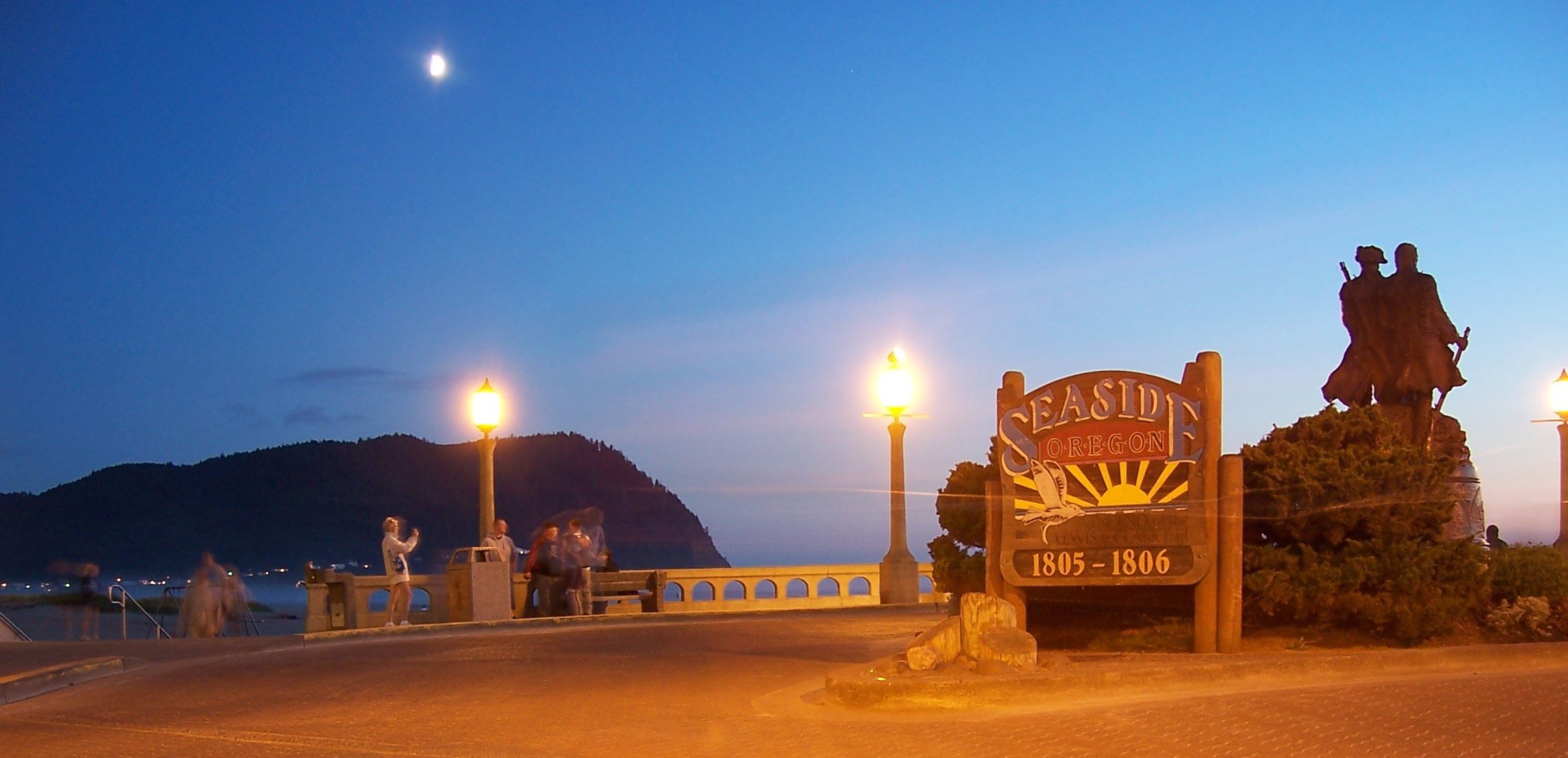
Seaside, Oregon
Five men from the Lewis and Clark Expedition spent nearly two months here in early 1806, tending fires under iron kettles to boil the Pacific into salt. They needed 28 gallons of it to preserve meat for the long journey home. Two centuries later, the city of Seaside still celebrates that desperate labor every September at the Salt Maker's Return festival, re-enacting the tedious, essential work that once kept an expedition alive. The salt cairn is gone, but the ocean that supplied it has never stopped shaping this town.
A Frenchman's Gift to the Shore
Alexandre Gilbert arrived in Seaside by way of the Franco-Prussian War, San Francisco, and Astoria. Born in 1843, he had fought in the conflict that reshaped Europe before crossing an ocean and most of a continent to build a beach cottage on the Oregon coast in 1885. By 1912, Gilbert was mayor of Seaside, but his lasting mark was not political. He donated the land for the city's mile-and-a-half-long Promenade -- the "Prom" -- a concrete walkway that still traces the edge of the Pacific, separating the sand from the town. His cottage, expanded in 1892, survived nearly a century before becoming the Gilbert Inn in the 1980s. His office building, the Gilbert Block on Broadway, still stands in the district that bears his name.
Between River and Rock
Seaside sits at the southern end of the Clatsop Plains, built on both sides of the Necanicum River where it empties into the Pacific. To the south, Tillamook Head rises 1,200 feet in a wall of forested basalt, marking the boundary between the town's broad beaches and the rugged headlands beyond. The Clatsop people called their village here Ne-co-tat, a name in the Chinook language that has mostly faded from use but not from the land itself. The broad, gently sloping beaches still produce millions of Pacific razor clams each year, drawing thousands of diggers to the sand. Surfers work the waves year-round, even in winter, when the water temperature hovers in the mid-forties and the rain falls sideways.
The Barrels in the Hillside
Seismologists estimate a one-in-three chance that a major earthquake and tsunami will strike Seaside within the next fifty years. The city has not waited for certainty. Residents living above the tsunami inundation zone volunteer to store emergency barrels in their homes -- each packed with medical supplies, water purification systems, rations, tarps, and radios, enough to sustain twenty people for three days. By 2017, 119 barrels were distributed across hillside households, with a waiting list of families wanting to participate. In 2016, voters approved $99.7 million in bonds to relocate three schools out of the flood zone, passing the measure 65 to 35 percent. It was an expensive bet on a disaster that may not come for decades, but Seaside knows the Cascadia Subduction Zone does not operate on human timelines.
Sand Courts and Fireworks
For a town of just over 7,000 people, Seaside punches above its weight in spectacle. Its Fourth of July fireworks display is one of the largest on the West Coast. Every August, the Seaside Beach Volleyball tournament -- the second largest in the world -- transforms the waterfront into 192 courts hosting more than 1,800 teams over four days. The Miss Oregon Pageant holds its state finals here at the Civic and Convention Center. Art galleries cluster along Broadway in the historic Gilbert District, and the first Saturday of each month from March through December brings an art walk through town. Even the Seaside Jazz Festival, which for years drew top traditional jazz and swing bands from across the U.S. and Canada, reflected a town that has always understood entertainment is its economy.
Eighty Miles from Portland
Seaside owes its existence to accessibility. Railroad magnate Ben Holladay built Seaside House in the 1870s as a summer resort, and the town that grew around it was incorporated in 1899. Today, U.S. Route 26 delivers Portland's population 79 miles to the coast in under two hours, making Seaside the closest beach to Oregon's largest city. That proximity has defined its character: part resort, part year-round community, part escape valve for an urban population that needs salt air the way Lewis and Clark's expedition needed salt. The town's mean high temperature in August barely reaches 68 degrees, a relief from the Willamette Valley's summer heat, though the hottest day on record -- 95 degrees on September 23, 1943, and again on September 24, 1974 -- proves the coast is not immune to the unexpected.
From the Air
Seaside lies at 45.99N, 123.92W on the Oregon coast, at the southern end of the flat Clatsop Plains. From the air, look for the grid of the town nestled between the Pacific shoreline and the Necanicum River, with the dramatic wall of Tillamook Head (1,200 ft) rising immediately to the south. Seaside Municipal Airport (56S) serves the town. Astoria Regional Airport (KAST) is approximately 15nm to the north. Portland International (KPDX) is 80nm to the southeast. Expect low ceilings and marine fog, especially in winter and spring.