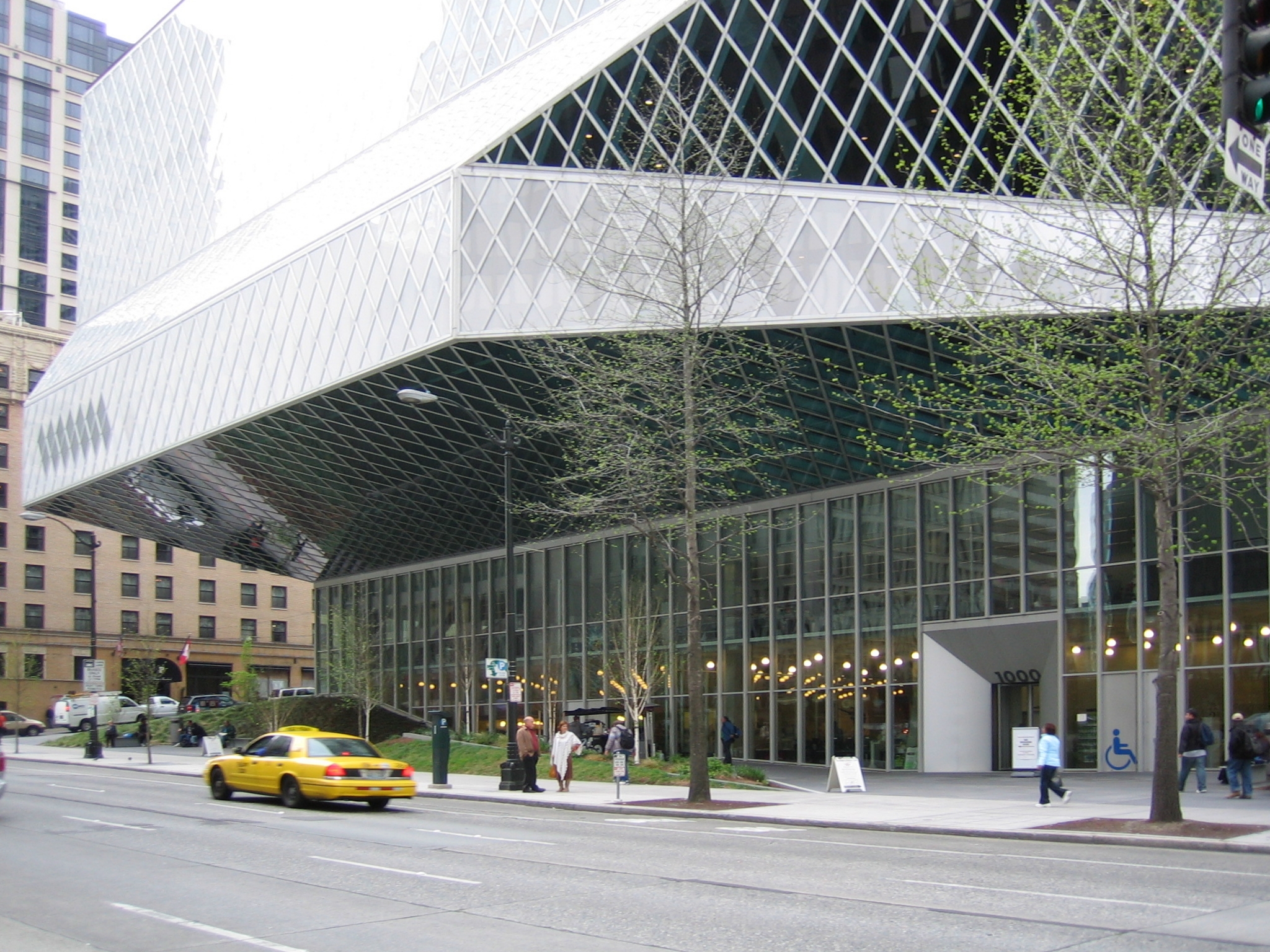
Seattle Central Library
Joshua Prince-Ramus found out from his mother. One day before the Seattle Public Library board held a mandatory meeting for firms interested in designing a new central library, Ramus -- a former Seattle resident working for the Dutch architecture firm OMA -- got a tip and flew in. OMA was not even on the invited list. They won the project anyway. The building that emerged from that last-minute flight opened on May 23, 2004, and immediately became one of the most debated structures in American architecture: an 11-story, 185-foot glass and steel creation that looks like a crumpled diamond wrapped in fishnet, sitting on the same city block where Seattle has housed its library for over a century.
Three Libraries, One Block
The block bounded by Fourth and Fifth Avenues and Madison and Spring Streets has held a library since 1906, when the Seattle Carnegie Library opened on December 19 with a Beaux-Arts design by Peter J. Weber. Andrew Carnegie himself donated $200,000 for its construction -- the first of six Carnegie libraries he would fund in Seattle. But the city kept outgrowing its reading room. The Carnegie building survived until the 1949 Olympia earthquake damaged its structure, and the growing population made it hopelessly cramped. It closed on March 22, 1957, and was demolished that July. A second library, five stories of international-style architecture by Bindon and Wright, opened on the same site on March 26, 1960, featuring innovations like drive-thru service to compensate for scarce parking. Sculptor George Tsutakawa installed his Fountain of Wisdom on the Fifth Avenue side -- the first of his many sculptural fountains. By the late 1990s, history repeated: two-thirds of the collection sat in storage inaccessible to patrons, and seismic concerns made the building a liability.
Libraries for All
On November 3, 1998, Seattle voters approved a $196.4 million bond measure called Libraries for All, funding a new central library and construction projects across the system. Bill Gates added a $20 million donation. The architects Rem Koolhaas and Joshua Prince-Ramus of OMA, working with Seattle's LMN Architects, approached the project with a counterintuitive conviction: in the digital age, people still respond to books printed on paper. They designed a building with capacity for over 1.5 million volumes, up from 900,000 in the old library. Bjarke Ingels, who would later become one of the world's most prominent architects, designed the interior boxes for OMA. The second library closed on June 8, 2001, and demolition began that November while a temporary library operated out of the Washington State Convention and Trade Center.
The Books Spiral
The building defies easy description from outside -- several discrete floating platforms seemingly wrapped in a steel net around a glass skin. Inside, the logic reveals itself floor by floor. The first level holds a lobby, children's center, and the Microsoft Auditorium seating 275. The third level, named the Norcliffe Foundation Living Room, offers a cafe, gift shop, and teen center. The fourth level -- the Red Floor -- uses 13 shades of red paint across its surfaces and houses meeting rooms and computer labs. The fifth level, the Charles Simonyi Mixing Chamber, provides 338 computer stations. But the signature feature is the Books Spiral: four stories of continuous shelving spanning the sixth through ninth floors, with a maximum slope of two degrees, designed so the entire nonfiction collection flows in unbroken Dewey Decimal order without being split across separate floors. It is a library that treats its books as a river rather than a series of ponds.
Masterpiece or Mistake
The numbers were undeniable: 2.3 million visitors in the first year, more than double the predicted volume, with roughly 30 percent coming from outside Seattle. The library generated $16 million in new economic activity for its surrounding area. Paul Goldberger of The New Yorker called it "the most important new library to be built in a generation, and the most exhilarating." The American Institute of Architects voted it number 108 on their list of Americans' 150 favorite structures. It won a 2005 national AIA Honor Award. But the backlash was equally pointed. The Seattle Post-Intelligencer's architecture critic Lawrence Cheek revisited the building in 2007 and reversed his earlier praise, calling it "confusing, impersonal, uncomfortable, oppressive." The Project for Public Spaces condemned how the building sealed itself away from the surrounding sidewalks, failing as a community hub. Researchers later published an entire book examining why visitors found the building so difficult to navigate.
The Diamond on Fourth Avenue
The debate over the Seattle Central Library may never resolve, and perhaps that is the point. Great buildings provoke strong reactions precisely because they refuse to be ignored. What is beyond argument is the building's ambition: a public library in a digital age that bet its future on the physical book and won -- at least by the metric of feet through the door. It stands on a block where Seattleites have come to read since 1906, the third structure built for the same purpose on the same ground. George Tsutakawa's Fountain of Wisdom, moved from the Fifth Avenue side of the old library to Fourth Avenue, still flows outside. The architects set out to make a library that felt inviting rather than stuffy, a building whose form followed the functions it needed to serve rather than the other way around. Whether they succeeded depends on whom you ask. But 185 feet of glass and steel rising from Fourth Avenue ensures that everyone has an opinion.
From the Air
Located at 47.607°N, 122.333°W in the heart of downtown Seattle, occupying the block between Fourth and Fifth Avenues and Madison and Spring Streets. The building's distinctive angular glass-and-steel form makes it instantly recognizable from the air -- its faceted diamond shape stands out sharply against the rectangular grid of surrounding buildings. Nearby airports: KBFI (Boeing Field, 3 nm south), KSEA (Seattle-Tacoma International, 11 nm south). Best viewed at 2,000-4,000 ft AGL. The library sits roughly 6 blocks north of King Street Station and Pioneer Square. On clear days, the glass panels catch sunlight in ways visible even from moderate altitude.