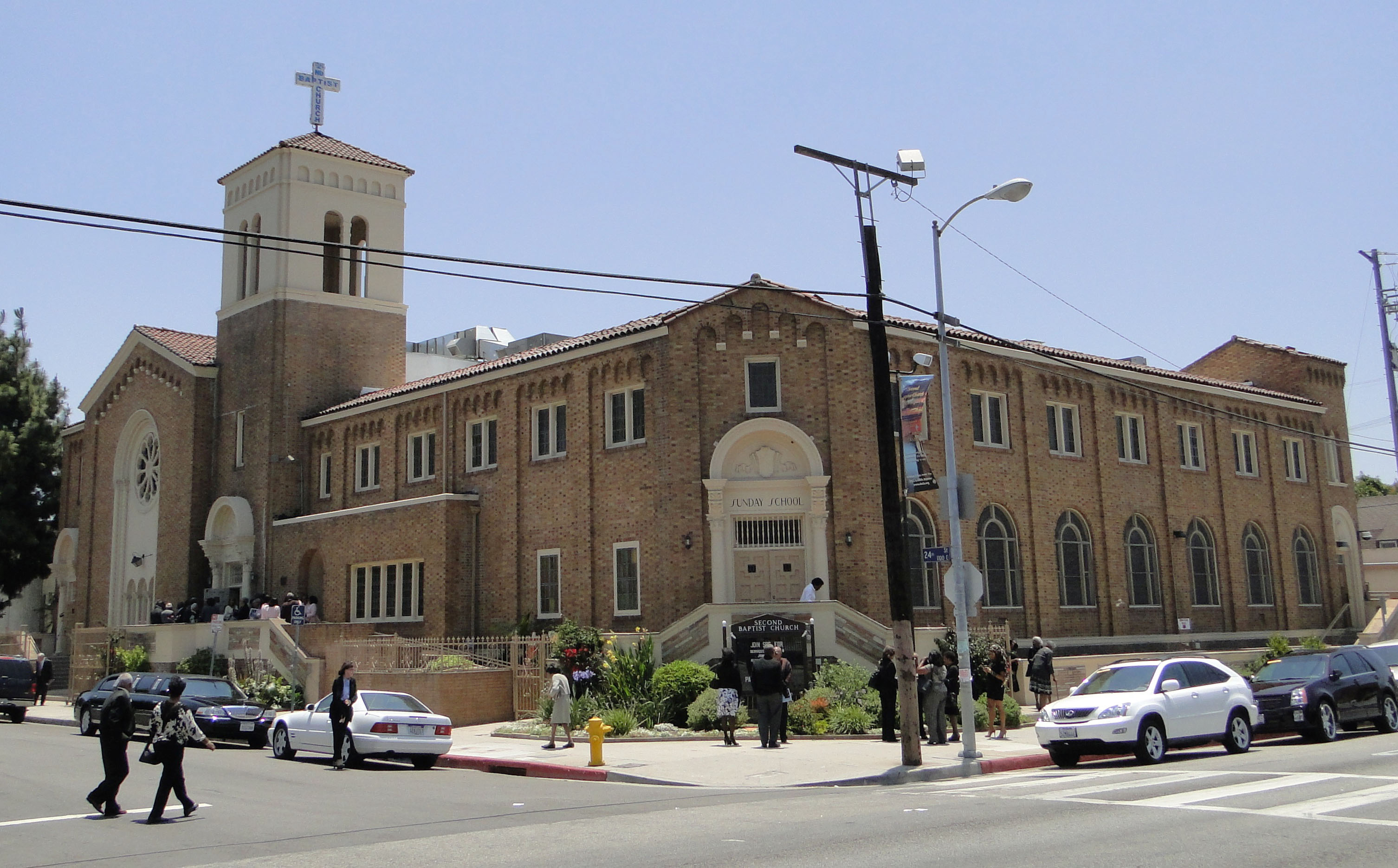
Second Baptist Church, Los Angeles
In a city without Carnegie Hall, without the churches of Harlem, without the long-established institutions of the Black East, Second Baptist Church became its own thing: a place where Los Angeles's African American community brought its aspirations, its grief, its organizing energy, and eventually, its most important guests. Martin Luther King Jr. stood at this pulpit twice.
Architecture of Aspiration
The current sanctuary was completed in 1926, built at a cost of approximately $175,000 — a substantial sum for a congregation in South Los Angeles during the 1920s. The design came from Paul R. Williams, the African American architect who would go on to design private homes for Frank Sinatra and Lucille Ball, commercial buildings across the city, and the international terminal at LAX. Working with architect Norman Marsh, Williams created a Lombardy Romanesque Revival building that could seat more than 2,000 people.
The choice of Williams was significant. Second Baptist's congregation was building for the future, investing in the proposition that the Black community of Los Angeles deserved institutions of genuine grandeur — not improvised spaces but permanent, beautiful ones designed by someone who understood what that beauty meant.
The building's scale and style communicated something to the neighborhood and to the city: that this congregation was serious, that it was here to stay, that its spiritual and civic life would be conducted in a space worthy of both.
Where History Gathered
The NAACP held its national convention at Second Baptist in 1928 — the first time that convention had been held west of the Mississippi. It returned in 1942 and 1949. The choice of Los Angeles, and of this church, was a statement about the growing importance of the West Coast Black community and about Second Baptist's status as the community's preeminent institution.
On July 12, 1961, Freedom Riders departed from Second Baptist — activists who would travel south to challenge the segregation of interstate bus terminals, knowing they faced violence. The church that sent them off was performing the function that churches have always performed in moments of crisis: gathering courage, providing blessing, marking the seriousness of what the departing travelers were undertaking.
Martin Luther King Jr. spoke here on February 16, 1964. He returned on March 17, 1968 — two weeks before he was assassinated in Memphis. The congregation that heard him in 1968 was hearing a man who knew he was in danger and had chosen to continue his work anyway.
An Open Door
In January 1953, Second Baptist Church officially opened its membership to people of all races — a decision that preceded the Civil Rights Act by more than a decade and that reflected the theology the congregation had always practiced: that the Gospel does not discriminate, and that a church that does is preaching something other than the Gospel.
The building was designated a Los Angeles Historic-Cultural Monument in 1978 and added to the National Register of Historic Places in 2009. These designations recognize what the congregation already knew: that the building is not merely a place of worship but a historic site, a place where decisions were made and words were spoken that changed the course of events.
Second Baptist Church remains an active congregation in South Los Angeles. The sanctuary designed by Paul R. Williams still stands, its Romanesque arches framing a space that has held a century of community life — grief and celebration, organizing and prayer, the specific courage of people who did not wait for history to happen to them.