Second Battle of Charleston Harbor
The calcium floodlights snapped on, and the Confederate defenders of Fort Wagner suddenly could not see. It was the summer of 1863 on Morris Island, a narrow spit of sand guarding the southern approach to Charleston Harbor, and the Union army was unveiling weapons that belonged more to the twentieth century than the nineteenth. While engineers dug zigzag trenches through waterlogged sand toward the fort's walls, blinding electric-white light pinned down the defenders so they could not shoot back accurately. Alongside the sappers, gunners deployed the Requa gun - twenty-five rifle barrels bolted to a single field carriage, an ancestor of the machine gun. After two bloody frontal assaults on Fort Wagner had failed, Major General Quincy Adams Gillmore had decided to take the fort the slow, grinding way. What followed was a sixty-day siege that reduced Charleston Harbor's defenses to rubble but never quite captured the city itself.
Digging Through the Dead
The siege began in earnest after the disastrous Second Battle of Fort Wagner on July 18, 1863, when Union forces lost over a thousand men in a frontal charge against the sand-and-palmetto fort. Gillmore's sappers began digging approach trenches, but Morris Island fought back. The sandy ground was shallow, underlaid by sticky marsh mud that made the trenches collapse. Worse, as the shovels bit deeper, they began uncovering the bodies of Union soldiers killed in the earlier assaults - men who had been hastily buried in the sand after the failed charges. Disease and fouled water plagued both sides. The Union army rotated troops through the forward trenches in shifts called the grand guard. During the evening of August 16, a Confederate shell burst through the bombproof headquarters, striking Colonel Joshua B. Howell in the head. He survived, but the incident convinced Gillmore to use only veteran troops in the most exposed positions.
The Swamp Angel Speaks
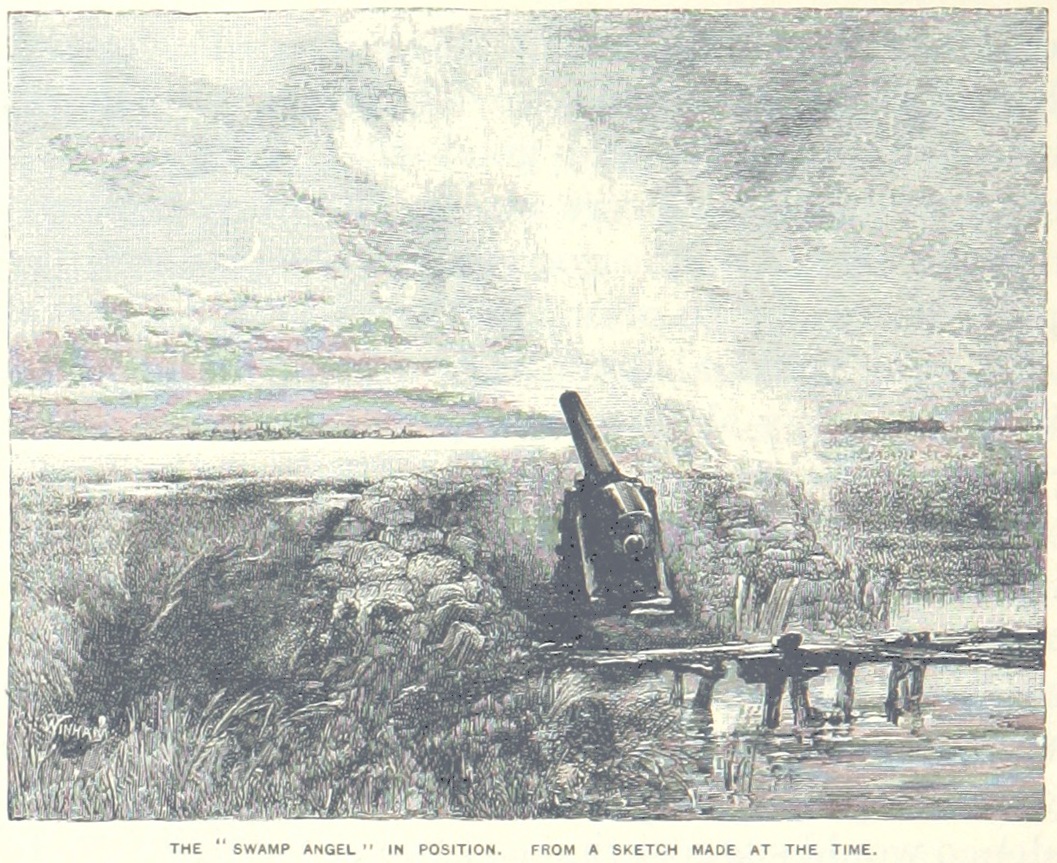
While the siege trenches inched toward Fort Wagner, Colonel Edward W. Serrell's engineers began an audacious side project on August 2. Deep in the marshes behind Morris Island, they constructed a massive artillery battery sunk into the swamp. By August 17, the platform was ready for its weapon: a 200-pound Parrott rifle that the soldiers christened the Swamp Angel. On August 21, Gillmore sent an ultimatum to Confederate General P.G.T. Beauregard - abandon Forts Wagner and Sumter, or Charleston itself would be shelled. Beauregard did not reply. The next day, using the steeple of St. Michael's Church as a bearing, the Swamp Angel fired its first round into the city of Charleston. It was the first time in the Civil War that a civilian population had been deliberately targeted for military purposes. Beauregard was outraged, demanding time to evacuate citizens. Gillmore granted a brief cease-fire but reminded Beauregard that Charleston was a legitimate military target as an ammunition supply hub. When firing resumed, the massive Parrott rifle held together for thirty-six shots before bursting apart. It was never replaced during the campaign.
Sumter Crumbles
By mid-August, Gillmore's batteries were within range of Fort Sumter itself, the island fortress where the Civil War had begun two years earlier. On August 17, Union guns opened fire. Nearly a thousand shells slammed into the masonry walls on the first day alone. By August 23, the once-imposing brick pentagon had been pounded into a shapeless heap of rubble. Beauregard pulled out as many guns as he could salvage. Gillmore telegraphed the War Department a triumphant dispatch: "Fort Sumter is a shapeless and harmless mass of ruin." He was half right. The fort was certainly shapeless, but it was far from harmless. Confederate forces stayed inside the rubble, using the ruined walls as improvised fortifications. The bombardment of Fort Sumter would continue off and on until December 31, 1863, but the garrison refused to leave.
Sixty Days and a Hollow Victory
Gillmore's attention returned to Fort Wagner. On August 25, General Thomas G. Stevenson personally led the 24th Massachusetts Infantry forward to capture Confederate rifle pits, with each soldier carrying two extra shovels to rebuild the positions as soon as they were taken. The attack overran the 61st North Carolina Infantry. The Union siege lines crept closer. On September 5, a thirty-six-hour bombardment killed 100 of the fort's remaining defenders. Colonel Lawrence M. Keitt, the garrison commander, reported to Beauregard that he had only 400 men left who could still fight. On the evening of September 6, Beauregard ordered the evacuation of Morris Island. Union troops walked into an empty Fort Wagner on September 7. The fort had held for sixty days against constant bombardment and a far larger army. The Union had captured a critical position at the mouth of Charleston Harbor and reduced Fort Sumter to rubble - yet Charleston itself remained in Confederate hands until Sherman's armies marched through South Carolina in 1865.
From the Air
Located at 32.75°N, 79.87°W on Morris Island at the southern entrance to Charleston Harbor. Morris Island is now uninhabited and only accessible by boat. Fort Wagner's exact site has been largely eroded by the ocean, but the island is visible from the air as a narrow sandbar south of Folly Beach. Fort Sumter sits in the harbor about 1.5 miles to the north-northeast. Fort Moultrie on Sullivan's Island is visible across the harbor mouth to the north. James Island lies to the west. Charleston International Airport (KCHS) is approximately 14 miles to the northwest. The geography of the harbor - the narrow entrance guarded by forts on multiple islands - is clearly visible from altitude and explains why Charleston was so difficult to capture.