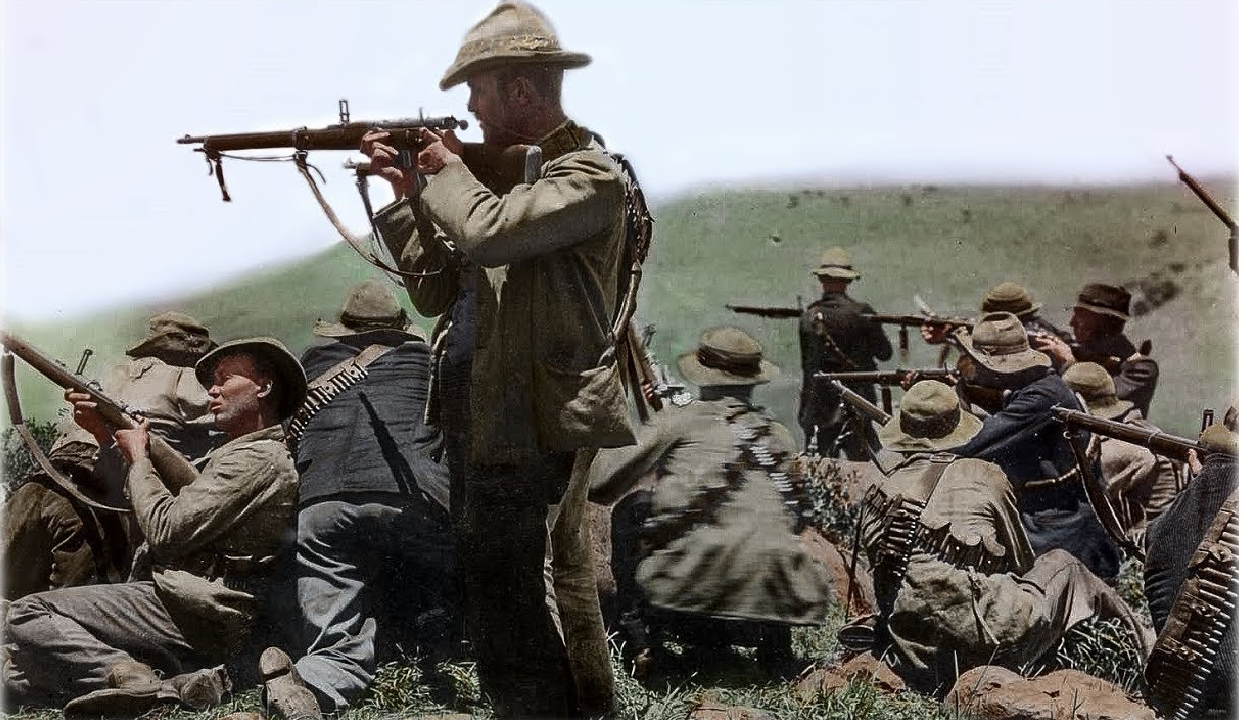
Second Battle of Colenso
Lieutenant Frederick Roberts was twenty-seven years old and the only son of Field Marshal Lord Roberts, the most decorated soldier in the British Empire. On 15 December 1899, at Colenso in Natal, he volunteered to ride into open ground swept by Boer rifle fire and hook a team to one of twelve abandoned field guns. He managed to help recover two of them. Two days later he died of his wounds. His father, already en route to South Africa to take overall command of the war, learned the news at sea. The younger Roberts received the Victoria Cross, one of four awarded that day. The guns he tried to save became the battle's most enduring symbol -- not of heroism, but of how badly things had gone wrong.
A Map That Lied
General Sir Redvers Buller had arrived in South Africa at the head of an army corps, only to find British garrisons besieged on three widely separated fronts. He sent Lord Methuen west to relieve Kimberley and Gatacre to the central front, then led his largest force -- 20,000 men -- toward Ladysmith, where 8,000 British soldiers were surrounded. The Boers under Louis Botha had dug in along the northern bank of the Tugela River at Colenso, blocking the road and railway to the besieged town. Buller originally planned to cross the Tugela 80 kilometres upstream at Potgieter's Drift, but defeats at Stormberg and Magersfontein rattled him. Needing a quick victory, he decided on a frontal assault at Colenso -- armed with only a crude sketch map based on farm surveys and a railway blueprint. That map showed a stream called the Doornkop entering the Tugela east of a loop in the river. In reality, it entered from the west. The error would funnel an entire brigade into a killing ground.
Three Fronts, Three Failures
Botha deployed nine commandos with elegant simplicity: his main force along the river's northern bank, a flanking force on Hlangwane hill south of the river to enfilade any crossing attempt, and a reserve to attack from upstream. He ordered his men to hold fire until the British were crossing or about to cross. On the left, Major General Arthur Fitzroy Hart led the 5th (Irish) Brigade in close column toward the Bridle Drift. His guide, a local recruit who spoke no English, led them instead toward the Punt Drift at the end of the river loop -- exactly the trap Buller's faulty map had made invisible. Botha's men opened fire into the packed column. Hart's brigade suffered over 500 casualties before they could be pulled out, with Hart repeatedly recalling battalions that tried to extend leftward to find the correct ford. In the center, Colonel Long pushed his two field batteries so far ahead of the infantry that they were within rifle range of the Boer trenches. The gunners fought until they ran out of ammunition, then crawled to a donga behind the guns. On the right, colonial light horse were pinned at the foot of Hlangwane, unable to advance.
Saving the Guns
By midmorning, Buller took personal command from General Clery. The situation was clear: Hart's brigade was shattered, Long's guns were stranded in the open, and the mounted troops on the right were going nowhere. Buller called the battle off -- even though Hildyard's 2nd Brigade, advancing in open order, had actually occupied the village of Colenso. He went forward himself, was slightly wounded, and called for volunteers to recover Long's abandoned artillery. Two teams of men and horses rode out under concentrated Boer fire. They managed to hook up and drag away two of the twelve guns. A second attempt failed when the horses and volunteers were shot down. During the afternoon, the British fell back to their camp. They left ten guns, many wounded, and some of Hildyard's men to be captured overnight. Buller had committed few of his reserves, reasoning that a full day in the boiling South African sun had sapped whatever fight remained. The cautious General Barton refused to support the hard-pressed troops on the right flank.
The Arithmetic of Black Week
The final accounting was stark. British casualties: 143 killed, 756 wounded, 220 captured. Boer casualties: eight killed, 30 wounded. The disparity was extraordinary even by the lopsided standards of the Second Boer War, and it closed out the worst week in recent British military memory. Stormberg on the 10th, Magersfontein on the 11th, Colenso on the 15th -- three battles, three humiliations, a pattern of frontal assaults against entrenched positions defended by marksmen with modern rifles. The press called it Black Week. Within days, Lord Roberts replaced Buller as Commander-in-Chief in South Africa, though Buller kept command in Natal. Four Victoria Crosses were awarded for the attempt to recover the guns: Captain Walter Congreve, Captain Harry Norton Schofield, Corporal George Nurse, and Lieutenant Frederick Roberts, who did not live to receive his.
Back to the River
Colenso was not the end but the beginning of Buller's ordeal. Over the next ten weeks, he tried to outflank the Boer positions by crossing the Tugela upstream -- first at Spion Kop, where British soldiers seized a hilltop they could not hold, then at Vaal Krantz, where they were repulsed again. Eventually Buller returned to Colenso itself and, in the Battle of the Tugela Heights in late February 1900, laboriously outflanked and captured Hlangwane -- the hill his men had been unable to take in December. Even then, ten more days of fighting were needed before Botha's forces broke and retreated. Ladysmith was finally relieved on 28 February 1900. The battle at Colenso had exposed in brutal clarity the gap between imperial confidence and colonial reality -- between the assumption that disciplined European infantry could carry any position, and the firepower of entrenched farmers who knew their ground.
From the Air
Colenso lies at 28.73S, 29.82E in KwaZulu-Natal, where the railway from Durban to Johannesburg crosses the Tugela River. From the air, the river's loops and bends are clearly visible -- including the fatal loop where Hart's Irish Brigade was trapped. Hlangwane hill rises south of the river; the Boer trench lines ran along the northern bank kopjes. Ladysmith is about 20 km to the north-northwest. The terrain is rolling grassland with rocky kopjes, cut by the river valley. Nearest airports: Ladysmith (FALY) and Pietermaritzburg (FAPM). Best viewed at 3,000-6,000 ft AGL to appreciate the river crossings, the relative positions of Hlangwane and the kopjes, and the flat southern approach the British had to cross under fire.