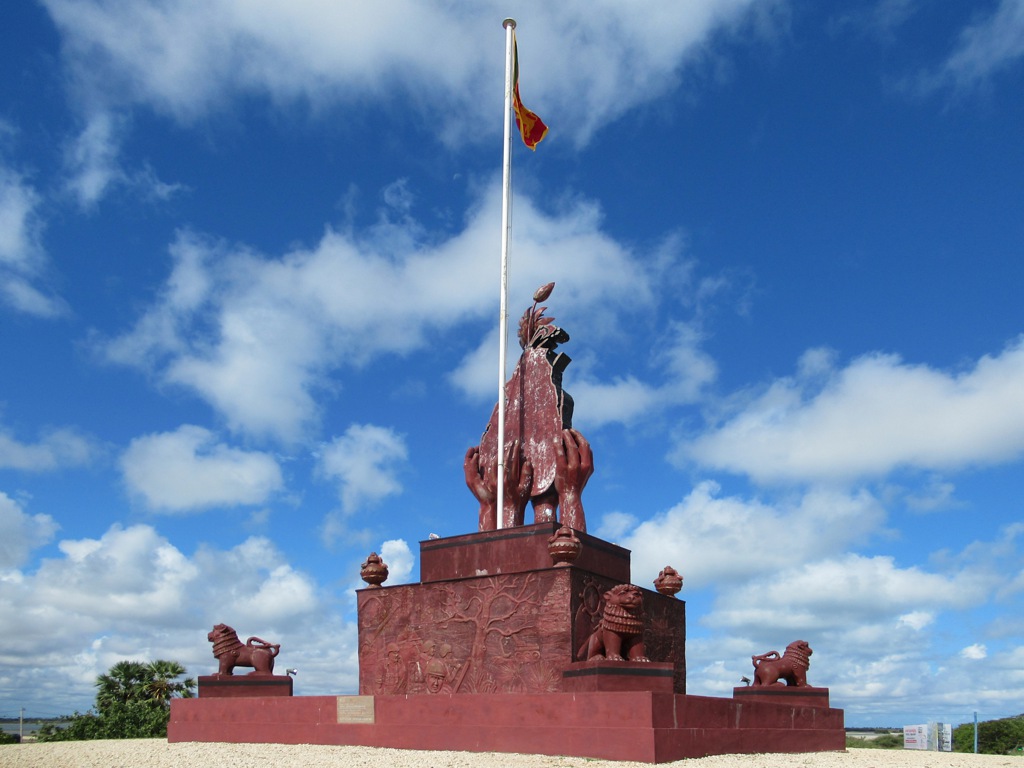
Second Battle of Elephant Pass
When the 9th Gajaba Battalion withdrew from Iyakkachchi, its fighting capacity had been reduced from 800 soldiers to 130 in a matter of hours. Over 70 were dead. More than 600 were wounded. The battalion had breached the first LTTE defensive line but then found itself trapped in the no-man's-land between the first and second lines, caught in pre-registered fields of fire with no way forward and no safe way back. This was not a skirmish at the margins of a war. This was the fall of Elephant Pass -- the largest military debacle in the history of the Sri Lankan Armed Forces, a defeat so complete that the president asked India to help evacuate 35,000 troops from the Jaffna Peninsula.
A Strategy of Strangulation
LTTE leader Prabhakaran had learned from the first battle in 1991, when a frontal assault cost hundreds of fighters and ultimately failed. This time, the strategy was patience. Rather than storm the base directly, the LTTE would encircle Elephant Pass, cut its supply lines, and strangle it slowly. By late 1999, the Sri Lanka Army had expanded the base into a complex of military installations under the 54th Division, with over 5,000 personnel. The forward defense line extended to Paranthan. But the LTTE had been steadily reversing government gains -- recapturing Kilinochchi in 1998, halting Operation Jayasikurui with forces led by the eastern commander Karuna Amman. The tide had turned, and Elephant Pass, for all its fortifications, was increasingly exposed.
The Wells of Iyakkachchi
The decisive blow fell in April 2000, and it was about water. Black Tiger assault units stormed the Iyakkachchi military base in a multi-pronged attack during the early morning hours. After several hours of intense fighting, they overran the well-fortified camp, destroying artillery, tanks, armored vehicles, and ammunition stores. The capture of Iyakkachchi was not merely a territorial gain. Located at Iyakkachchi were the only freshwater wells that supplied both Elephant Pass and Paranthan. Without water, the base's position became untenable. Major General Egodawela's 54th Division attempted to recapture Iyakkachchi from the south but failed. The two fresh battalions airlifted from Vavuniya -- the 1st Sinha and the 9th Gajaba -- were thrown into a counterattack that breached the first LTTE line but could not penetrate the second, suffering catastrophic casualties in the killing ground between them.
An Army Considers Evacuation
By May 9, Deputy Defence Minister Anuruddha Ratwatte reported the scale of the disaster: 758 soldiers killed, 2,368 wounded, 349 missing since the battle for Elephant Pass had begun on April 22. Opposition leader Ranil Wickramasinghe claimed 300 soldiers had been captured by the LTTE, who later handed over 126 bodies to the International Committee of the Red Cross. The LTTE's rapid advance raised the terrifying prospect that 35,000 Sri Lankan troops on the Jaffna Peninsula could be cut off entirely. President Chandrika Kumaratunga requested Indian assistance to evacuate the army from Jaffna. India declined. In the days before the base fell, Kumaratunga reshuffled the military command structure, placing retired Chief of Defence Staff Rohan Daluwatte in overall charge and appointing General Sarath Fonseka as Jaffna Commander.
Victory, Then the Limits of Victory
The LTTE pushed toward Jaffna after capturing Elephant Pass, gaining footholds at Chavekachechri and Ariyalai. But the peninsula's defensive geography now worked against them. Sri Lankan forces, well supplied with heavy artillery and air support, held defensive lines that offered the LTTE little tactical leverage. The fighters suffered heavy casualties from artillery and airstrikes and were eventually forced to retreat to the Muhamalai and Nagarkovil lines. In September 2000, the army launched Operation Agni Keila to recapture lost territory, but the narrow strips of land the troops had to cross were pre-registered by LTTE artillery and extensively booby-trapped. The counteroffensive stalled. Elephant Pass remained in LTTE hands for nearly nine years. When the Sri Lankan Armed Forces finally retook it on January 9, 2009, it came during the war's final offensive -- a campaign that would end in May 2009 with the complete defeat of the LTTE. The pass that three empires had fortified and two sides of a civil war had fought over three times was, at last, quiet.
From the Air
Located at 9.55N, 80.41E on the narrow causeway linking the Jaffna Peninsula to the Sri Lankan mainland. The strategic chokepoint is clearly visible from altitude: a thin strip of land flanked by lagoons, with the A-9 Highway and railway running through. A post-war monument now stands at the site. From the air, the contrast between the Jaffna Peninsula to the north and the mainland to the south makes the bottleneck geography unmistakable. Jaffna International Airport (VCCJ) is approximately 30 nautical miles north. Palaly Air Force Base is nearby. The flat, low-lying terrain surrounding the causeway shows how difficult it would be to advance through such confined space under fire.