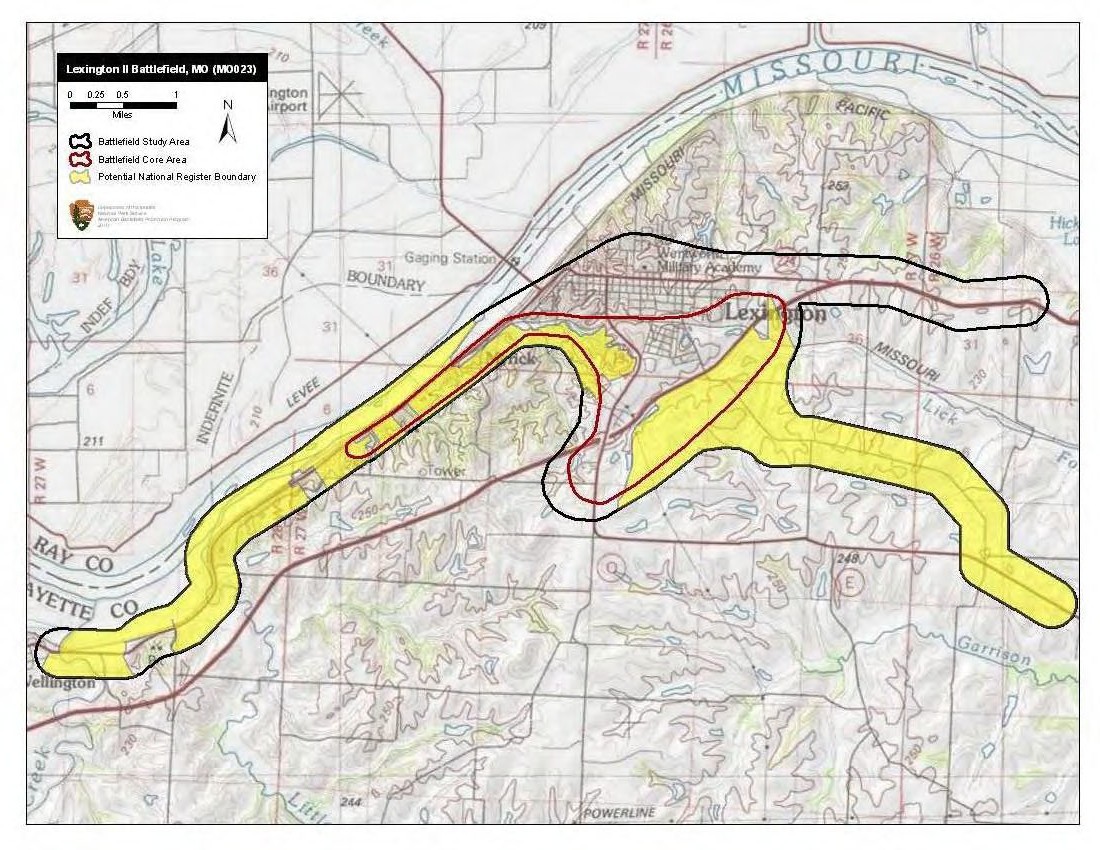
Second Battle of Lexington
Kansas politics almost handed Sterling Price a victory without a fight. By October 1864, the Confederate general was marching 17,000 men westward along the Missouri River, yet Kansas Governor Thomas Carney delayed calling up the state militia for weeks -- not because the threat was unclear, but because he suspected the mobilization was a political ploy to keep his supporters away from the polls on election day. By the time Union Major General James G. Blunt reached Lexington, Missouri, on October 18 with just 2,000 men and eight mountain howitzers, he was operating without the reinforcements that partisan bickering had held back.
Price's Desperate Gamble
Sterling Price's Missouri Expedition was born of desperation. By September 1864, the Confederacy was losing on every front. The Atlanta campaign had tilted the presidential election toward Lincoln, and Confederate General Edmund Kirby Smith could not transfer his Trans-Mississippi infantry east because the Union Navy controlled the Mississippi River. Price convinced Smith that invading Missouri would divert Union forces, spark a popular uprising, and perhaps tip the election toward the peace candidate, George B. McClellan. On September 19, Price's Army of Missouri -- 13,000 cavalrymen, many poorly armed, with only 14 small-caliber cannons -- entered the state. The campaign immediately went wrong. A botched assault at the Battle of Pilot Knob on September 27 cost hundreds of casualties. The defenses at Jefferson City proved too strong to attack. Price turned west, collecting recruits in the pro-Confederate Boonslick region, but these new men were, as one historian described them, 'farm boys, unarmed and ill-prepared.' Successful raids at Glasgow and Sedalia boosted morale and captured weapons, but the sluggish wagon train slowed the army's progress while Union forces closed in from the east.
Two Guns Against Eight
Blunt arrived at Lexington on October 18 and found it nearly indefensible -- open terrain, roads running in from every direction, and the only high ground near the Missouri River at the old Masonic College site where Price had won the first siege of Lexington in 1861. Blunt was sleep-deprived and made few preparations before dark. He deployed Colonel Thomas Moonlight's brigade at the Masonic College and Colonel Charles R. Jennison's troops at a fairgrounds to the south. His eight 12-pounder mountain howitzers were his only artillery. On October 19, Price struck with 17,000 men in three prongs, Shelby's division leading. The Confederate Iron Brigade under M. Jeff Thompson spent three hours deploying before attacking at 2:00 p.m. The battle's decisive factor proved absurdly asymmetric: just two guns from Collins's Missouri Battery, firing rifled artillery, outranged all eight of Blunt's mountain howitzers. Those two Confederate pieces dominated the field.
A Fighting Withdrawal Into Darkness
Despite being massively outnumbered, Blunt's men put up fierce resistance. Jennison's skirmish line held with troops from the 3rd Wisconsin and 15th Kansas Cavalry Regiments. Moonlight's brigade fell back from a cornfield to a ravine near the fairgrounds. Captain Palmer's battalion, deployed three miles east of Lexington, held its position against multiple Confederate assaults and was cut off from the main force for over a day. By 3:00 p.m., Blunt began withdrawing. Shelby had failed to position Jackman's brigade to cut off the Union retreat. Moonlight made a covering stand southwest of the fairgrounds with 500 men and four cannons, leapfrogging defensive positions as the 11th Kansas Cavalry held each line until flanked, then falling back while the artillery covered the retreat. The Confederate pursuit weakened after dark, and fighting ended around midnight as Union troops crossed Sni-A-Bar Creek. Lieutenant Colonel Preston B. Plumb ordered the bridge burned, but Confederates extinguished the fire.
The Beginning of the End for Price
Casualties at Lexington were light -- Union losses estimated at about 40, Confederate losses roughly double that. Both commanders wildly overestimated the opposing force: Blunt thought he had faced 20,000 Confederates, while Price believed he had engaged 3,000 to 4,000 Union troops. But the battle's true significance was intelligence. For the first time since Price entered Missouri, the Union high command had definitive evidence of his exact strength and movements. Blunt retreated to the Little Blue River, fought another delaying action there on October 21, and then fell back to the Big Blue River where Curtis's Army of the Border waited in prepared positions. The trap was closing. On October 22, the battles of Byram's Ford and Second Independence bracketed Price's army. On October 23, the Battle of Westport shattered it. Defeat at Mine Creek on October 25 turned retreat into rout. By the time the survivors reached Texas, Price had lost more than two-thirds of his army. The Confederates never mounted another offensive in the Trans-Mississippi theater.
From the Air
Located at 39.18N, 93.88W at Lexington, Missouri, on the south bank of the Missouri River in Lafayette County. The town is visible from altitude along the river bend. The Masonic College site and courthouse area mark the historical battle positions. Nearest airports include Lexington Municipal Airport (K02K, adjacent) and Whiteman Air Force Base (KSZL, roughly 30nm south). Recommended viewing altitude: 3,000-5,000 ft AGL to see the river position and road approaches that defined the battle. The Missouri River here forms a distinctive bend visible from altitude.