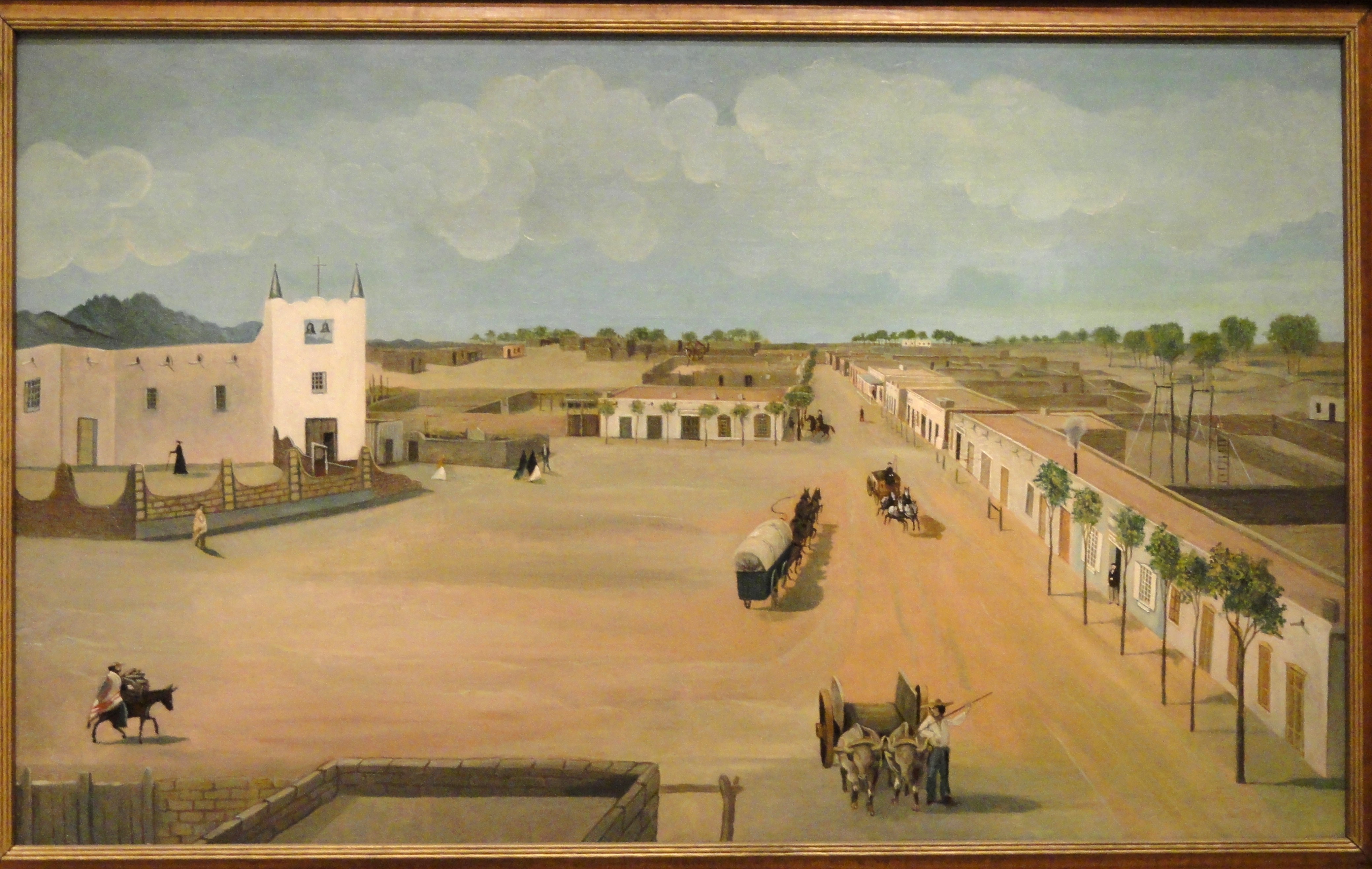
Second Battle of Mesilla
By July 1862, the Confederate dream of a Pacific empire was dying in the New Mexico dust. After defeats at Glorieta Pass and Albuquerque, rebel forces retreated south through the Rio Grande valley, desperate for supplies and increasingly unwelcome. Their capital in the Confederate Arizona Territory was Mesilla, a small town in the Mesilla Valley that had declared for the South just a year earlier. But when starving soldiers began seizing cattle and crops from locals, both New Mexican and Puebloan, the population turned against them. On July 1, 1862, the last engagement between Union and Confederate forces in Arizona erupted in the streets of Mesilla. It was less a battle than a rout, and it marked the end of Confederate ambitions west of Texas.
A Starving Army in Retreat
The Confederate retreat had been brutal. Following their flight from the Battle of Albuquerque and the advance of Union forces from California into Arizona, rebel troops had no supply lines, no reinforcements, and no welcome. Mesilla had served as the capital of Confederate Arizona, but that status meant nothing to hungry soldiers who had lost their campaign. They scoured the surrounding territory, taking what they could from whoever had it. The civilian population, a mix of New Mexicans, Puebloans, and Anglo settlers, watched their crops and livestock disappear into Confederate cookfires. Resentment built quickly. By the time fighting broke out, the rebels had made enemies of the very people they needed for survival.
Death in the Streets
The battle began in the town itself. Accounts are fragmentary, but the violence was real. Twenty citizens of Mesilla died in the fighting, though it remains unclear how many were combatants and how many were caught in crossfire. The skirmishing spread to the outskirts, where New Mexican guerrillas seized two pieces of Confederate artillery and successfully drove the rebels out of the area. Captain Cleaver of the 7th Texas Infantry died in the engagement, along with between seven and twelve other Confederate soldiers. As many as 40 locals may have been killed, making this one of the bloodier moments in a campaign that had largely consisted of maneuver and retreat. The Confederates, outgunned and outnumbered, fled south toward El Paso.
Pursuit and Welcome
The fighting at Mesilla did not end the pursuit. A large party of New Mexicans and Puebloans continued chasing the retreating rebels as they made for the Texas border. The Confederates had made too many enemies to find safe passage. When Union officers finally arrived in Mesilla, they found the population eager to do business. Locals who had hidden money and resources in advance of the Confederate occupation now dug them up and began trading openly. The warm welcome suggested that whatever sympathy for the Southern cause had existed in 1861 had evaporated under the weight of forced requisitions and military desperation. The Civil War in the far Southwest was effectively over.
The Ghost of Confederate Arizona
The Second Battle of Mesilla marked the end of Confederate Arizona as a functioning political entity. The territory had been proclaimed in March 1861 by a convention of secessionists, recognized by the Confederate Congress in January 1862, and defended by forces under Colonel John Baylor. But the ambition outstripped the resources. Confederate Arizona was always more idea than reality, a paper government over a vast, arid, thinly populated region that the South could neither hold nor supply. After July 1862, no Confederate force would ever return to New Mexico. The territory remained under Union control for the rest of the war, and the dreams of a Southern route to the Pacific died in the Mesilla Valley.
The Valley From Above
Modern Mesilla sits just south of Las Cruces, a small historic town centered on a plaza that looks much as it did in 1862. From the air, the Mesilla Valley stretches along the Rio Grande, a ribbon of green irrigated farmland between the Organ Mountains to the east and the desert mesas to the west. The town is visible as a compact cluster of buildings around the central plaza, distinct from the sprawl of Las Cruces to the north. Interstate 10 runs along the southern edge of the valley, roughly following the route Confederate forces took in their flight toward El Paso. The Franklin Mountains mark the Texas border to the south, and beyond them lies the pass where the last remnants of the Confederate Arizona expedition finally escaped New Mexican pursuit.
From the Air
The Second Battle of Mesilla took place at approximately 32.27N, 106.80W in the town of Mesilla, now a historic district south of Las Cruces, NM. The site is at approximately 3,900 feet MSL in the Mesilla Valley along the Rio Grande. Las Cruces International Airport (KLRU) is approximately 5 nm north. The historic plaza is visible as a small cluster of older buildings distinct from surrounding development. Best viewed from the east at 5,000-6,000 feet with the Organ Mountains as backdrop. I-10 traces the Confederate retreat route toward El Paso. Watch for traffic in the Las Cruces Class D airspace.