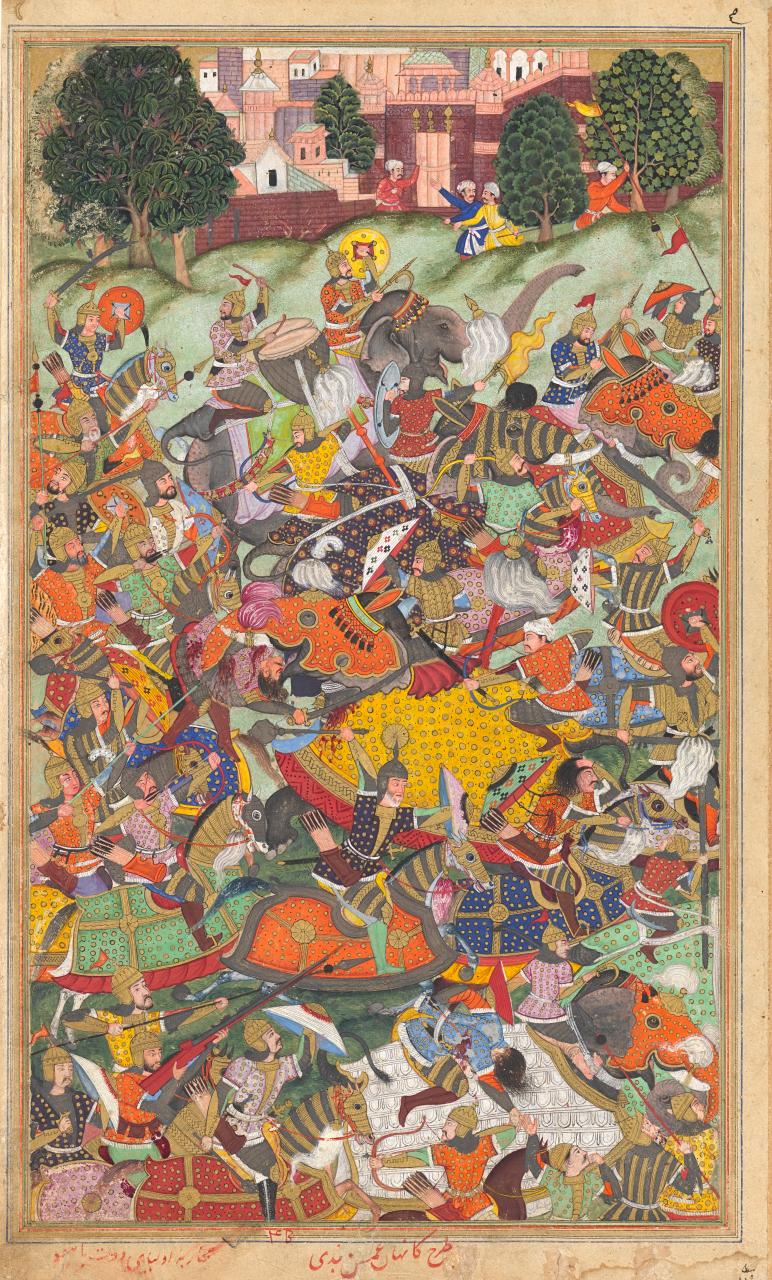
Second Battle of Panipat
Twenty-two battles without a single defeat. That was Hemchandra's record when he rode his war elephant Hawai onto the plains of Panipat on November 5, 1556. Born to humble circumstances in Rewari, he had risen from market trader to chief minister, from chief minister to commanding general, and finally to self-crowned emperor -- taking the ancient title Vikramaditya after seizing Delhi just weeks earlier. Across the field stood an army nominally led by a thirteen-year-old boy named Akbar, whose guardian Bairam Khan had done the real work of marshaling the Mughal forces. The flat, sun-baked ground between them had already hosted one battle that shaped an empire thirty years before. It was about to host another.
An Empire in Pieces
The roots of the battle reach back to 1540, when Sher Shah Suri chased the Mughal emperor Humayun out of India and established the Sur Empire. Sher Shah proved a formidable ruler, but his death in 1545 at Kalinjar set the dynasty on a downward slide. His successor Islam Shah held things together until his own death in 1554, after which the empire fractured into competing factions. Humayun exploited the chaos, defeating Sikandar Shah Suri on July 23, 1555, and reclaiming Delhi and Agra. But Humayun died in January 1556 from a fall down his library stairs, leaving the Mughal throne to his thirteen-year-old son Akbar. That death created an opening Hemchandra was quick to seize. Serving as both chief minister and general to the ineffectual Adil Shah Suri, he launched a rapid campaign from Bengal, sweeping through Bayana, Etawah, Sambhal, and Kalpi. When he reached Agra, the Mughal governor fled without a fight. By October 7, Hemchandra had taken Delhi itself, crowning himself at Purana Quila.
The Guns That Never Arrived
Akbar and Bairam Khan marched south to reclaim Delhi, but they caught a stroke of fortune before the battle even began. Ali Quli Khan Shaibani, sent ahead with ten thousand cavalry, stumbled upon Hemchandra's artillery train moving under a weak guard. The Afghan escorts abandoned their guns and fled. It was a devastating loss. Hemchandra had conquered twenty-two battles in succession partly through the effective use of artillery, and now he would face the Mughals without a single cannon. His army was otherwise formidable: thirty thousand cavalry, five hundred war elephants clad in plate armor and mounted with musketeers and crossbowmen. But firepower at range -- the very advantage that might have shattered a Mughal charge before it closed -- was gone. Akbar and Bairam Khan, meanwhile, positioned themselves eight miles behind the front lines, entrusting the actual fighting to their experienced commanders.
Elephants Against Arrows
Hemchandra opened the battle aggressively, loosing his war elephants against both flanks of the Mughal line. The initial charge was terrifying -- armored beasts crashing through cavalry formations -- but the Mughal soldiers who survived the rampage did not retreat. Instead, they peeled to the sides and began hammering Hemchandra's horsemen with archery. At the center, the Mughal forces advanced to the edge of a deep ravine and held position. Neither Hemchandra's elephants nor his cavalry could cross the chasm, and they stood exposed to withering fire from the far side. Meanwhile, Mughal riders on their faster mounts slipped around the flanks, slashing at elephant legs and picking off their riders. Hemchandra pulled his elephants back, and the Afghan momentum stalled. When Ali Quli Khan saw the attack slackening, he led his cavalry in a sweeping arc, striking the Afghan center from behind. Hemchandra, watching from atop Hawai, drove forward to counter. His lieutenant Shadi Khan Kakar fell. Bhagwan Das fell. Still Hemchandra fought on, and the tide appeared to turn in his favor -- both Mughal wings had been driven back.
One Arrow, One Empire
Hemchandra pressed his advantage, moving his elephants and cavalry forward to crush the Mughal center. He was, by most accounts, on the verge of victory. Then a Mughal arrow -- fired by no one in particular, aimed at no one in particular -- struck him in the eye. He collapsed unconscious in his howdah. The effect was instantaneous. An army that had followed this man through twenty-two consecutive victories watched him slump and vanish behind the walls of his riding platform. Panic rippled outward. Formations broke. Soldiers who moments earlier had been winning turned and ran. Five thousand men lay dead on the field when the fighting ended, and many more were killed in the rout that followed. Hours later, Mughal soldiers captured the elephant carrying the unconscious Hemchandra and brought him to camp. Bairam Khan urged the young Akbar to behead the fallen general. Whether Akbar wielded the sword himself or refused to strike a dying man depends on which chronicler you trust -- the contemporary Qandhari says Akbar did it; the later court historian Abu'l-Fazl says he refused. Either way, Hemchandra was dead, and Akbar claimed the title Ghazi.
What Remained at Panipat
Hemchandra's head was sent to Kabul and displayed outside the Delhi Darwaja. His body was gibbeted at a gate in Purana Quila, the same fortress where he had crowned himself barely a month before. His patron Adil Shah Suri was defeated and killed by a rival in April 1557, ending any hope of a Sur restoration. Among the spoils the Mughals collected were 120 of Hemchandra's war elephants, whose devastating charges had so impressed the victors that elephants soon became a permanent fixture of Mughal military strategy. Akbar, the boy emperor who may or may not have swung the executioner's sword that day, went on to build one of the most expansive and tolerant empires in Indian history. Today, a memorial known as Hemu's Samadhi Sthal marks the spot in Panipat where Hemchandra was killed. The flat Haryana plain around it gives no hint of the carnage that once unfolded there -- just fields stretching to the horizon, the same featureless ground that has drawn armies to Panipat again and again across the centuries.
From the Air
Located at 29.39N, 76.97E on the flat Haryana plains roughly 90 km north of Delhi. The battlefield sits near the modern city of Panipat, visible from altitude as dense urban fabric surrounded by agricultural land. The terrain is flat in all directions, explaining why armies historically chose this corridor for decisive engagements. Nearest major airport is Delhi's Indira Gandhi International (VIDP/DEL), approximately 90 km south. Karnal airfield lies closer to the northeast. Best viewed at 3,000-5,000 ft AGL for context of the surrounding plains.