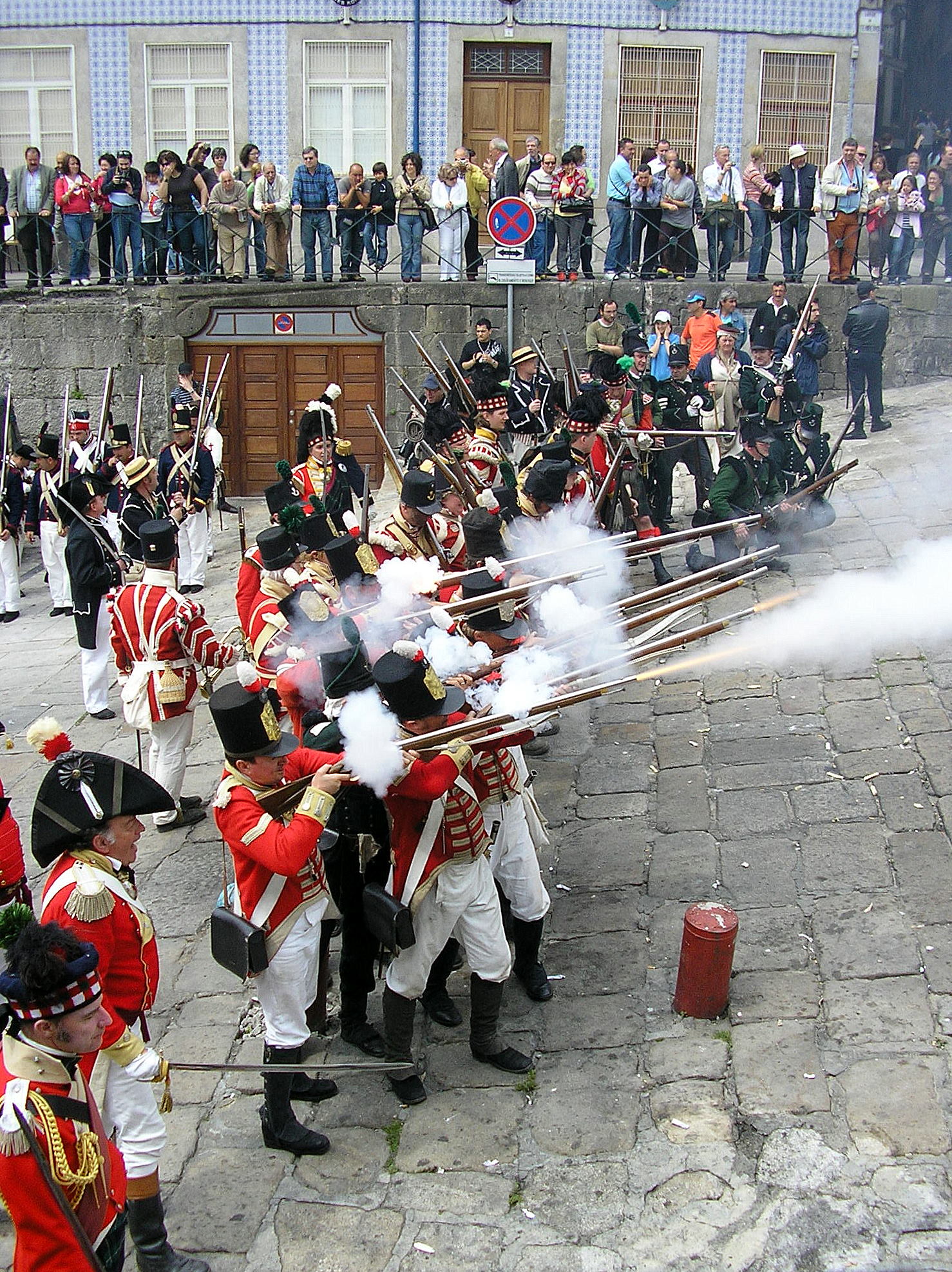
Second Battle of Porto
The entire battle turned on a barber. On the morning of May 12, 1809, Colonel John Waters -- a British intelligence officer who spoke Portuguese -- was searching the south bank of the Douro for any means of crossing into French-held Porto. Near the Monastery of Serra do Pilar, he met a local barber who led him to a small skiff hidden in the brush. Across the river, four wine barges sat unguarded. Waters assembled an improbable crew -- the barber, a prior as guide, and several local boatmen -- and rowed across unseen. They brought back the barges and confirmed that the Porto seminary, a massive three-story building on the north bank, stood empty. When General Arthur Wellesley heard the news, he did not deliberate. "Well, let the men cross," he said. The Second Battle of Porto had begun.
A City Under Occupation
Porto had been in French hands since the First Battle of Porto on March 29, 1809, a disaster that cost 8,000 military casualties and thousands of civilian lives, roughly half of them in the collapse of the Ponte das Barcas pontoon bridge. Marshal Nicolas Soult had captured Portugal's second city and its valuable dockyards and arsenals, halting to refit his army before a planned advance on Lisbon. He considered himself secure. The Douro was tidal, deep, fast-flowing, and 200 yards wide. The only bridge had been destroyed in the earlier battle. Soult's troops had gathered every boat from the opposite bank and moored them on Porto's wharves, under guard. The river was full of wine barges -- Porto was the hub of the port wine trade -- but they were all on the French side. When Wellesley arrived at Vila Nova de Gaia on May 11, setting up headquarters in the Monastery of Serra do Pilar, the Douro seemed impassable.
Wine Barges and a Seminary
From the monastery's terrace, Wellesley studied the north bank through a telescope and spotted the diocesan seminary on high ground east of the city walls. It was large, solidly built, and unfortified -- a potential strongpoint if troops could reach it. Waters' crossing with the barber changed the calculus entirely. By mid-morning, a platoon of 25 men from the 3rd Foot had rowed across in a captured wine barge and entered the seminary. Their company followed, then the light company. The bends in the river hid the crossing from French eyes. By the time the French realized British troops were on the north bank, the "Buffs" had fortified their position and Major-General Edward Paget had taken command of a growing bridgehead. Wellesley's artillery, positioned in the monastery garden on the south bank, could fire shrapnel across the river in support.
Soult's Fatal Miscalculation
Soult had stayed up late the previous night planning his withdrawal and slept through the initial crossing. General Maximilien Foy was the first French officer to grasp the danger. He rushed three battalions of the 17th Light Infantry eastward and attacked the seminary around half past eleven, but the fortified position held. Wellesley's shrapnel fire from across the river shattered the assault. Foy was wounded and his troops fell back with heavy losses. A second attack with six battalions fared no better. Then Soult made his critical error. To reinforce the seminary attack, he pulled the troops guarding the boats moored at the Ribeira wharves in central Porto. The moment those guards departed, the people of Porto liberated the boats and rowed them across the river to Vila Nova de Gaia, ferrying British soldiers back in anything that could float. Four battalions crossed into the heart of Porto and attacked the French from behind.
Retreat Through the Mountains
The French broke. Soult's army fled northeast along the road to Valongo in disorder, pursued by British infantry pouring out of Porto. A squadron of 150 men from the 14th Light Dragoons, led spontaneously by General Charles Stewart, charged the French rearguard, capturing 300 prisoners at the cost of three of four officers wounded and 21 men killed or severely wounded. The British lost 125 men in the entire battle. The French suffered 600 killed or wounded plus 1,800 captured, including Foy. Wellesley's second-in-command, Paget, lost his arm to a French bullet at the seminary. The pursuit continued for days. With his retreat routes blocked, Soult was forced to destroy all 58 guns, burn his baggage train, and flee through mountain footpaths. He reached Spain with roughly half the force he had brought to Porto. The Second French invasion of Portugal was over, and Arthur Wellesley -- soon to be named Baron Douro of Wellesley, and eventually Duke of Wellington -- had announced himself as Napoleon's most dangerous adversary.
From the Air
The battle centered on the Douro River crossing at Porto (41.149N, 8.611W). The Monastery of Serra do Pilar, Wellesley's headquarters, sits prominently on the south bank at Vila Nova de Gaia. The seminary (now Porto Orphan's College) is on the north bank east of the city center. Francisco Sa Carneiro Airport (LPPR/OPO) is 12km northwest. The Douro gorge, bridges, and Ribeira waterfront are key visual references. Best viewed at 2,000-4,000 feet to appreciate the river crossing terrain. Oceanic climate with possible morning river fog.