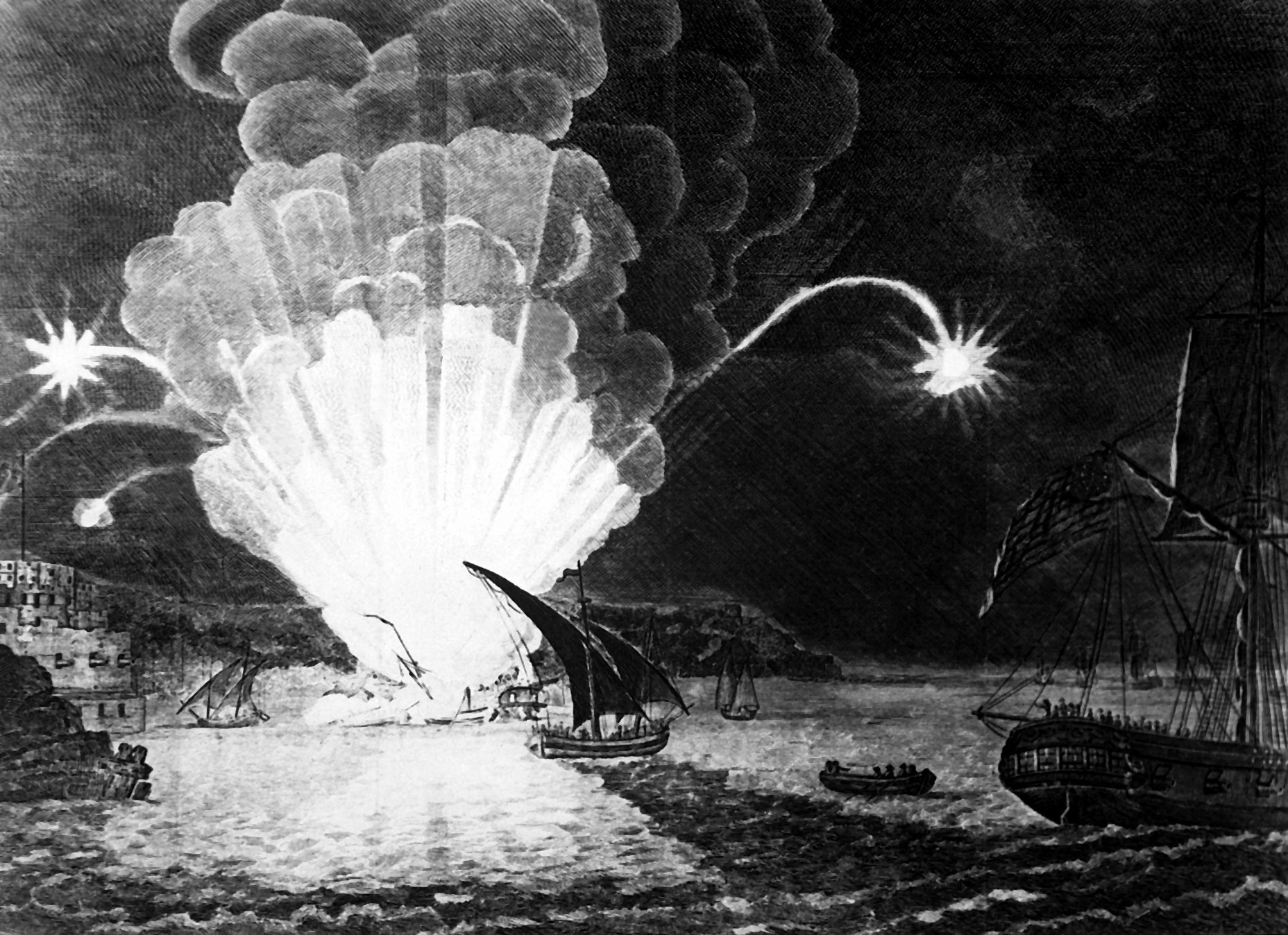
Second Battle of Tripoli Harbor
On the night of February 16, 1804, Lieutenant Stephen Decatur Jr. and a small party of U.S. Navy sailors slipped into Tripoli Harbor aboard a captured ketch, boarded the American frigate Philadelphia, which the Tripolitans had seized after it ran aground on a reef, overpowered its guards, and set the ship ablaze rather than let it serve the enemy. British Admiral Horatio Nelson reportedly called it "the most bold and daring act of the age." It was only the prelude. Over the next seven months, the full weight of the young American navy would be hurled against Tripoli's defenses in a campaign that tested the limits of both courage and gunpowder.
The Pasha's Price
The First Barbary War began because Tripoli's ruler, Pasha Yusuf Karamanli, demanded tribute payments from the United States in exchange for safe passage of American merchant ships. When the payments stopped, Karamanli declared war. Commodore Edward Preble assumed command of the U.S. Mediterranean Squadron in 1803 and began a blockade, but the loss of the frigate Philadelphia in October gave the Tripolitans a powerful bargaining chip: the ship itself, turned into a gun battery in the harbor, and its crew held as prisoners. After Decatur's raid destroyed Philadelphia, Preble sailed to Naples and secured support from the Kingdom of Sicily, acquiring two bomb ketches and six gunboats. His squadron arrived off Tripoli on June 12, 1804. Negotiations for the prisoners' release went nowhere. Karamanli wanted money. Preble was prepared to use force.
Fire in the Harbor
Preble's attacking force was vastly outmatched on paper: 1,060 Americans in one frigate, three brigs, three schooners, two bomb vessels, and six gunboats against 25,000 Tripolitan defenders with 19 gunboats, two galleys, and 115 cannons. On August 3, Preble launched his assault, sending six gunboats to engage the Tripolitan navy head-on. Decatur led the attack and captured three enemy gunboats while sinking a fourth, but the victory came at a terrible personal cost: his brother James Decatur was killed by a fatal shot during the fighting. Preble offered Karamanli $80,000 to ransom the American prisoners plus $10,000 as a diplomatic gift. The pasha demanded up to $300,000. On August 7, the Americans attacked again, only to have a gunboat's powder magazine struck by enemy fire, killing ten men instantly, including Lieutenant James R. Caldwell and Midshipman John Sword Dorsey.
Five Hundred Shells and No Surrender
The Americans bombarded the city with over 500 shells during the August 7 assault, but Tripoli's mortar construction absorbed the punishment without catastrophic damage. Preble postponed further action until August 25, during which time the Tripolitans forced their American captives to repair fortifications. The renewed bombardment expended all available ammunition for little effect. On August 28, another attack sank a Tripolitan gunboat but cost the Americans a vessel of their own, with three killed and one wounded. Over 600 rounds slammed into the city, one of which nearly killed Captain William Bainbridge, still held prisoner inside the walls. Preble tried once more to negotiate: 42 Tripolitan prisoners for some Americans. Karamanli raised his price to $400,000.
The Intrepid's Last Voyage
Desperate to break the stalemate, Preble conceived a plan to send a fire ship packed with explosives into the harbor. The vessel chosen was the Intrepid, the same ketch Decatur had used to burn Philadelphia months earlier. Lieutenant Richard Somers volunteered to command the mission. On the night of September 4, the Intrepid began moving toward the harbor. Tripolitan guns opened fire. Then the ship exploded, killing all thirteen crew members. Whether the blast was triggered by Tripolitan fire or deliberately detonated by Somers to prevent capture remains debated. Among the dead was Henry Wadsworth, whose nephew and namesake, the poet Henry Wadsworth Longfellow, would carry his memory into American literature. On September 10, Preble called off the campaign.
Praise Without Victory
The Second Battle of Tripoli Harbor cost the Americans 30 killed and 20 wounded over its month-long duration. Preble never forced Karamanli to surrender, and the American prisoners remained in captivity. Yet the campaign earned admiration on both sides of the Atlantic. Pope Pius VII declared that the United States, "though in their infancy, have done more to humble the anti-Christian barbarians on the African coast than all the European states had done." A monument was erected to honor the officers who died: Somers, Caldwell, James Decatur, Wadsworth, Joseph Israel, and John Dorsey. Preble handed command to his successor, Samuel Barron, and the Sicilian gunboats sailed home. The war would not end until the following year, but the harbor of Tripoli had already entered American military legend as the place where a young nation proved it could fight, even when it could not win.
From the Air
Located at 32.90N, 13.19E in the harbor of Tripoli, Libya. The harbor area where the battle took place is visible along the coastline of central Tripoli. Mitiga International Airport (HLLM) is approximately 8 km east. Tripoli International Airport (HLLT) is about 34 km south. From 5,000-10,000 ft, the harbor entrance, the old city waterfront, and the Red Castle fortress that served as a backdrop to the fighting are all clearly visible.