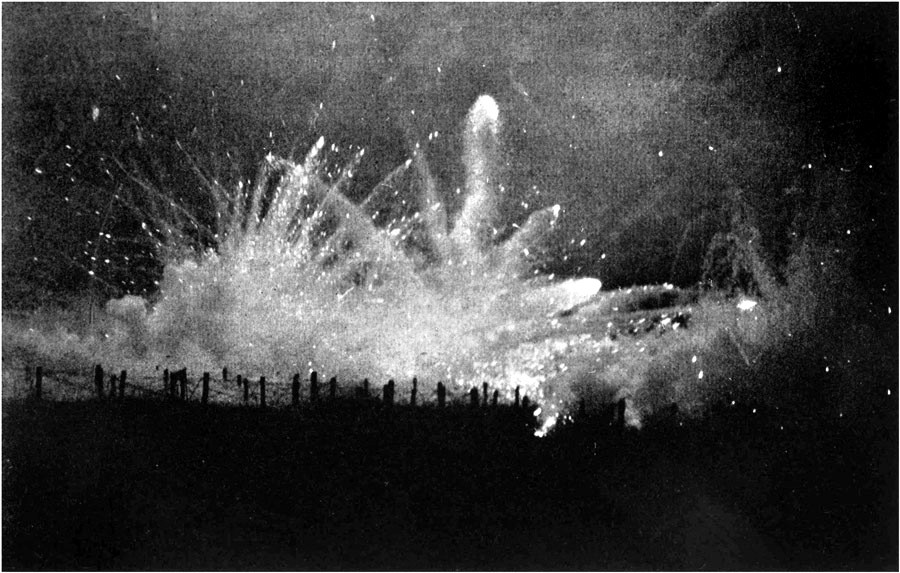
Second Battle of Ypres
It was five in the afternoon on Thursday, 22 April 1915, and the wind was finally right. North of Ypres, German soldiers in the village of Langemark turned the valves on 5,730 steel cylinders dug into their trenches, and 168 tons of liquid chlorine boiled into a gas. A yellow-green cloud, heavier than air, sank into the low ground and began to roll southwest across no-man's-land toward the French line. It smelled of pineapple and pepper. The French Territorials and the Algerian Tirailleurs in its path had perhaps a minute to understand what was happening before they could not breathe. This is where chemical warfare entered the world.
The Idea of Fritz Haber
Chlorine had been chosen by a man who would later win the Nobel Prize. Fritz Haber, the German chemist who had pulled nitrogen from the air to feed the world with synthetic fertiliser, supervised the cylinders being laid in person at Langemark. He had argued for chlorine over tear gas because chlorine was heavier than air and would pour into trenches. Walther Nernst, Otto Hahn, James Franck, Gustav Hertz - four future or current Nobel laureates were involved in preparing the attack. Haber's wife Clara, herself a chemist, killed herself with her husband's service revolver ten days after the gas was released, after arguing with him about the morality of what he had done. Haber left for the Eastern Front the next morning to supervise another gas attack.
The Cloud at Langemark
The men in the path of the gas were French colonial troops - reservists from Brittany in the 87th Territorial Division and Algerians and Moroccans of the 45th. They had no protection of any kind. The chlorine burned the moist linings of eyes, nose, throat and lungs, producing acid that drowned men in the fluid of their own bodies. Some ran. Many could not. Within an hour there was a gap roughly 8,000 yards wide in the Allied line, undefended, with the road to Ypres open behind it. But the German infantry advancing behind the cloud were also afraid of their own weapon. They wore cotton pads soaked in sodium thiosulfate and moved cautiously. They stopped at Pilckem and Langemark and dug in. The chance to take Ypres almost unopposed passed, while in the gap thousands of men were dying in ways that medicine had no name for yet.
The Canadians Hold
On the southern shoulder of the break-in, the 1st Canadian Division had been in the line less than a week. They watched the cloud pass to their north and recognised what it was - chlorine, several Canadians said, smelled like the chemical in their drinking water. They held. Through the night of 22-23 April, the 10th and 16th Battalions counter-attacked into Kitcheners' Wood without reconnaissance and with the bayonet, taking 75 percent casualties to close part of the gap. At dawn on the 24th, a second cloud was released straight at the Canadian line west of Saint-Julien. Word ran along the trenches to urinate on handkerchiefs and breathe through them - the ammonia in urine, someone had realised, would neutralise the chlorine. It was a desperate field expedient and it half-worked. The Canadians held the position long enough for British reinforcements to arrive. Among the dead was Lance Corporal Frederick Fisher of Montreal, who twice took a Colt machine gun forward to cover the retreat of his battalion and was killed on 23 April. He was 20 years old.
What Gas Did
By the end of the Second Battle of Ypres on 25 May, the Allies counted roughly 7,000 dead from gas alone and more than three times that number wounded. The deaths were among the worst the war produced. Survivors described men coughing up the lining of their lungs, choking for hours, drowning standing up. Field hospitals around Ypres filled with soldiers whose lips had turned blue-black and who could not be helped because there was no antidote. By July 1915, both sides had primitive respirators - cotton pads dipped in chemical solutions and tied across the face - and the war's chemical arms race was on. Phosgene followed in December, mustard gas at Ypres in 1917. The word Yperite entered the chemical vocabulary, after the town that had witnessed the start. It is not the largest number gas killed in the war. It is the first.
The Brooding Soldier
If you stand today at Vancouver Corner, at the crossroads in Sint-Juliaan where the second gas attack hit the Canadian line, you can see the memorial that Canada built here. It is a single stone column eleven metres high, topped by a soldier's head and shoulders, head bowed over his rifle in the 'arms reversed' posture of mourning. Around it cedars are clipped into the shapes of artillery shells and shell-bursts. Some of the soil in the gardens was brought from every Canadian province, so that the men buried here would lie in earth from home. The memorial was designed by Frederick Chapman Clemesha, a veteran of the war, and unveiled in 1923 by Marshal Foch. It commemorates the 6,035 Canadians who became casualties in 48 hours - one man in three who went into the line - and the roughly 2,000 of them who died. Foch, who knew the cost of holding ground, called the Canadians' stand 'one of the most magnificent efforts of the whole war.'
After the Yellow Cloud
The fighting continued for another month after the first gas attack - the Battle of Frezenberg in early May, where Princess Patricia's Canadian Light Infantry was reduced from 700 men to 150 holding the line; the Battle of Bellewaarde at the end of May, where the Germans repeated the gas attack with red signal lights and cotton-pad masks were waiting. Ten Victoria Crosses were awarded for the Second Battle of Ypres, including one to Captain Francis Scrimger, the Canadian doctor who may have first passed the order to use urine against the chlorine. By the time the salient stabilised at the end of May, the Allied line had been pushed three miles back toward Ypres itself, and the town was now in artillery range from three sides. Everything that happened at Ypres for the next three years - Third Ypres at Passchendaele, the mustard gas in 1917, the city ground to powder - flowed from the choice made at Langemark on that clear April afternoon.
From the Air
The 22 April 1915 gas release ran along a 6.5 km front from Langemark (50.91 N, 2.92 E) to Gravenstafel (50.89 N, 2.97 E). The Saint Julien Memorial sits at Vancouver Corner (50.8994 N, 2.9406 E) and is the obvious aerial reference point. Approach from the south at 1,500-2,500 ft AGL for the best sense of how the chlorine cloud, driven by a light north-east breeze, would have rolled across the gentle fields. Wevelgem (EBKT) is the nearest civil field, 25 km southwest; Ostend-Bruges (EBOS) lies 35 km north. Spring afternoon visibility is generally good, but the same calm air conditions that made the gas attack possible can produce stagnant low haze.