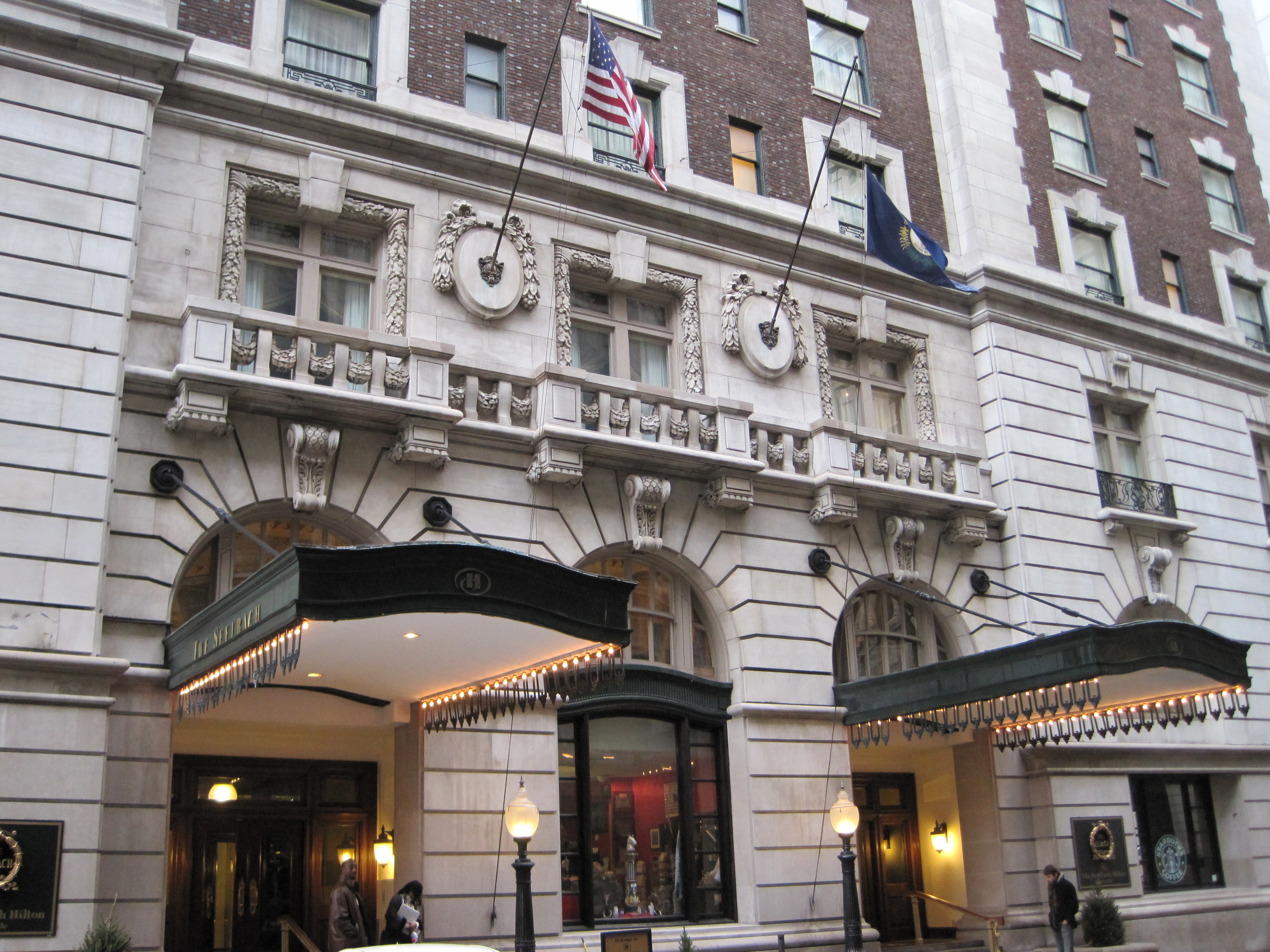
Seelbach Hotel
The Mayor of Louisville told them no one would come. In 1903, when brothers Louis and Otto Seelbach proposed building a grand European-style hotel at the corner of 4th and Walnut streets, the location was considered absurdly far from the city's center. The brothers, Bavarian immigrants from the small town of Frankenthal, broke ground anyway. When the Seelbach Hotel opened its doors on May 1, 1905 -- timed perfectly for Kentucky Derby week -- over 25,000 people visited on opening day alone. The mayor's prediction had been spectacularly wrong.
Marble from Three Countries
Louis Seelbach had arrived in Louisville in 1869 at age 17 and worked his way through the hotel industry at the original Galt House before opening his own bar and grill in 1874. When he and Otto finally built their dream hotel, they spared nothing. The structure incorporated marble from Italy, Germany, and France, and wood from the West Indies and Europe, all assembled in the French Renaissance style. The opening night gala featured dinner parties in each of the 150 rooms. By 1907, a ten-story expansion had raised the room count to 500, with the lower two floors faced in stone and the upper eight in brick. The rooftop garden was enclosed as a year-round winter garden. The Rathskeller, a Bavarian-style basement restaurant decorated with rare Rookwood Pottery tiles depicting German landscapes, became one of the hotel's most distinctive spaces -- and remains the only surviving Rookwood ensemble of its kind.
Fitzgerald's Reckless Evening
In April 1918, a young F. Scott Fitzgerald frequented the Seelbach while training nearby for deployment in World War I. One evening, after indulging in expensive bourbon and cigars, he became so unruly that he had to be restrained and was ejected from the hotel. The experience clearly made an impression. Years later, Fitzgerald set the wedding of Tom and Daisy Buchanan in The Great Gatsby at a fictional hotel he called the Muhlbach -- widely understood to be modeled on the Seelbach. The reference could point to either the Grand Ballroom, once located on the hotel's roof, or the Rathskeller where Fitzgerald was known to drink. Today the hotel's breakfast room is called Gatsby's on Fourth, a nod to its most famous literary connection.
Presidents, Gangsters, and Secret Passages
Nine U.S. presidents have stayed at the Seelbach, from William Howard Taft in 1911 through George W. Bush in 2002. But the hotel's guest list runs far wilder than the Oval Office. During Prohibition, Al Capone was a frequent visitor, drawn to clandestine poker games held within the hotel's walls. One story from the 1920s recounts Capone fleeing through a series of secret stairways and tunnels when Louisville police raided a game in progress. Lucky Luciano and Dutch Schultz were also regulars. The Seelbach's guest register reads like a who's who of twentieth-century celebrity: Elvis Presley, the Rolling Stones, Whitney Houston, Julia Child, Wolfgang Puck, and Robin Williams all passed through its doors.
Death and Resurrection
Louis Seelbach died in 1925, and the hotel changed hands repeatedly over the following decades -- sold to Abraham Liebling in 1926, to the Eppley Hotel Company in 1929, then to Sheraton in 1956 as part of what was then the second-largest hotel sale in American history. Under Sheraton, the original name was stripped away entirely. The hotel was sold again to Gotham Hotels in 1968, briefly regaining its identity before the 1973-75 recession drove the owners into bankruptcy. The Seelbach closed in July 1975. Three years later, Louisville-born Hollywood actor Roger Davis purchased the shuttered building. A painstaking restoration began in 1979, and on April 12, 1982, the Seelbach held a grand reopening. The hotel eventually joined the Hilton chain in 1998 and underwent a $12 million renovation in 2009.
The Hotel That Built a Neighborhood
The mayor who doubted the Seelbach could not have imagined how thoroughly the brothers proved him wrong. The hotel did not merely survive its remote location -- it transformed it. Other hotel owners, seeing the Seelbach's success, built nearby, and the once-empty intersection of 4th and Walnut (now Muhammad Ali Boulevard) grew into a bustling commercial district. Listed on the National Register of Historic Places, the Seelbach remains Louisville's defining historic hotel, its Rathskeller still gleaming with those irreplaceable Rookwood tiles, its hallways still carrying echoes of presidents and gangsters and a young writer who got himself thrown out but never forgot the place.
From the Air
The Seelbach Hotel is located at 38.2508N, 85.7581W in downtown Louisville, Kentucky, on the corner of 4th Street and Muhammad Ali Boulevard. The ten-story building sits within the dense downtown grid roughly 5 miles south of Louisville Muhammad Ali International Airport (KSDF). The Ohio River, forming the Kentucky-Indiana border, provides a strong visual reference just north of downtown. Bowman Field (KLOU), a general aviation airport, lies about 5 miles southeast. Best viewed at 2,000-3,000 feet AGL. Look for the cluster of historic buildings along 4th Street in the heart of the downtown hotel district.