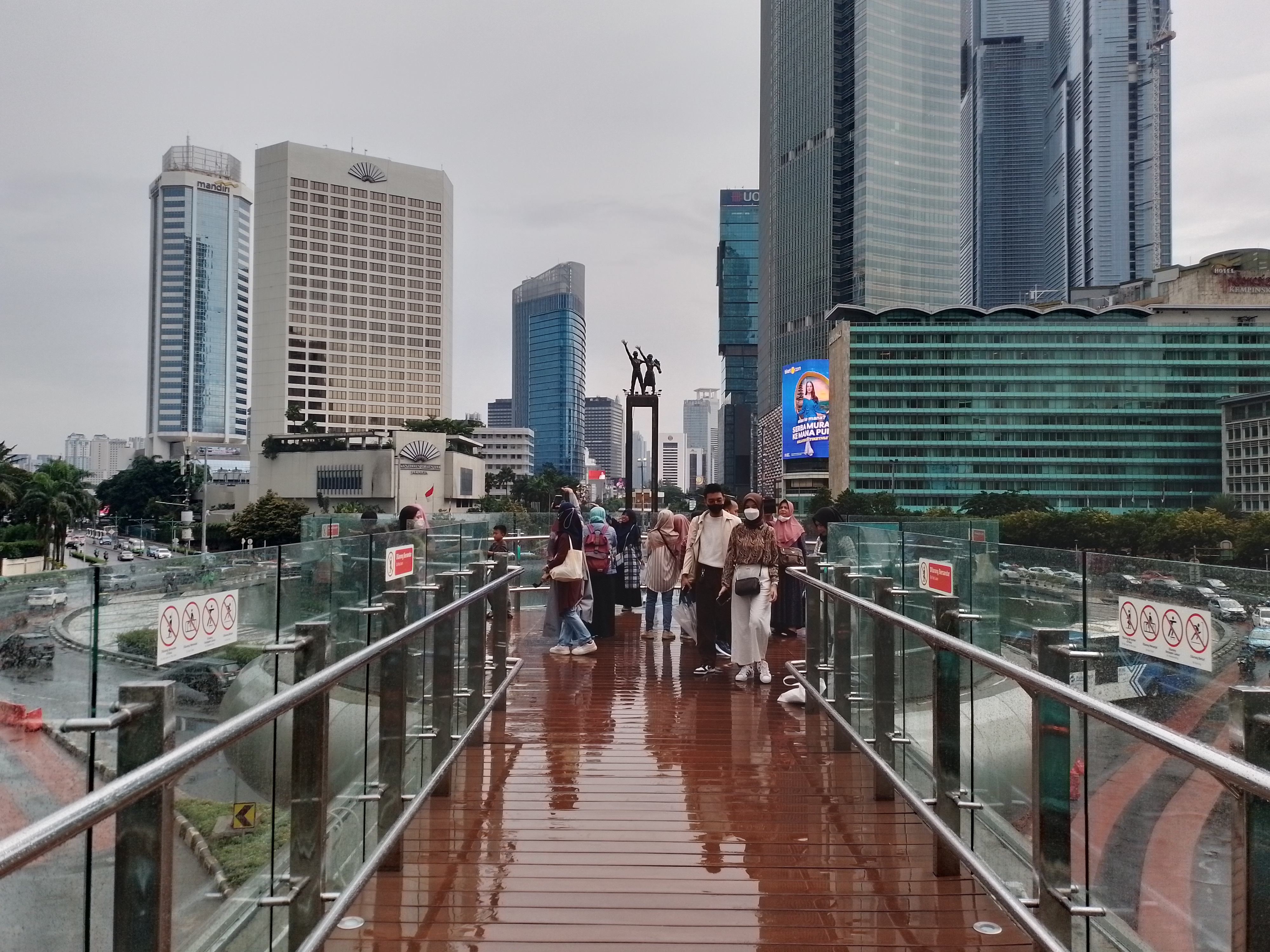
Selamat Datang Monument
The name was supposed to be grander. Henk Ngantung, the vice governor of Jakarta who sketched the original design, wanted to call it "Indonesian people greet their future." President Sukarno -- who had a hand in every detail of 1960s Jakarta, from highway alignments to statue poses -- approved the concept but simplified the name. Selamat Datang. Welcome. Two bronze figures, a man and a woman, stand thirty meters above the traffic of Central Jakarta with arms raised in greeting, their welcoming gesture unchanged since 1962. They were built to greet athletes arriving for the fourth Asian Games. Sixty years later, they greet everyone else too.
Sukarno's Sculptor
Edhi Sunarso worked from Ngantung's sketches in a studio that received distinguished visitors: Sukarno himself, U.S. Ambassador Howard P. Jones, cabinet ministers. The president treated Jakarta's beautification as a personal project, and the statues going up across the capital in preparation for the 1962 Asian Games reflected his ambitions for a nation barely seventeen years independent. Sunarso's design drew heavily from Soviet socialist realism -- the muscular confidence of Vera Mukhina's style is unmistakable in the figures' bold postures and idealized proportions. The woman holds a flower bouquet in her left hand while both figures wave with their right. Each figure stands five meters from head to toe, or seven meters from raised fingertip to foot. They were placed atop a pedestal at the center of a new roundabout, bringing the total height to roughly thirty meters above the roadway. Construction began on August 17, 1961 -- Indonesia's Independence Day -- and was completed in time for the Games the following year.
The Roundabout as Living Room
The monument sits at the center of Bundaran Hotel Indonesia, a traffic circle named for the grand Hotel Indonesia nearby. The roundabout occupies a strategic crossroads in Jakarta's geography: Jalan M.H. Thamrin, the city's main avenue, intersects here with Jalan Imam Bonjol and Jalan Sutan Syahrir. When the hotel and its roundabout were completed, they formed a gateway for visitors arriving in the capital. A circular pond with fountains surrounds the monument's base, restored in 2002 with new water features and lighting. But it is the paved plaza around the pond that has given Bundaran HI its second life. After the fall of Suharto's New Order regime in 1998 -- the period Indonesians call Reformasi -- the space became a magnet for civic demonstrations. Protesters discovered what urban planners had not intended: that a traffic island makes an excellent stage, visible from every approaching road.
Sunday Mornings, Car-Free
Every Sunday, Jakarta shuts down Jalan Thamrin and surrounding streets for Car-Free Day, and Bundaran HI transforms. The exhaust-choked roundabout becomes a pedestrian carnival. Joggers loop past the monument. Cyclists weave between families on foot. Street photographers set up where traffic usually crawls. Temporary vendors sell food and drinks from carts. For a few hours, Jakarta's most congested intersection becomes its most human space -- a reversal that says something about what cities need and what they usually provide. The monument's welcoming figures preside over the scene with the same outstretched arms, though on Sundays they seem to be greeting not dignitaries or athletes but the city itself, taking a breath.
A Bus Stop Shaped Like a Ship
In October 2022, the Jakarta government unveiled a revitalized TransJakarta bus stop adjacent to the roundabout -- Bundaran HI Astra -- designed by architect Kuncara Wicaksana. The two-story structure curves like the hull of a cruise ship, its facade patterned with batik-inspired motifs. The upper floor includes an observation deck facing south toward the monument, prayer rooms, commercial areas, and passenger waiting spaces. It is a building that takes public transit seriously as civic architecture, not just infrastructure. The bus stop joins a landscape that Sukarno began reshaping six decades ago, when he believed that a newly independent nation needed monuments and grand avenues to prove it had arrived. The Selamat Datang Monument was part of that proof. What Sukarno could not have anticipated is that the space around it would prove more durable than the ideology behind it -- the roundabout outlasting the rhetoric, the welcome gesture outlasting the occasion.
From the Air
Located at 6.19S, 106.82E in the heart of Central Jakarta. The monument stands at the center of the Bundaran Hotel Indonesia roundabout, identifiable from the air by the circular fountain and the intersection of Jalan M.H. Thamrin running north-south. The large green expanse of Merdeka Square with the National Monument (Monas) lies approximately 1 km to the north. Nearest major airport is Soekarno-Hatta International (WIII), about 25 km northwest. Halim Perdanakusuma Airport (WIHH) is approximately 12 km southeast. Best viewed at low altitude in clear conditions.