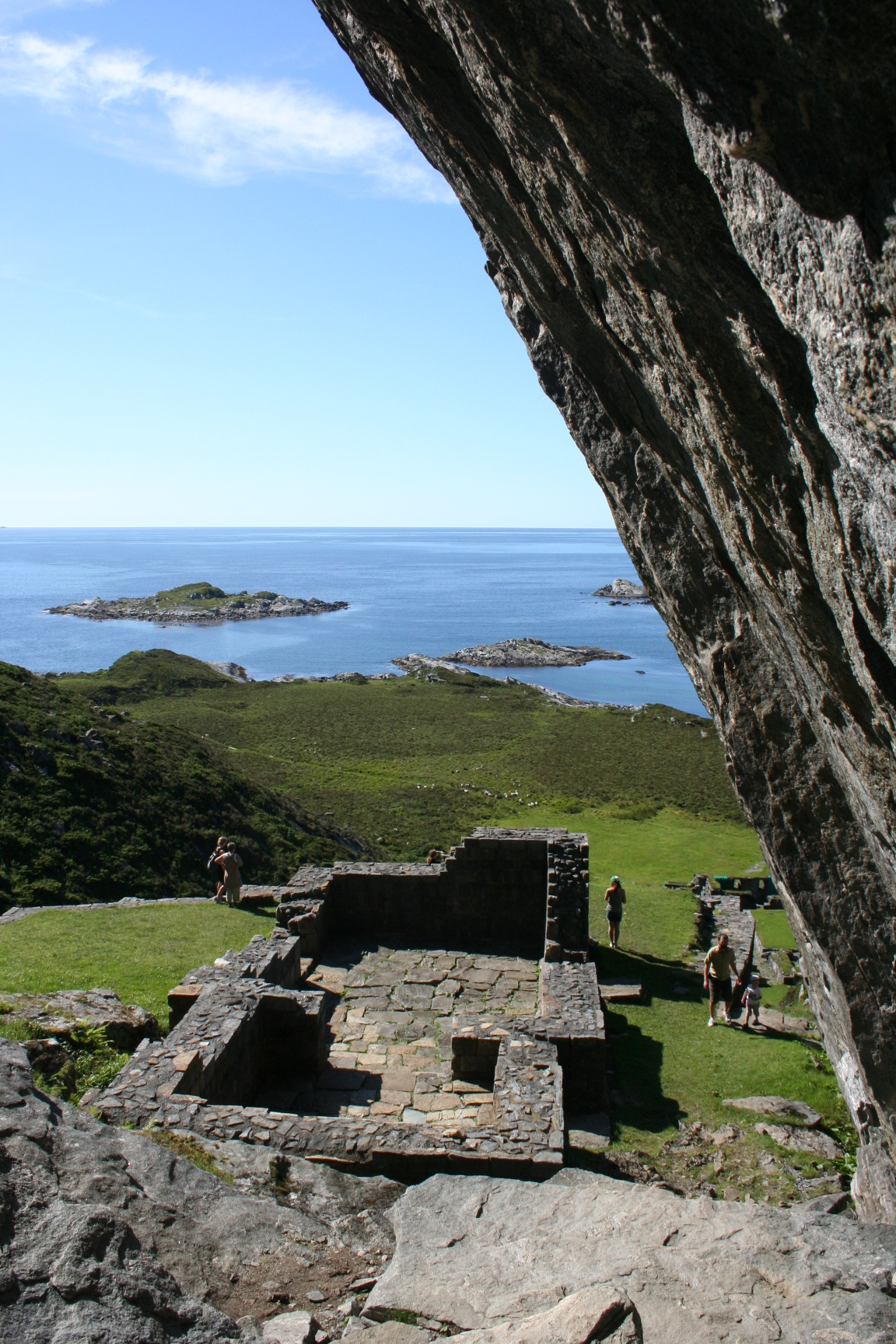
Selja Abbey
According to legend, an Irish princess named Sunniva fled a heathen king and washed ashore on a windswept island off the western coast of Norway. She died there, in a cave above the sea. Within a century, pilgrims were climbing the same rocky paths to venerate her remains, a bishop had established his seat on the island, and a cathedral dedicated to Saint Michael rose above the waves. The island is Selja, fifteen minutes by boat from the mainland village of Selje in what is now Stad Municipality, Vestland county. The monastery that followed, Selja Abbey, became one of medieval Norway's most important spiritual centers, and its remarkably preserved ruins still stand open to the salt air a millennium later.
A Saint Born from the Sea
The story of Selja Abbey begins with Sunniva of Selja, patron saint of the Diocese of Bergen. Legend holds that Sunniva was heir to an Irish kingdom who chose exile over submission to a pagan ruler. She and her followers set sail without a fixed destination, eventually landing on Selja's shores. The caves where they sheltered became sacred sites after their deaths, attracting devotion that would persist for centuries. By around 1070, the island hosted both a bishopric and a cathedral, making it a node in Norway's emerging Christian infrastructure. The shrine of Saint Sunniva drew travelers from across Scandinavia, turning this small island into a pilgrimage destination that punched far above its geographic weight.
The Monastery Between Two Cities
Founded around 1100, the Benedictine monastery owed its existence in large part to the local bishop, who was instrumental in its establishment. The connection between abbey and bishopric remained close throughout the monastery's life, even after the bishop relocated to Bergen shortly after the founding. Selja's position midway between Bergen and Nidaros made it a natural stopover for travelers moving along the coast, and for two centuries the abbey thrived as both a religious and practical waypoint. Monks maintained the shrine of Saint Sunniva until approximately 1170, when the relics were transferred to Bergen. After that, the monastery carried on alone, quieter but still functioning as a center of Benedictine devotion on the edge of the North Sea.
Fire, Plague, and Silence
In 1305, a disastrous fire struck the abbey. The extent of rebuilding remains unclear, but the monastery never fully recovered. Whatever diminished community persisted through the early fourteenth century may have been extinguished entirely by the Black Death in 1349, which devastated Norway's population. Some evidence suggests a small monastic presence lingered as late as 1451, but the end came definitively under Bishop Finnboge of Bergen, who served from 1461 to 1474. He dismissed the last abbot and absorbed the abbey's estates into the See of Bergen. An appeal to the Pope to redirect those estates to Nidarholm Abbey failed. The monks were gone, and the island fell quiet.
Ruins that Time Forgot to Erase
What makes Selja unusual among medieval Norwegian monastic sites is preservation through neglect. No later settlement grew over the ruins. No farmers cannibalized the stone for walls or barns. The remains of the abbey, the shrine of Saint Sunniva, and the cathedral sit exposed and remarkably intact, their walls tracing rooms where monks once chanted and pilgrims once knelt. The artist Bernt Tunold, who spent his childhood on the island in the late nineteenth century, painted the ruins repeatedly, capturing the way stone and sky merge on Selja's exposed landscape. Today the island remains accessible only by boat, and that short crossing still carries something of the pilgrim's journey: a deliberate separation from the mainland, a passage toward something older and more deliberate than the daily world left behind.
From the Air
Located at 62.05N, 5.30E on the island of Selja off Norway's western coast, visible as a small island near the mouth of Nordfjord. Best viewed below 5,000 ft for ruin detail. Nearest airports: ENSD (Sandane Airport, Anda, approximately 60 nm east) and ENFL (Floro Airport, approximately 40 nm south). Expect maritime weather with frequent low clouds and rain. The abbey ruins and cathedral remnants are visible on the island's slopes in clear conditions.