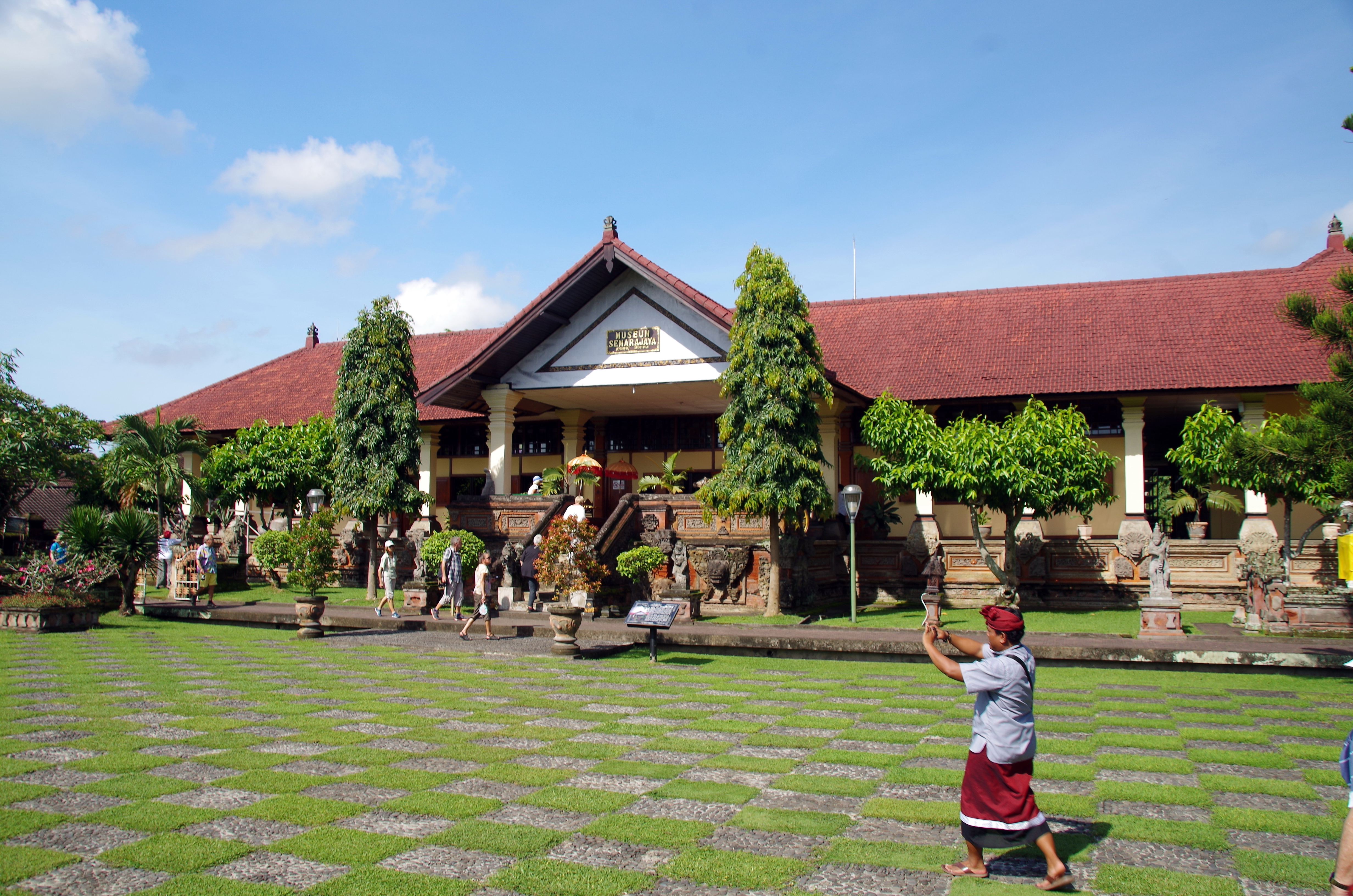
Semarajaya Museum: A School Built on Defiance
The date is no coincidence. On April 28, 1908, Dutch troops overwhelmed the forces of Ida Dewa Agung Jambe, the last king of Klungkung, in the ritual mass suicide known as puputan. That same day, on the same ground where the palace gate once stood, the colonial government began constructing a school. Eighty-four years later, on April 28, 1992, Indonesia's Minister of Home Affairs inaugurated the building as the Semarajaya Museum. Three times the same date, three different meanings: conquest, assimilation, and finally reclamation. The museum sits within the Kertha Gosa Complex in Semarapura, and its architecture tells the whole story in a single glance, Dutch colonial symmetry fused with traditional Balinese ornamentation, a building that refuses to belong entirely to either world.
The Palace Gate That Became a Classroom
The Semarajaya Museum building stands at Pamedal Agung, once the formal entrance to the Klungkung Kingdom's palace. After the puputan of 1908, the Dutch government chose this symbolically charged location for a Meer Uitgebreid Lager Onderwijs school, the extended lower education system the colonial administration used across the Dutch East Indies. The choice was deliberate. Where a Balinese king had walked, Dutch-educated students would now study. The building blended Dutch architectural sensibility with Balinese traditional elements, a hybrid that reflected colonial policy more than cultural respect. Yet the structure endured, outlasting the colonial era, Japanese occupation, and Indonesian independence. It served as Klungkung Junior High School I before its conversion into a museum, each reinvention layering new purpose onto ground that has never stopped carrying meaning.
What the Walls Remember
The museum's collection spans far deeper than colonial history. Prehistoric relics share display space with artifacts from the Klungkung Kingdom, the last of the great Balinese kingdoms to fall to Dutch control. Klungkung had been the supreme court of Balinese Hindu kingdoms since the Gelgel dynasty shifted its capital here, and its cultural influence radiated across the island. The relics on display trace that arc, from ancient stone tools and ceremonial objects through the refined court arts that made Klungkung a center of painting, literature, and music. Ida Dewa Agung Jambe, who had ruled as king since 1904, led the final resistance. His decision to face the Dutch in puputan rather than accept subjugation became one of the defining moments of Balinese identity. The museum that bears the dynasty's legacy now ensures visitors confront not just the artifacts but the choices they represent.
Bersamamu: Learning Together
The Klungkung Regency Government has turned the museum into something more than a repository of old things. Through a program called Bersamamu, which translates to "together with you," school students and community groups are guided through the collection by museum staff, then handed off to specialists in history, fine arts, and traditional Balinese folk games. The program was formally designated a regional innovation of Klungkung Regency, a bureaucratic label for what amounts to an ambitious idea: that a museum built by colonizers on the ashes of a kingdom can become a living classroom where the colonized culture reasserts itself. Instructors teach painting techniques derived from the same traditions that produced the famous Kertha Gosa ceiling panels next door. Students learn folk games their grandparents played. The building that was designed to replace Balinese education with Dutch education now teaches Balinese culture to Balinese children.
Standing in the Complex
The Semarajaya Museum does not exist in isolation. It sits within the Kertha Gosa Complex, also known as Taman Gili, the remnant of the royal palace that once governed all of southern and eastern Bali. Walk outside the museum's doors and you face the Kertha Gosa Pavilion itself, its painted ceiling still depicting the torments of hell and the rewards of heaven in the style that made Klungkung court painting famous. The floating pavilion Bale Kambang rises from its surrounding moat nearby. Together, these structures form a compressed archive of Balinese political, judicial, and artistic history. The museum is open Tuesday through Sunday, from seven in the morning until six in the evening, and lies about 44 kilometers from Ngurah Rai Airport. Visitors who arrive expecting a quiet provincial museum find instead a site where every stone, every doorway, every repurposed wall carries the weight of resistance and reinvention.
From the Air
Semarajaya Museum sits at 8.535S, 115.403E within the Kertha Gosa Complex in Semarapura, the capital of Klungkung Regency in eastern Bali. From the air, the complex is identifiable on the north side of town by its courtyards and the moat surrounding the Bale Kambang pavilion. The nearest major airport is Ngurah Rai International (WADD), approximately 44 kilometers to the southwest. Mount Agung dominates the skyline to the northeast. At lower altitudes, the museum's colonial-era roofline is visible within the palace remnants, distinct from surrounding Balinese architecture.