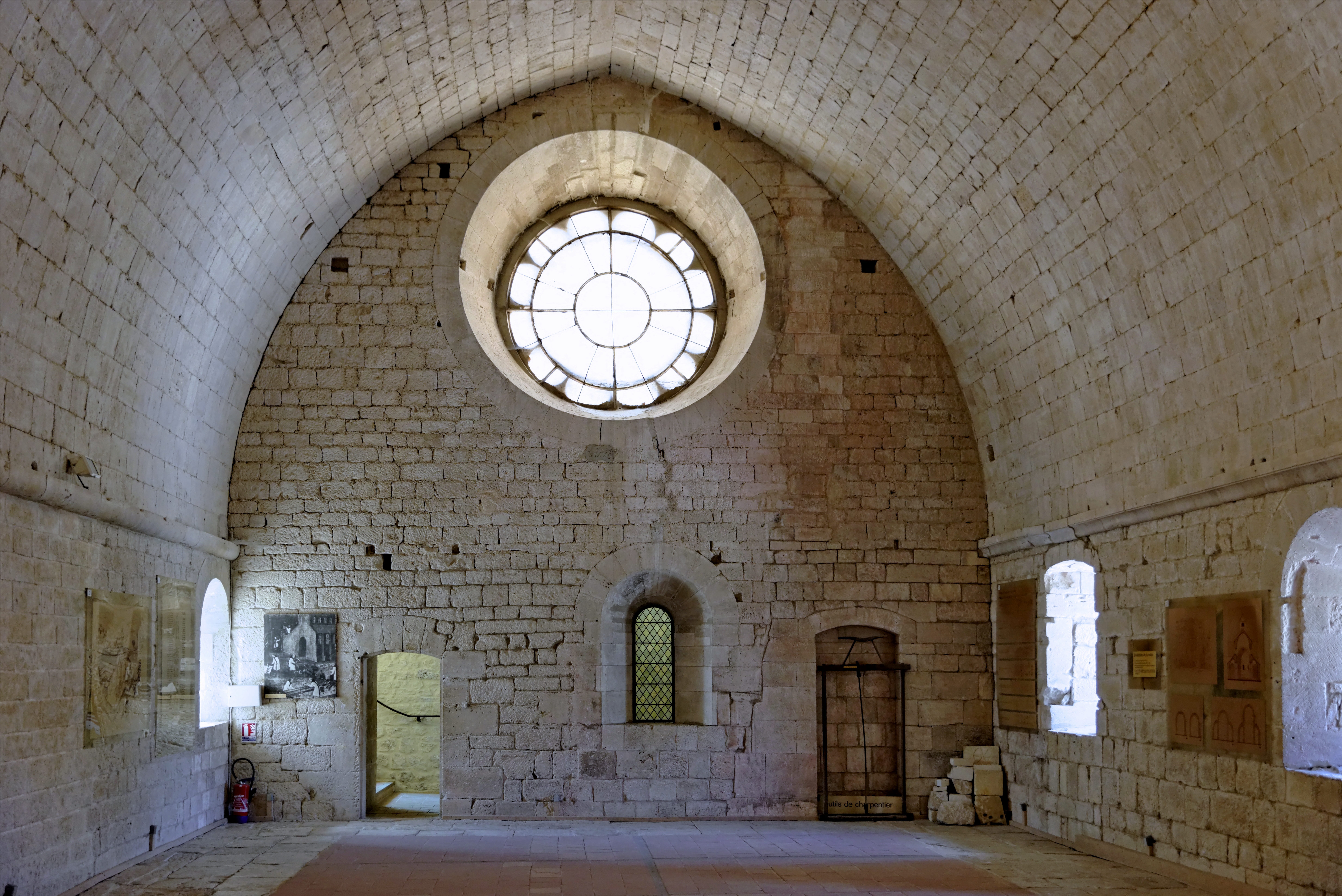
Senanque Abbey
The lavender fields that front Senanque Abbey have become one of the most photographed scenes in Provence -- rows of purple blurring into the honey-colored Romanesque stone, the image appearing on so many postcards and calendars that it risks becoming a cliche. But step past the lavender and into the twelfth-century cloister, where paired columns rise to capitals carved into the simplest possible leaf forms, and the austerity hits like cold water. This was always the point. The Cistercians built Senanque not to be beautiful but to be severe, and the beauty crept in despite their intentions.
Monks in a Hidden Valley
Senanque was founded in 1148 by Cistercian monks from Mazan Abbey in the Ardeche, under the patronage of Alfant, bishop of Cavaillon, and Ramon Berenguer II, Count of Provence. The narrow valley near the village of Gordes in the Vaucluse offered exactly what the Cistercian rule demanded: seclusion, silence, and distance from the temptations of the world. The first community lived in temporary huts. Within four years, the abbey had grown so rapidly that by 1152 it could found a daughter house, Chambons Abbey, in the diocese of Viviers. The seigneurs of Simiane became patrons, and their support enabled the construction of the abbey church, consecrated in 1178.
Severity as Design
The structures at Senanque follow the rule of Citeaux Abbey, the mother house of the Cistercian order, with a precision that makes them among the finest surviving examples of Romanesque architecture in France. The abbey church takes the form of a tau cross, with an apse projecting beyond the outer walls. Unusually, its liturgical east end faces north -- the valley was too narrow for the conventional orientation. The cloister, dormitory, chapter house, and calefactory all survive. The calefactory -- the single heated room in the entire complex -- served as the scriptorium, where monks could write without their ink freezing. A refectory was added in the seventeenth century, but the abbey remains remarkably untouched: the cloister capitals reduce ornamentation to its barest forms, deliberately refusing to offer sensual distraction to men whose lives were organized around prayer and labor.
Rise, Ruin, and Return
In the thirteenth and fourteenth centuries, Senanque reached its peak, operating four mills and seven granges across large estates in Provence. Decline followed. By 1509, the community had shrunk to about a dozen monks, and the appointment of an abbot in commendam -- a layman drawing the abbey's income -- signaled that vocations had dried up. During the Wars of Religion, Huguenots ransacked the abbey and destroyed the lay brothers' quarters. The French Revolution delivered the final blow: the abbey's lands were nationalized, the single remaining monk was expelled, and Senanque was sold to a private buyer.
Lavender, Honey, and Silence
The story might have ended there, but in 1854 the site was repurchased for a new community of Cistercian monks of the Immaculate Conception. They were expelled again in 1903 and departed to Lerins Abbey on the island of Saint-Honorat near Cannes. A small community returned in 1988 as a priory of Lerins, and monks live at Senanque again today. They grow lavender, tend honeybees, and offer the abbey for spiritual retreats. With Silvacane Abbey and Le Thoronet Abbey, Senanque forms the Three Sisters of Provence -- three early Cistercian foundations whose austere beauty defines the style. The lavender gets the photographs, but the architecture tells the deeper story: that nearly nine centuries ago, a group of men sought God in the hardest way they knew, by stripping away everything that was not essential, and what they built with their refusal of ornament turned out to be extraordinarily beautiful.
From the Air
Located at 43.928N, 5.187E in a narrow valley near Gordes, Vaucluse. The abbey and its lavender fields are visible nestled into the valley floor. Avignon-Caumont Airport (LFMV) lies 35 km west. The hilltop village of Gordes is 4 km south. Best viewed from 2,000-3,000 ft AGL, approaching from the south to see the abbey framed by the valley walls.