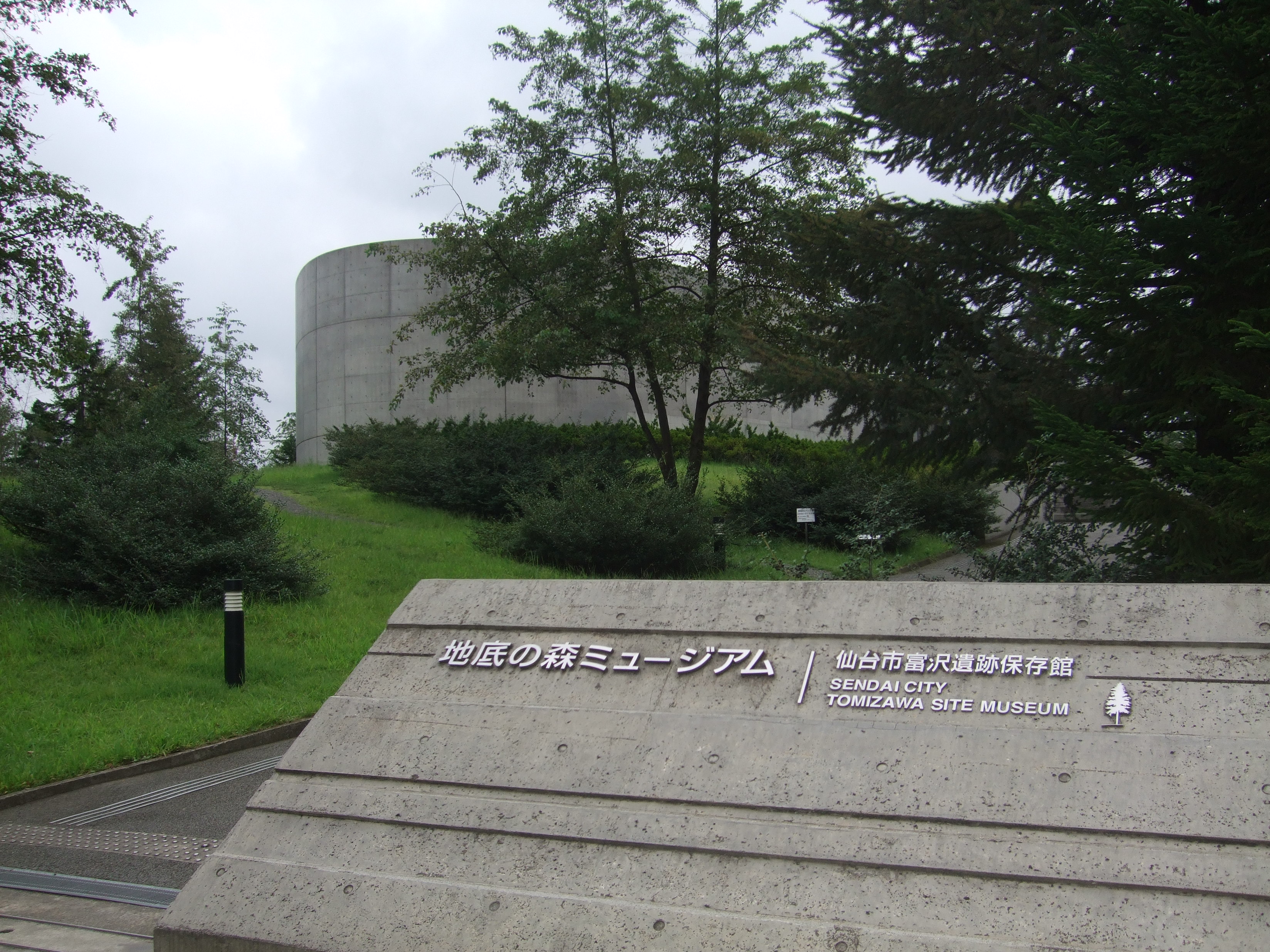
Sendai City Tomizawa Site Museum
They were digging for a school when they found a world. In 1988, construction crews surveying a site for a new elementary school in Sendai's Taihaku ward drove their equipment into something the city's planning office had not anticipated: the preserved stumps of spruce trees that had been standing when mammoths still roamed northern Honshu. Surrounding them lay the scattered remnants of a campfire and hundreds of chipped stone tools, evidence that humans had huddled among these trees roughly 20,000 years ago, at the bitter peak of the last Ice Age. The school was never built. What rose in its place is the Tomizawa Site Museum, known locally as the Underground Forest Museum, a building designed around a single, extraordinary idea: leave everything exactly where it was found.
Frozen in Time Beneath the Soil
The fossilized forest that fills the museum's basement spans roughly 800 square meters. The trees are spruce, a species that no longer grows in the Sendai lowlands, remnants of a colder epoch when northern Japan's coastal plains looked more like modern Siberia. Groundwater had kept the stumps and roots sealed in an anaerobic envelope for millennia, preventing decay. Among the preserved wood, archaeologists identified small pieces of coalified material from a campfire and hundreds of discarded stone implements, the detritus of daily survival. Deer dung was also recovered from the layers, hinting at the prey these Ice Age inhabitants tracked through the frozen woodland. The Tomizawa site is said to be the only place in the world where a fossilized forest of this age has been found alongside direct evidence of human habitation spanning centuries.
A Building That Steps Aside
The museum, which opened on November 2, 1996, after five years of conceptualization and two years of construction, was designed to serve the exhibit rather than upstage it. Eighty percent of the building's total area is exhibition space. The main gallery sits in the basement, directly above and around the preserved forest floor. Its high, ovular ceiling rises without any vertical support beams, so nothing interrupts the sweep of ancient stumps stretching across the room. Projections on the curved walls recreate what the landscape is theorized to have looked like 20,000 years ago, shifting between daylight and night, summer and the deep snows of the glacial winter. The effect is less like visiting a museum case and more like standing inside a diorama with real artifacts beneath your feet.
Where Visitors Make Their Own Stone Tools
The remaining twenty percent of the museum is given over to classrooms and hands-on learning spaces. Visitors, many of them school groups from across Miyagi Prefecture, can try their hands at crafting stone implements using techniques similar to those employed by the original inhabitants of the site. Other workshops teach basic archaeological procedures, letting participants experience the slow, meticulous work of excavation and cataloging. These programs connect the ancient campsite downstairs to something tangible, the muscle memory of striking flint and shaping an edge, a small echo of the same survival skills practiced on this exact patch of ground two hundred centuries ago.
The School That Became a Time Machine
The story of the museum's origin carries its own quiet drama. When the archaeological survey turned up the first spruce stumps in 1988, the Sendai Board of Education faced a choice: build the school as planned or preserve what lay beneath. They chose to relocate the school entirely. It took nearly a decade from discovery to opening day, a testament to the care required to excavate, stabilize, and display such a fragile site. Today, the Underground Forest Museum stands as a reminder that the most significant discoveries often arrive uninvited. Beneath the modern streetscape of Taihaku, commuters and schoolchildren walk daily over ground that once supported an Ice Age forest, a campfire, and the quiet persistence of human life at the edge of a glacial world.
From the Air
Located at 38.22N, 140.87E in the Taihaku ward of Sendai, in the Tohoku region of Honshu, Japan. The museum is not visually distinctive from altitude, situated in a residential neighborhood south of central Sendai. Look for the broad floodplain of the Natori River to the south and the urban grid of Sendai extending north toward Aoba Castle's hilltop. Nearest major airport: Sendai Airport (RJSS), approximately 10nm southeast. JGSDF Kasuminome Airfield is closer, roughly 5nm east. The Tohoku region experiences variable weather; expect seasonal cloud cover and possible snow in winter months.