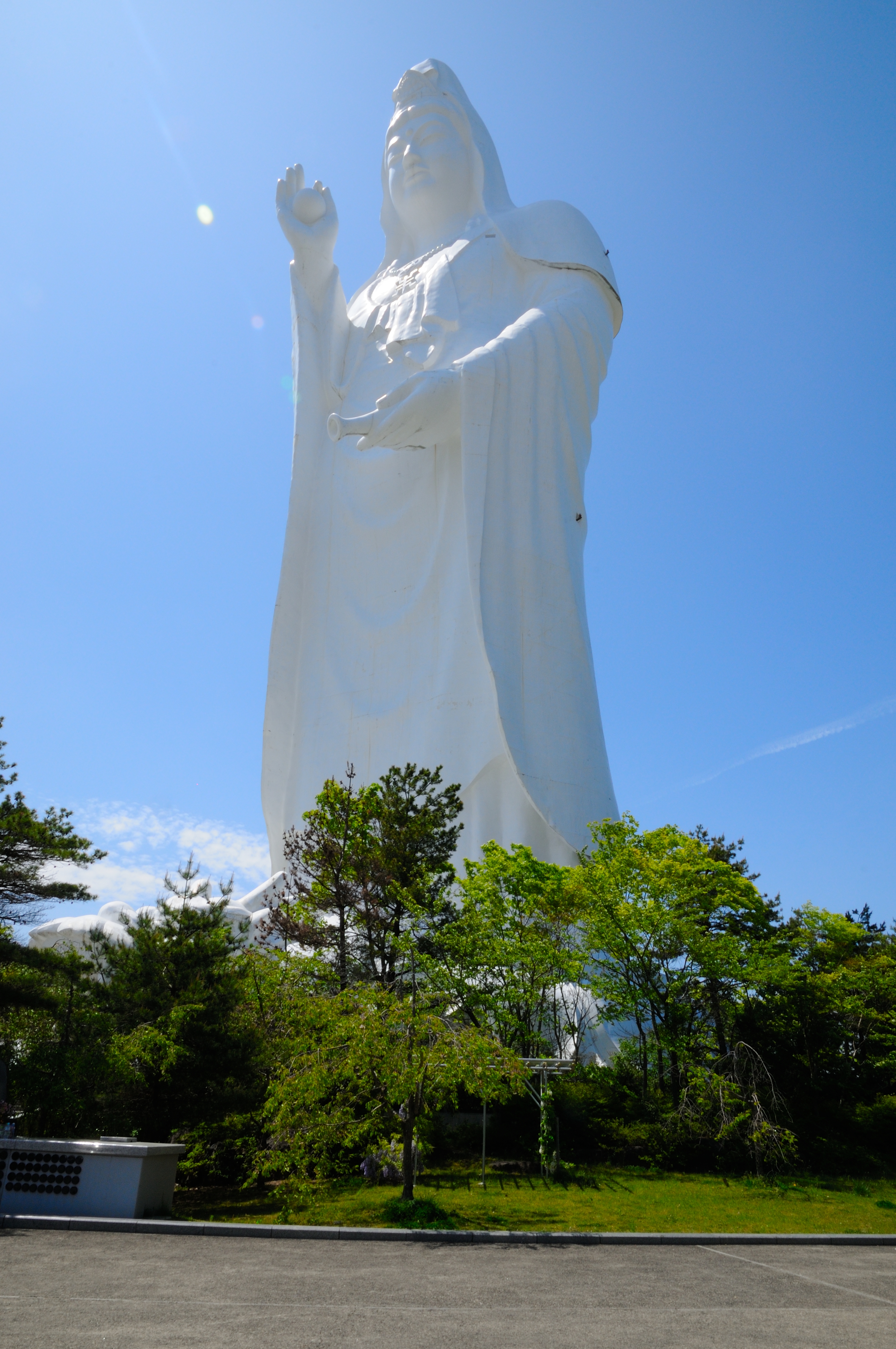
Sendai Daikannon
From the air, she is unmistakable: a slender white figure rising 100 meters above a residential neighborhood in northwestern Sendai, taller than the Statue of Liberty with its pedestal, taller than anything else on the skyline. The Sendai Daikannon, completed in 1991, depicts Byakue Kannon, the white-robed bodhisattva of compassion, holding a wish-granting jewel called the nyoihoju in her right hand and a vessel containing the water of wisdom in her left. For two years after her completion, she was the tallest statue in the world. Then the 120-meter Ushiku Daibutsu took the title in 1993. But height was never really the point. Step inside, and you begin to understand what is.
108 Buddhas in a Spiral Descent
The statue is hollow, and visitors enter through a doorway at the base. The first floor opens into a hall of large Buddha statues and mythical guardian kings, their gilded faces catching dim light. An elevator carries visitors to the twelfth level, near the crown of Kannon's head. From there, the only way down is on foot, winding along stairs and ramps that spiral through the interior. At each of the twelve levels, eight wooden cabinets display seated Buddhas, 108 in total. The number is deliberate: in Buddhist tradition, 108 represents the number of earthly desires that bind human beings to suffering. Walking past each one on the long descent is meant as a meditative act, a gradual shedding of attachment, level by level, until you reach the ground floor and step back into daylight.
A Goddess in a Neighborhood
What makes the Sendai Daikannon so striking is not just her scale but her setting. She does not stand on a mountaintop or in a temple complex set apart from daily life. She rises from the grounds of Daikanmitsu-ji, a Shingon Buddhist temple, surrounded by ordinary houses, convenience stores, and narrow residential streets in the Nakayama district. From certain angles at ground level, she looms over two-story homes like a figure from a different reality altogether. Neighbors have lived in her shadow since 1991. The juxtaposition is part of the experience: sacred and secular compressed into the same block, a 100-meter embodiment of compassion visible from kitchen windows and parking lots.
The Tallest Goddess in Japan
At the time of her completion, the Sendai Daikannon was the tallest statue in the world. The monument itself stands 92 meters, with the pedestal bringing the total to an even 100 meters. That global record lasted just two years before the Ushiku Daibutsu, a bronze Amitabha Buddha 80 kilometers northeast of Tokyo, surpassed it at 120 meters. Even so, the Sendai Daikannon remains the tallest statue of a goddess anywhere in Japan, and she still ranks among the ten tallest statues on Earth. Her white surface catches the sun on clear mornings and glows against the dark ridgeline of the Ou Mountains to the west, a beacon that pilots and passengers approaching Sendai Airport have noted long before touchdown.
Compassion Cast in Concrete and Steel
Kannon, known in Sanskrit as Avalokiteshvara, is the bodhisattva who chose to remain in the cycle of rebirth rather than enter nirvana, vowing to hear the cries of all sentient beings. The Sendai Daikannon portrays her in the Byakue, or white-robed, form, a manifestation associated with purity and the granting of wishes. The nyoihoju jewel in her right hand symbolizes the fulfillment of prayers, while the water vessel in her left represents the wisdom that washes away ignorance. Visitors paying the small entry fee can contemplate these symbols not from a distance but from within, climbing through the body of compassion itself, surrounded by 108 silent Buddhas who mark the path from suffering to release.
From the Air
Located at 38.30N, 140.82E in the Nakayama district of northwestern Sendai. The statue is 100 meters tall and brilliant white, making it one of the most visible landmarks in the Sendai metropolitan area from the air. Look for her against the green ridgeline of hills to the west of the city. She is roughly 8nm northwest of central Sendai and about 18nm north-northwest of Sendai Airport (RJSS). From standard approach altitudes into RJSS, the statue is clearly visible on the left side when arriving from the south or west. The Ou Mountains rise to the west, and the Pacific coast lies approximately 15nm to the east. JGSDF Kasuminome Airfield is approximately 7nm to the southeast.