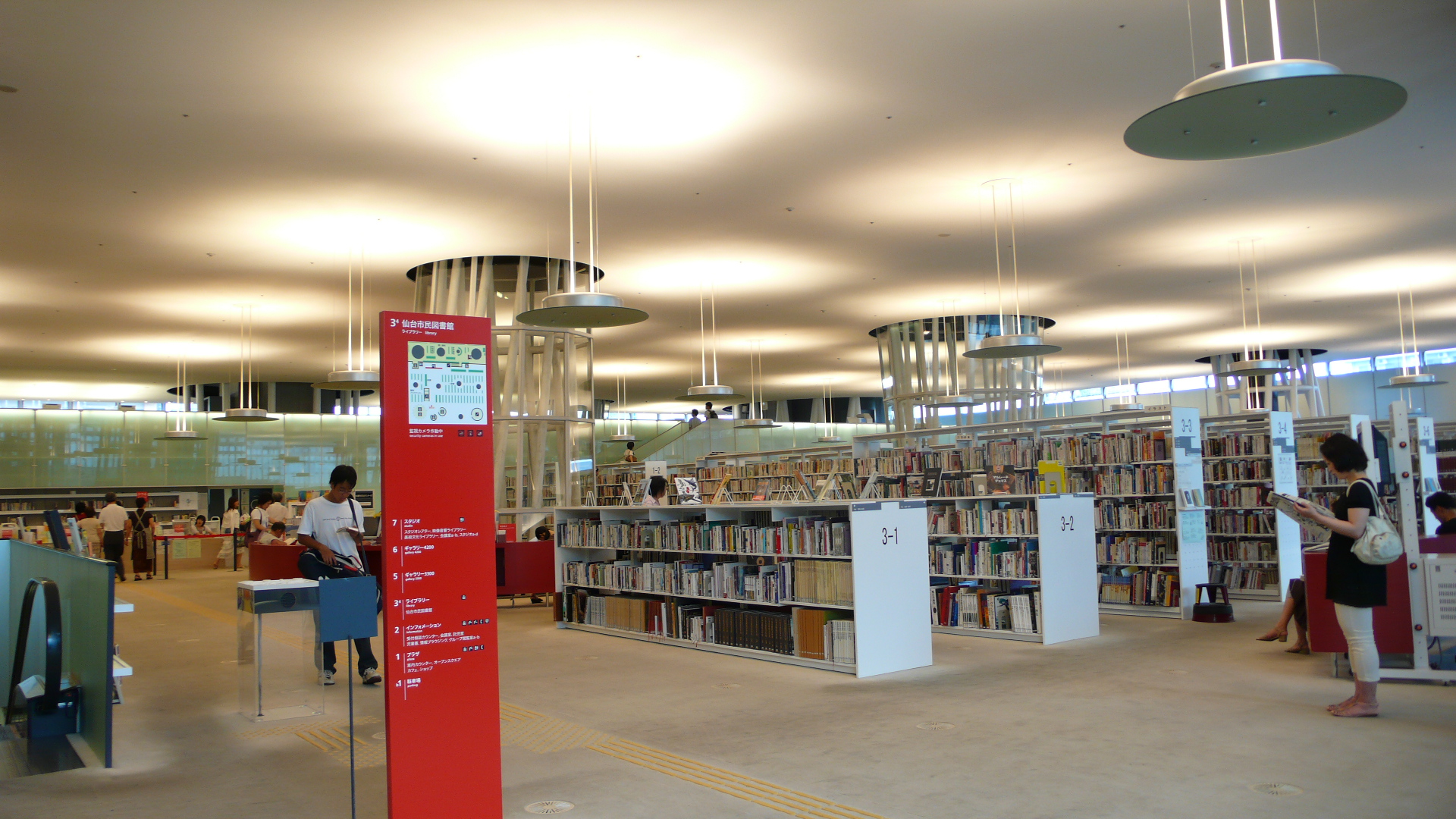
Sendai Mediatheque
Thirteen steel tubes rise through seven glass floors like seaweed swaying in a current. That was Toyo Ito's own metaphor for the building he designed in 1995 for the city of Sendai -- a public library and gallery that would feel less like an institution and more like a living organism. When the Sendai Mediatheque opened in January 2001, architectural critics recognized it immediately as one of the most important buildings of its generation. Ito had taken the two sacred cows of modern architecture -- Mies van der Rohe's fluid transparency and Le Corbusier's stacked slab-and-column structure -- and fused them into something entirely new. The result was a nearly cubic glass enclosure on Jozenji Street, a six-lane tree-lined boulevard in central Sendai, that seemed to breathe with the city around it.
Tubes, Plates, and Skin
The Mediatheque's structure is built from three elemental components. The thirteen tubes are clusters of thick-walled steel pipes, ranging from 7 to 30 inches in diameter, that pass through every floor from ground to roof. Although they appear continuous, each tube was manufactured in floor-height segments and assembled sequentially during construction. The tubes do far more than hold the building up: they house stairs, elevators, light shafts, and the vertical circulation of air, water, and electricity. The constant movement of people through their transparent walls creates a visual pulse that connects all seven levels. The floor plates are composed of a honeycomb network of steel sections infilled with lightweight concrete, spanning between the irregularly spaced tubes without any beams. And the skin -- the facade -- changes character on every exposed face: double-glazed glass on the south, steel panels and aluminum mesh elsewhere, each surface modulating light and views differently throughout the day.
A Lantern on Jozenji Street
During the day, the Mediatheque's diaphanous glass facade mirrors the zelkova trees lining Jozenji Street, blending with its white, opaque neighbors through sheer reflectivity. At night, the building transforms completely. Interior lighting on each floor glows a different color, turning the entire volume into a multi-hued lantern visible for blocks. The ground floor was conceived as an extension of the sidewalk itself -- a cafe, bookstore, and open event plaza flow freely without partitions, visible through the double-glazed facade. That permeability was deliberate. Ito resisted the rigid assignment of activities to predetermined zones. Every floor has a different character -- distinct ceiling heights, different partition materials, different lighting colors, and furniture designed by different designers whose styles become each level's strongest identifying feature. The spaces to the south and north feel markedly different because of light quality and wall surfaces, yet the boundaries remain loose.
Seven Floors of Media
The Mediatheque houses far more than books. The ground floor serves as a public plaza with its cafe, shop, and information desk. The second floor holds a multimedia library with stations for viewing and editing film and audio recordings, a children's library, and resources for sight- and hearing-impaired visitors. The third and fourth floors operate as a conventional lending library, the fourth serving as a mezzanine. The fifth and sixth floors are dedicated to gallery spaces -- the fifth open to the public, the sixth reserved for professional exhibitions. The seventh floor houses a cinema, studio spaces, meeting rooms, and administrative offices. Ito described the result as fundamentally different from modernism's universal space. Each level's spatial conditions loosely determine its use, shaped by tube placement, ceiling design, and the specific quality of light filtering through its particular stretch of skin.
Surviving the Unthinkable
On March 11, 2011, the magnitude 9.0 Tohoku earthquake struck northeastern Japan with devastating force. The four tubes closest to the Mediatheque's outer corners had been engineered to resist what engineers call a 400-year earthquake -- a seismic event so severe it is statistically expected only once in four centuries. The building was put to the ultimate test. It survived with little to no damage, a vindication of Ito's structural innovation that went far beyond aesthetics. While nearby buildings suffered serious harm and Sendai itself faced catastrophic flooding from the tsunami that followed, the Mediatheque's forest of steel tubes flexed and held. The building reopened and continued its role as a civic anchor -- a place where the city gathers to read, view art, watch films, and simply exist together in public space.
From the Air
Located at 38.266N, 140.866E in central Sendai, along Jozenji Street (identifiable from altitude as a wide tree-lined boulevard running east-west). The building's flat glass roof and cubic form are distinctive from above, contrasting with surrounding structures. Sendai Airport (RJSS) lies approximately 13 nautical miles to the south-southeast. Best viewed at 2,000-4,000 feet, where the building's transparent character and its relationship to the tree canopy of Jozenji Street become apparent. At night, the multi-colored glow of each floor is visible from considerable distance.