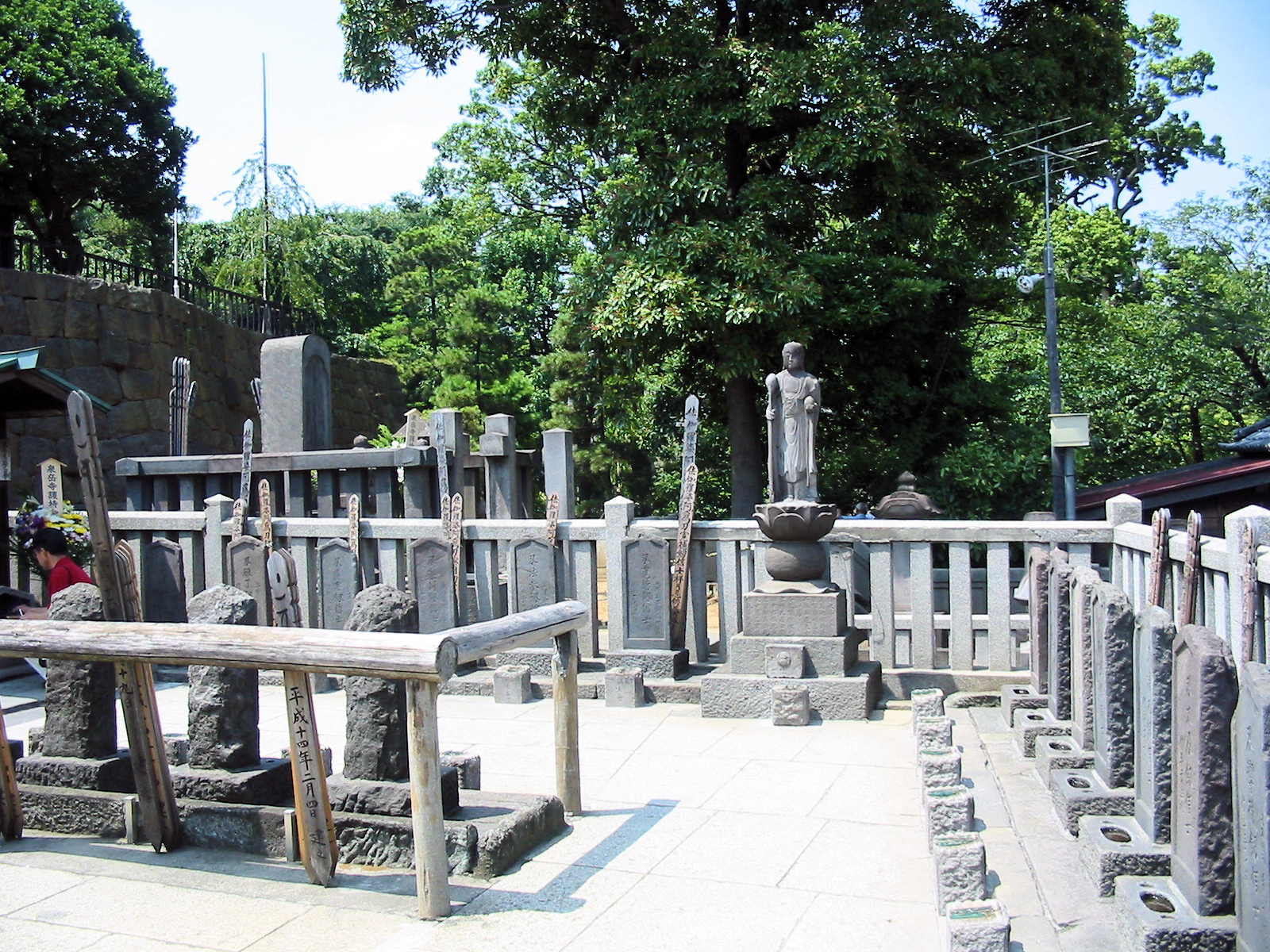
Sengaku-ji
Forty-eight graves stand in neat rows on a hillside in Takanawa, shaded by pine and incense smoke. One belongs to Lord Asano Naganori, forced to commit seppuku in 1701 after drawing his sword inside Edo Castle. The other forty-seven belong to the retainers who spent nearly two years planning their revenge, carried it out on a freezing December night in 1702, then surrendered and followed their master into death. Sengaku-ji is not merely a Buddhist temple. It is the final chapter of Japan's greatest samurai story, etched in stone and still burning with incense left by visitors who come to honor loyalty carried to its ultimate conclusion.
A Temple Born of Shogunate Power
Sengaku-ji began modestly in 1612, founded as a small chapel by Tokugawa Ieyasu, the first shogun of the Edo period, near modern Kasumigaseki. When the Kan'ei Fire of 1641 reduced it to ash, the third shogun Tokugawa Iemitsu saw an opportunity for something grander. He ordered five powerful daimyo clans -- Mori, Asano, Kutsuki, Niwa, and Mizutani -- to rebuild the temple at its present site in Takanawa on a much larger scale. The temple rose into one of the three great Soto Zen temples of Edo, its halls and gardens reflecting the combined wealth and obligation of Japan's feudal elite. It became the bodaiji -- the ancestral funeral temple -- for the Asano clan, a role that would seal its place in history within a few decades.
A Blade Drawn in the Wrong Place
In March 1701, Lord Asano Takumi-no-Kami Naganori of Ako lost his patience with the court official Kira Kozuke-no-suke Yoshinaka inside the halls of Edo Castle and drew his sword -- one of the gravest breaches of samurai protocol imaginable. Asano failed to kill Kira, and the shogunate sentenced him to commit seppuku that same day. No punishment fell on Kira. The Asano domain was confiscated, and his retainers became ronin, masterless samurai cast adrift. Asano's remains were brought to Sengaku-ji, the Asano family temple, where they were interred while his former warriors scattered across Edo, some taking up menial work, some pretending to have descended into drunkenness -- all of it a calculated ruse to lull Kira's guard.
The Night of the Vendetta
On December 14, 1702, forty-seven ronin led by Oishi Kuranosuke stormed Kira's mansion in a pre-dawn raid. They found their target and killed him. What followed was a grim procession through the streets of Edo: the ronin carried Kira's severed head to Sengaku-ji, washed it at a well within the temple grounds, and placed it on the altar before Lord Asano's grave. Their duty fulfilled, they surrendered to the authorities. The shogunate, caught between admiration for their loyalty and the need to enforce the law, ordered all forty-seven to commit seppuku. They were buried at Sengaku-ji beside their lord. One additional grave belongs to Kayano Shigezane, a fellow retainer who took his own life before the raid, bringing the actual count to forty-eight.
Where Incense Never Stops
The story of the forty-seven ronin became Japan's most retold tale of loyalty. The Kabuki epic Chushingura dramatized the events and embedded them deep in Japanese culture. The graves were designated a National Historic Site in 1922. Today, visitors still light incense at each grave, and the fragrant haze that hangs over the hillside is constant. Every December 14, the Gishi-sai festival draws crowds who retrace the ronin's march through Tokyo. A small museum on the temple grounds displays personal belongings of the ronin -- letters, armor, and the weapons they carried on that winter night. The well where Kira's head was washed still stands, enclosed and marked, a visceral reminder that this is not myth but documented history.
Quiet Persistence in Modern Tokyo
Sengaku-ji sits in a rapidly modernizing neighborhood between Sengakuji Station and Shinagawa Station, surrounded by office towers and high-rise apartments. Yet the temple compound preserves a stillness that the city has not managed to consume. The main gate opens onto a tree-lined path. The main hall, rebuilt after wartime damage, maintains the austere elegance of Soto Zen architecture. The graves occupy a gentle slope at the rear, arranged with military precision. Among them rests Asano's widow Yozen-in and his younger kinsman Asano Nagahiro, who was permitted by the shogunate to re-establish the Asano clan. For a place defined by a single dramatic night more than three centuries ago, Sengaku-ji carries its legacy with remarkable composure -- not as a tourist attraction, but as a living temple where monks still chant and incense still rises for the dead.
From the Air
Sengaku-ji is located at 35.638N, 139.736E in the Takanawa neighborhood of Minato-ku, Tokyo. From the air, the temple compound appears as a cluster of traditional rooflines and mature trees set amid dense urban development between Shinagawa and central Tokyo. Best viewed below 3,000 feet. The nearest major airport is Tokyo Haneda (RJTT), approximately 7 nm to the south. Tokyo Narita (RJAA) lies about 35 nm to the east. Clear conditions recommended for spotting the temple grounds against the surrounding cityscape.