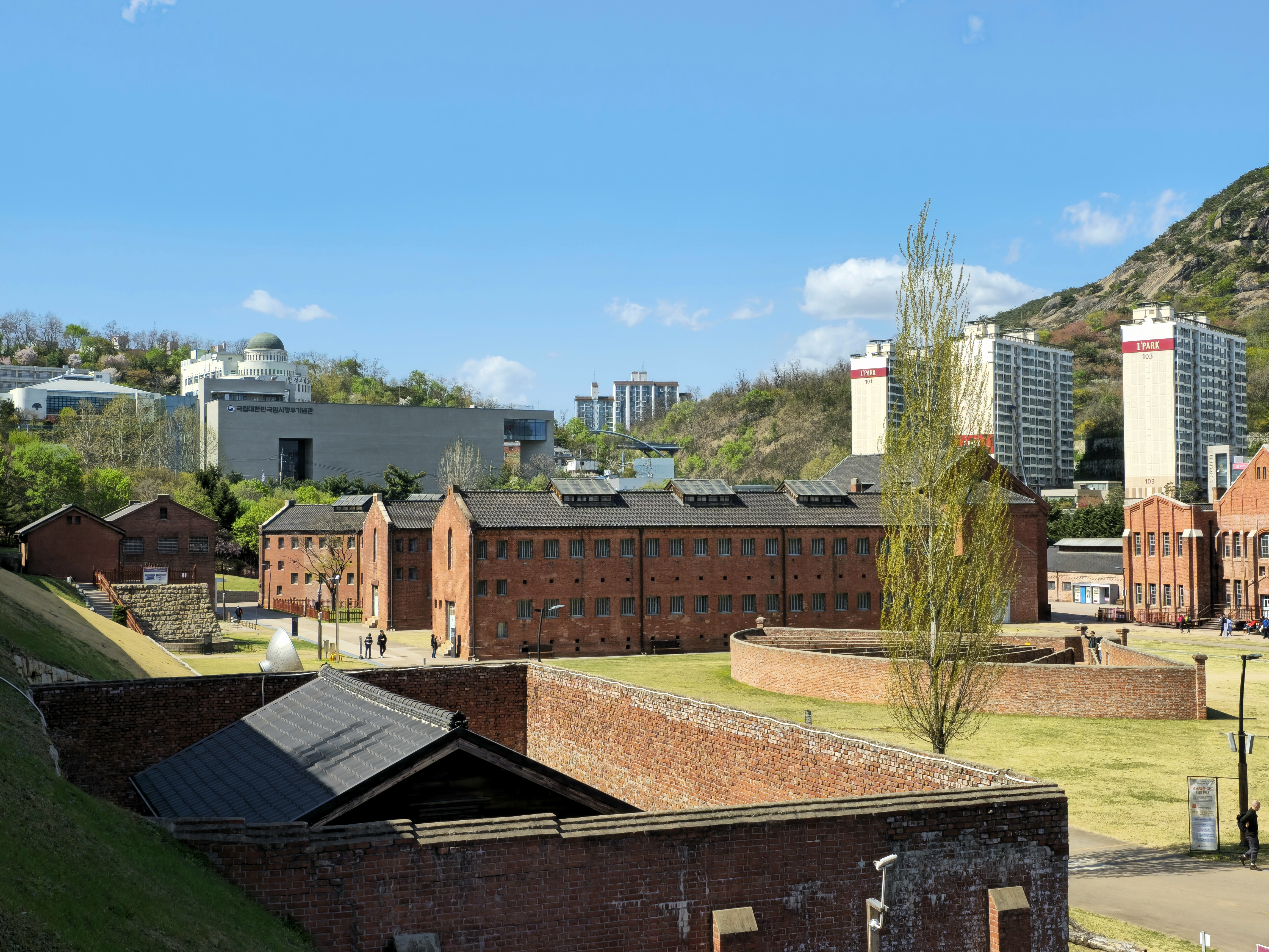
Seodaemun Prison
Yu Gwan-sun was seventeen years old when she was arrested for leading independence demonstrations in 1919. She was eighteen when she died in Seodaemun Prison, her body broken by torture. Decades later, Kim Dae-jung would sit in a cell in the same complex, a dissident who would one day become president of South Korea and win the Nobel Peace Prize. The walls of Seodaemun held both of them, along with thousands of others whose only crime was refusing to accept the political order of their time.
The Colonial Machine
Construction began in 1907, one year before Japan formally annexed Korea. The prison opened on October 21, 1908, as Gyeongseong Gamok, designed to hold roughly 500 inmates. Its purpose was straightforward: to contain those who opposed Japanese imperial authority. By 1919, the March First Movement had overwhelmed that capacity. An estimated two million Koreans took to the streets demanding independence, and Japan responded with mass arrests. About 3,000 activists were crammed into the prison at once, six times its intended population. The facility had separate quarters for women and young girls, and it was in these cells that Yu Gwan-sun continued her protests, leading fellow prisoners in demonstrations even behind bars. Kim Ku, the independence leader who would later head the Korean Provisional Government in exile, was imprisoned here in 1911. By 1945, nearly 3,000 prisoners occupied the complex.
Freedom and Its Reversals
Liberation from Japan in August 1945 did not empty the cells. The South Korean government continued using Seodaemun as a prison, and between 1945 and 1950, the population tripled. When North Korean forces captured Seoul in late June 1950 during the Korean War, they released over 8,500 inmates. The reprieve was brief. North Korean authorities replaced the freed prisoners with seven to nine thousand political detainees of their own, and as they retreated from Seoul in September 1950, they executed at least 1,000 of them. Through the decades of authoritarian rule that followed, Seodaemun continued to hold those who challenged state power, including future presidents Kim Dae-jung and Moon Jae-in.
Walls That Remember Selectively
The prison was converted into the Seodaemun Prison History Hall in 1998, set within Seodaemun Independence Park near the Independence Gate. Today, visitors walk through preserved cellblocks, interrogation rooms, and execution chambers. Statues of friends Lee Hyo-jeong and Park Jin-hong, reunited in one of the women's cells, commemorate the bonds forged in captivity. But the museum has drawn criticism for what it chooses not to remember. Its exhibitions focus almost exclusively on the Japanese colonial period, while the prison's extensive use during the postcolonial era and the democratization movement is largely ignored. Most of the post-1945 buildings and the southern section of the complex were demolished during redevelopment, a decision that erased the physical evidence of more recent, and politically uncomfortable, history.
The Names on the Walls
The roster of Seodaemun's inmates reads like an index of modern Korean history. Ahn Chang-ho, the independence activist and educator. Cho Bong-am, a political prisoner executed in 1959. Shin Joong-hyun, the godfather of Korean rock music, imprisoned for refusing to write a song praising the dictator Park Chung-hee. Kim Jae-gyu, who assassinated Park in 1979 and was himself executed here in 1980. Heo Wi, a righteous army commander, was executed within weeks of the prison's opening in 1908. The poet Ko Un and the journalist Cho Yong-soo passed through these walls. Each name represents a different chapter of Korea's turbulent path from colonized kingdom to divided nation to modern democracy, a path that ran, repeatedly, through these cells.
From the Air
Located at 37.574N, 126.957E in Seoul's Seodaemun District, near Dongnimmun Station on Subway Line 3. The prison complex and surrounding Independence Park are visible as a green area on the western edge of central Seoul. Nearest airports: Gimpo International (RKSS) approximately 10 km west, Incheon International (RKSI) approximately 48 km west. The nearby Independence Gate is a useful visual landmark.