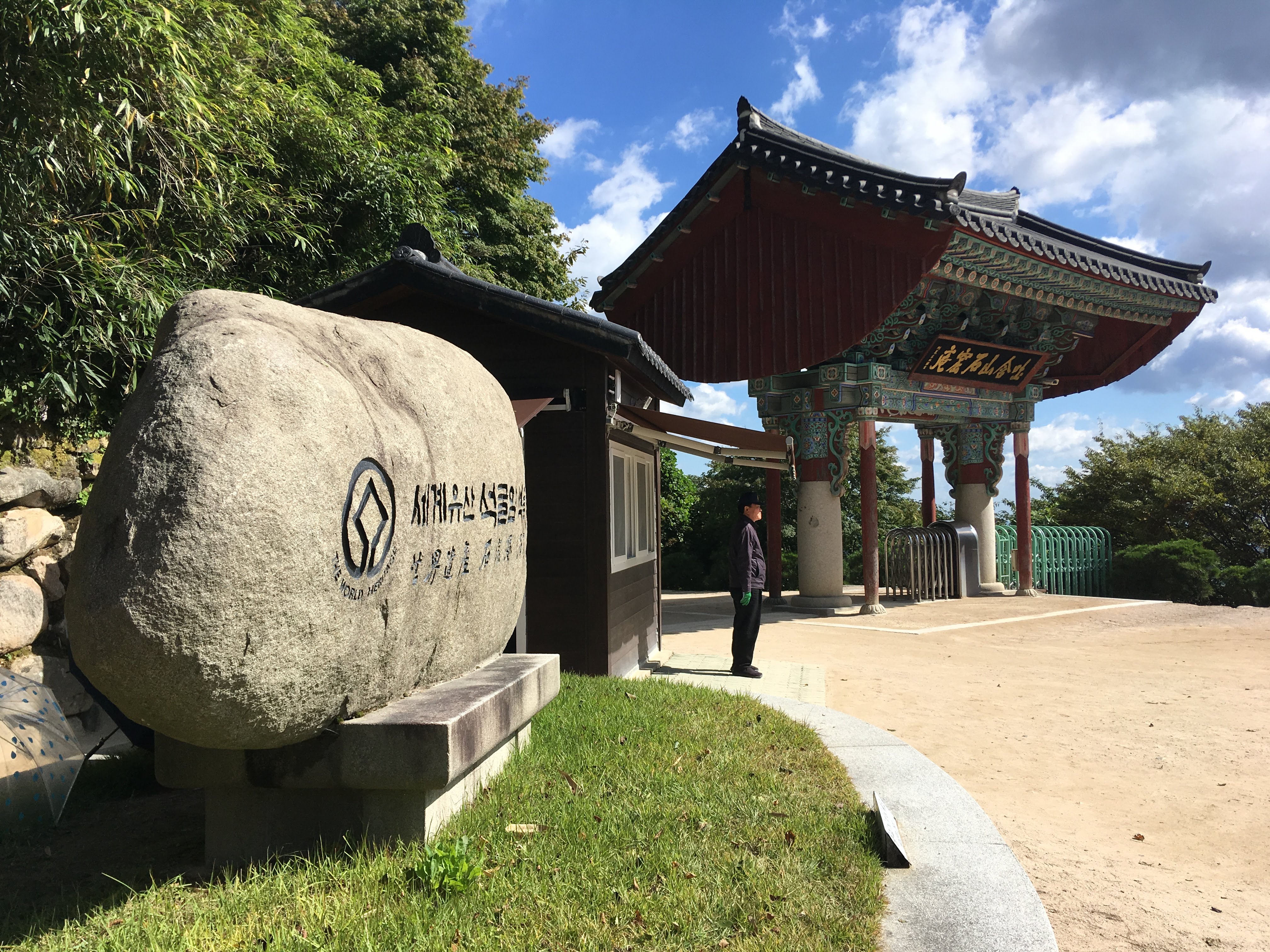
Seokguram
The Buddha faces east, toward the sea. At 750 meters above sea level on the slopes of Tohamsan, the Seokguram Grotto was built so that the first rays of sunrise over the East Sea would travel through the entrance corridor, past the guardian kings and bodhisattvas lining the walls, to illuminate the face of a 3.5-meter granite Buddha seated on a lotus throne. The alignment was not accidental. The architects of 8th-century Silla Korea engineered it into the mountain, along with proportions based on the golden rectangle and a ventilation system that kept the stone breathing for over a thousand years -- until someone tried to fix it.
A Grotto Built Backward
Most Buddhist cave temples began as natural caves that sculptors enlarged and decorated. Seokguram was different. Kim Daeseong, a Silla nobleman, began construction in either 742 or 751 -- during the cultural peak of the Unified Silla kingdom -- by assembling a grotto from individual granite blocks on an open mountainside, then covering it with earth. The grotto was built around the sculptures, not carved into existing rock. After Kim's death, the Silla court completed the project in 774. The result is an architectural hybrid: a man-made cave that functions with the precision of a building. An arched entrance leads through a rectangular antechamber, down a narrow corridor lined with bas-reliefs, and into a circular rotunda capped by a dome measuring nearly seven meters in diameter. The Silla architects understood that granite and earth would interact with moisture and temperature, and designed the structure to breathe naturally.
Forty Figures in Stone
The main Buddha sits at the center of the rotunda, realistic in form, hands positioned in the gesture symbolizing enlightenment. Rather than attaching a stone halo to the back of the figure's head -- the standard approach -- the sculptors placed a granite roundel carved with lotus petals on the wall behind, creating the illusion of radiance through shadow and depth. Surrounding the Buddha are forty carved figures representing the full spectrum of Buddhist cosmology: three bodhisattvas, ten disciples of the historical Buddha, the Hindu deities Brahma and Indra, the Four Heavenly Kings guarding the corridor, and eight Guardian Deities in the antechamber. The most striking single figure is the Eleven-faced Avalokitesvara, the Bodhisattva of Compassion, standing 2.18 meters tall on the back wall -- the only bas-relief facing forward rather than in profile. Some scholars detect Greek influence in the features of the ten disciples, a trace of artistic ideas that traveled the Silk Road from Gandhara to Korea.
The Cure That Nearly Killed It
Centuries of neglect under Confucian-oriented Joseon rulers, who suppressed Buddhism, left the remote grotto seriously damaged by the early 20th century. The Japanese colonial government attempted three rounds of repairs, each one worse than the last. Between 1913 and 1915, workers nearly completely dismantled the grotto and reassembled it -- then encased the structure in concrete, which was cutting-edge technology at the time. The concrete sealed the grotto's natural ventilation system. Humidity built up, water leaked through, and the sculptures began to erode from moisture they had resisted for a millennium. In 1917, drainage pipes were buried above the dome; they did not work. Between 1920 and 1923, waterproof asphalt was applied to the concrete; it made things worse. By 1927, moss and mold covered the carvings, and workers resorted to spraying hot steam to clean the sculptures -- a method now considered unthinkable.
Behind Glass
After World War II, in the 1960s, President Park Chung Hee ordered a major restoration. Engineers installed mechanical temperature and humidity controls to do what the original ventilation system had done naturally before it was sealed in concrete. A wooden superstructure was built over the antechamber -- a decision that remains controversial, since historians believe the original design left the entrance open to the sky and the sea view. Today, visitors view the interior through a glass wall installed to protect the sculptures from the combined effects of body heat, breath moisture, and the sheer volume of tourists drawn to one of South Korea's most revered cultural sites. Designated the 24th National Treasure of South Korea in 1962 and added to the UNESCO World Heritage List alongside Bulguksa Temple in 1995, Seokguram is both a masterpiece of Buddhist art and a cautionary tale about the damage that good intentions can inflict on the things they aim to preserve.
From the Air
Seokguram is located at 35.80N, 129.35E on the eastern slopes of Tohamsan (745m) in southeastern South Korea, overlooking the East Sea (Sea of Japan). The grotto sits at approximately 750m elevation. The mountainous terrain and forest cover make the site itself difficult to spot from the air, but Tohamsan is a prominent landmark east of Gyeongju. Nearest airports are Ulsan (RKPU) approximately 55km south and Gimhae International (RKPK) about 100km southwest.