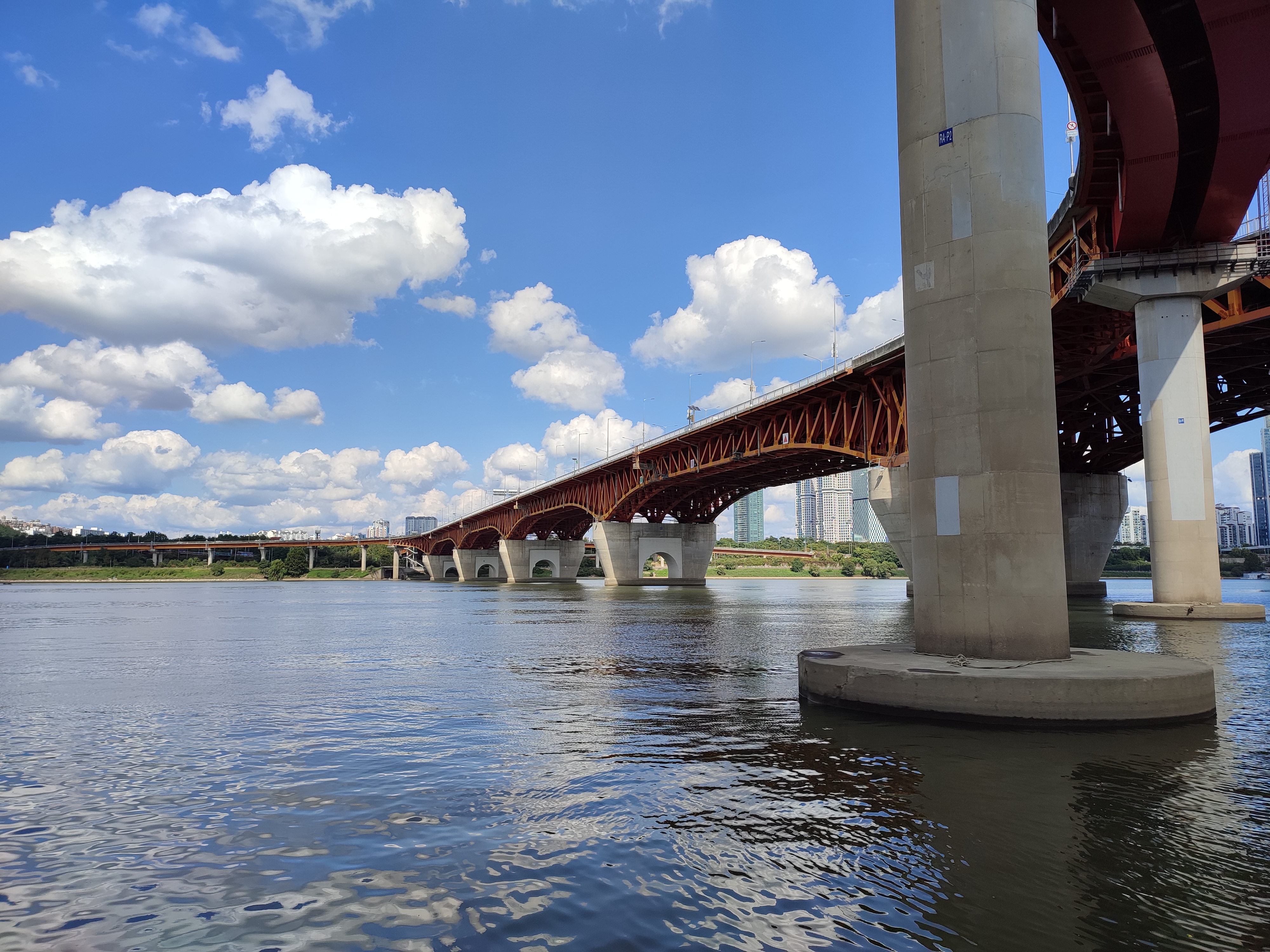
Seongsu Bridge Disaster
The night before, city workers had quietly laid a steel plate over a widening gap in the bridge's surface. It was a patch, not a repair. At 7:38 on the morning of October 21, 1994, a 48-meter span of the Seongsu Bridge gave way during rush hour, dropping vehicles and a bus full of commuters into the Han River. Survivors compared the sound to thunder. Thirty-two people died, including eleven police officers in a van who had been selected as model officers for a ceremony that day. The bridge had carried 160,000 vehicles daily. It had never once been subject to a detailed structural inspection.
Speed Over Safety
The Seongsu Bridge was born from South Korea's ppalli ppalli culture, the national ethos of speed that had powered the country's transformation from war-ravaged poverty to industrial powerhouse. Constructed between 1977 and 1979 as part of dictator Park Chung Hee's plan to develop the Gangnam region south of the Han River, the bridge was the eleventh span across the river. Dong Ah Construction won the contract with a bid that was half the expected cost, a price that guaranteed corners would be cut. Foreign firms were excluded from domestic construction contracts at the time, stretching thin the domestic companies that lacked technical expertise in critical areas like steel plate welding. When a Zainichi Korean engineer hired to manage the steel factory insisted on inspecting the welds, causing delays, he was fired.
110 Out of 111
The white paper issued by the Seoul District Prosecutor's Office laid bare the scope of the failure. Radiographic testing after the collapse found that 110 of the bridge's 111 welded connections contained defects. Welds that should have penetrated 18 millimeters of steel only reached 2 to 8 millimeters. The direct cause of the collapse was the faulty welding of the vertical members connecting the suspension trusses to the anchor trusses. Fatigue stress from years of heavy traffic did the rest. Investigators concluded that had the vertical members been welded correctly, the increased loads would never have exceeded reasonable limits. They also found that the collapse could theoretically have occurred within three years of the bridge's construction. The design itself was sound; every failure was in execution and oversight.
The Reports No One Read
Four days after the collapse, prosecutors discovered something damning: the Dongbu Corporation, responsible for bridge maintenance, had submitted damage reports to the Seoul Metropolitan Government in February and April warning that the steel girders were in urgent need of repair, complete with photographs. City officials had filed false reports certifying the bridge as safe without performing required daily checks. The investigation led to seventeen arrests: four city officials, seven Dongbu Corporation employees, and six Dong Ah Construction personnel. Charges ranged from criminal negligence resulting in death to forgery of public documents. Dong Ah Construction argued that the five-year statute of limitations for negligent manslaughter had expired, since the bridge was built fifteen years earlier. The judge ruled that the clock started on the day of the collapse, not the day of construction.
Two Mayors and a President's Apology
The political fallout was swift and severe. Seoul Mayor Lee Won-jong resigned the day of the disaster. His replacement lasted eleven days before being removed when it emerged he had ignored internal reports questioning the bridge's safety. President Kim Young-sam appeared on national television to deliver his second official apology, acknowledging that South Korea's rapid development since the 1960s had produced negative consequences alongside its economic gains. He pledged reforms to construction oversight. Nine months later, the Sampoong Department Store collapsed, killing 502 people and becoming the deadliest peacetime disaster in South Korean history. The recurring catastrophes earned the Kim administration a grim popular nickname. The Disaster Control Act, passed in response to both tragedies, fundamentally reshaped how South Korea inspected and maintained its infrastructure.
The Bridge Rebuilt
The city initially planned to repair and reopen the Seongsu Bridge within three months, but public outcry forced a complete reconstruction. The new bridge opened on July 3, 1997. A memorial stone erected on October 21 of that year by the families of the victims stands near the bridge, a reminder that the cost of speed is sometimes measured in lives. Among the dead was Adele Aida, a forty-year-old undocumented immigrant from the Philippines who had been traveling to a community meeting. The Lotte Welfare Foundation and the Temporary Workers Friendly Association of Korea provided compensation to her family through the Philippine embassy, a small gesture that acknowledged what the disaster made painfully clear: infrastructure failures do not discriminate.
From the Air
The Seongsu Bridge spans the Han River at 37.537N, 127.035E, connecting Seongdong District to Gangnam District in eastern Seoul. The rebuilt bridge is visible as one of the many crossings over the Han River. Nearest airports: Gimpo International (RKSS) approximately 18 km west, Incheon International (RKSI) approximately 55 km west. Seoul Air Base (RKSM) is about 10 km to the south. The Han River corridor is a major visual navigation feature.