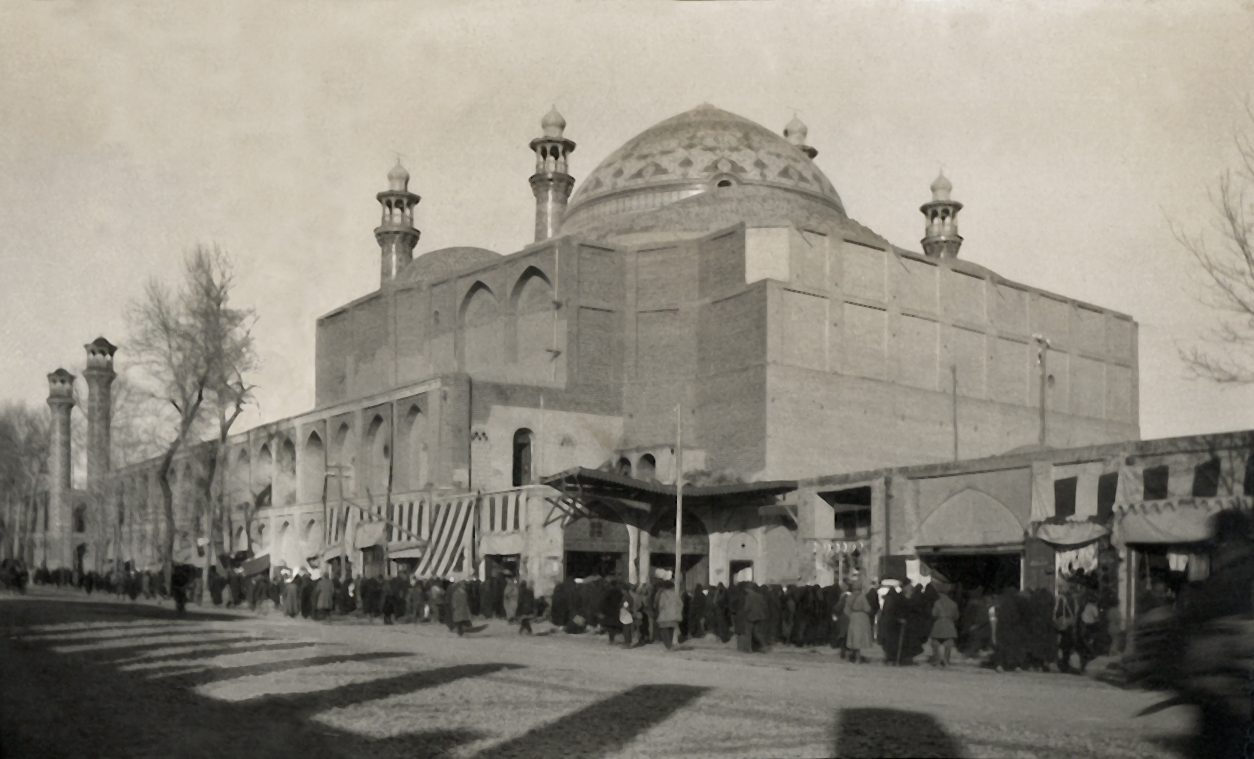
Sepahsalar Mosque
A clock crafted in France in 1880 sits between two minarets atop the Sepahsalar Mosque, its three bells still ringing across the Baharestan district of central Tehran. The clock is a small oddity -- a piece of European precision mounted on a structure built to showcase the flamboyant tilework and geometric mastery of late Qajar Iran. But that tension between influences defines the Sepahsalar. Commissioned in 1879 by Mirza Hosein Khan Sepahsalar, Grand Vizier to Naser al-Din Shah Qajar, the mosque took five years to complete and became one of Tehran's most recognizable landmarks, its eight minarets making it unique among Iranian mosques.
Grand Vizier's Monument
Mirza Hosein Khan Sepahsalar was a reformist politician who had served as Iran's ambassador to the Ottoman Empire before becoming Grand Vizier. He ordered the mosque's construction during the reign of Naser al-Din Shah, and the first phase was completed in 1884. The Sepahsalar was both a mosque and a madrasa -- a theological school -- with some 60 chambers arranged in twin-storied arcades around a large courtyard. The design reflects the Grand Vizier's ambition: this was not simply a place of worship but an institution meant to rival the great religious complexes of Isfahan and Mashhad. The main entrance portal, flanked by two massive minarets, opens into a sahn -- an open courtyard -- decorated with tiles bearing full-blown floral girih patterns in the characteristically exuberant Qajar style.
Beneath the Dome
The prayer hall dome rises 37 meters, supported by 44 columns. Inscriptions in both Thuluth and Kufic scripts cover the walls, recording the endowment details and religious texts. The tilework throughout favors floral motifs over geometric ones, a departure from earlier Persian traditions but consistent with the late Qajar taste for ornamentation. An inscription band around the courtyard documents the original endowment -- who paid for what, and under whose authority. These details, mundane as they sound, anchor the mosque in a specific moment of Iranian political history, when the Grand Vizier wielded enough power and wealth to commission a building of this scale in the capital.
Blood in the Courtyard
In November 1949, the Sepahsalar became the scene of a political assassination. Abdolhossein Hazhir, a former Prime Minister and then Minister of the Royal Court, was shot by a member of the Fada'iyan-e Islam, a militant Islamist group that carried out several high-profile assassinations in the late 1940s and 1950s, and died of his wounds the following day. The killing underscored the mosque's role as more than an architectural treasure -- it was a public gathering point in the heart of political Tehran, close to the Baharestan parliament building. After the 1979 Iranian Revolution, the mosque was officially renamed the Shahid Motahhari Mosque in honor of a cleric killed during the revolutionary upheaval. Tehranis, however, still call it by its original name.
Surviving the Centuries
Historical photographs show the Sepahsalar under construction between 1879 and 1884, with workers standing amid half-finished minarets. Later images from the 1930s reveal the mosque surrounded by a Tehran that was rapidly modernizing under Reza Shah's urban planning campaigns. Through the Pahlavi era and the revolution that ended it, the mosque endured. Its eight minarets remain a unique feature in Iranian mosque architecture -- most mosques have two or four. The French clock still keeps time above the north iwan, a relic of the era when Iran's ruling class looked both to Islamic tradition and European modernity for inspiration. The Sepahsalar stands as a monument to that tension, beautiful and unresolved.
From the Air
Located at 35.689N, 51.433E in central Tehran's Baharestan district, near the parliament building. Identifiable by its eight minarets and large dome. Nearest airports: Mehrabad International (OIII) approximately 10 km west, Tehran Imam Khomeini International (OIIE) approximately 50 km south. Best viewed at 5,000-8,000 ft AGL. The dome and minaret cluster is a visual reference point in central Tehran.