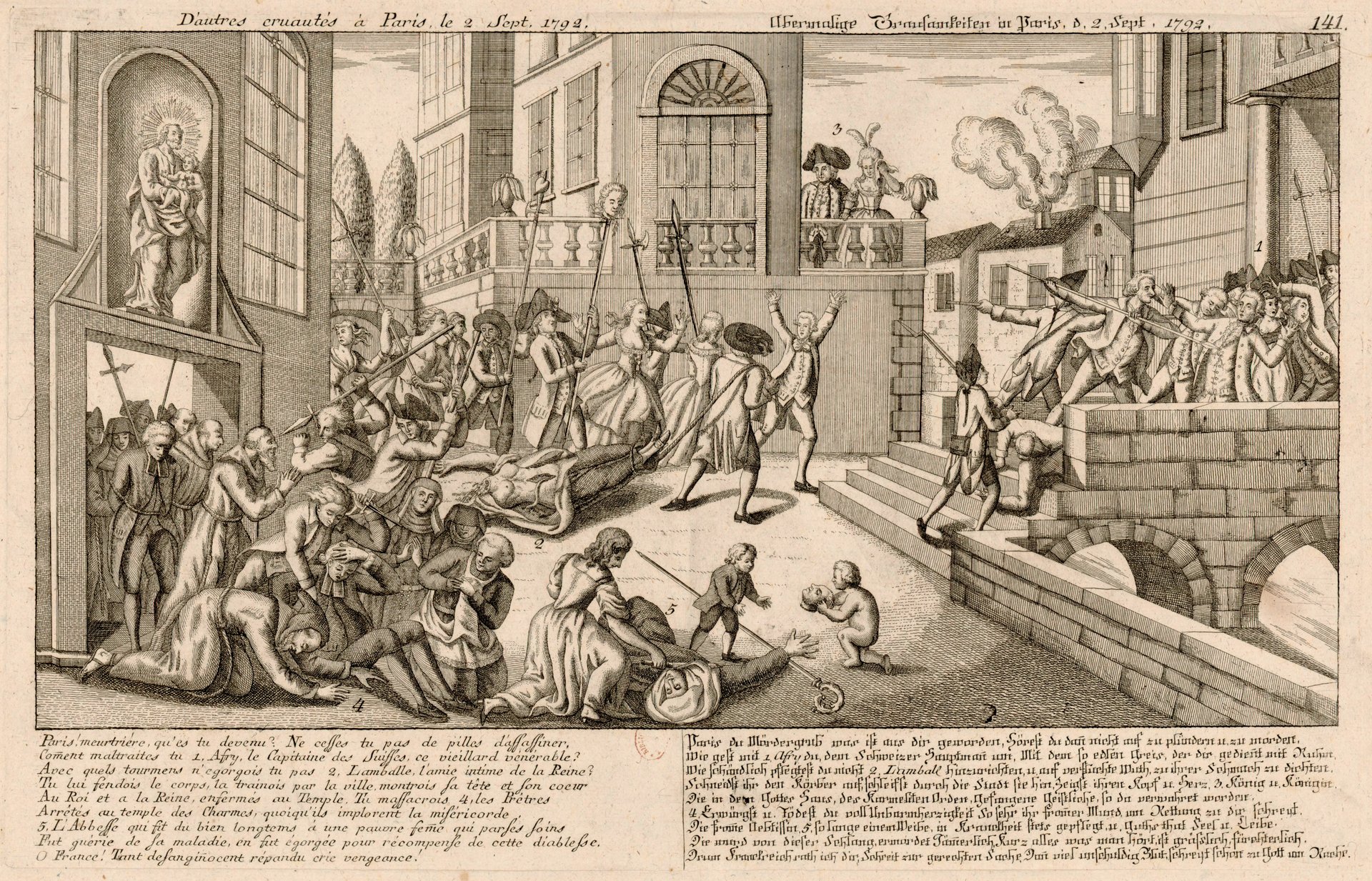
The September Massacres: Five Days of Revolutionary Terror
Georges Danton's voice filled the Legislative Assembly at one o'clock on the afternoon of September 2, 1792. "The bell we are about to ring is not an alarm signal," the Minister of Justice declared. "It sounds the charge on the enemies of our country." Ninety minutes later, the killing began in the middle of Saint-Germain-des-Pres. Within twenty hours, more than a thousand prisoners were dead. The September Massacres would last five days, consume at least 1,176 lives across Paris, and reveal something the Revolution's leaders preferred not to examine too closely: that once sanctioned violence finds its own logic, it does not ask permission before expanding.
The Fear That Opened the Gates
The context was genuine panic. Prussia and Austria had invaded France, and by late August 1792 the Duke of Brunswick's army had crossed the frontier. On August 23, the fortress of Longwy fell. Verdun, the last major stronghold before Paris, was under siege. Rumors swept the capital that prisoners -- royalists, refractory priests, Swiss guards captured during the assault on the Tuileries -- would break free and attack Paris from within while the foreign armies struck from without. The Legislative Assembly called for volunteers to muster on the Champ de Mars. The Commune ordered the city gates sealed. In this atmosphere of existential dread, the prisons became targets -- not because of what the inmates had done, but because of what terrified Parisians imagined they might do.
The Killing Grounds
The massacres began at the Carmes prison, where about 150 priests were being held for refusing to swear loyalty to the Civil Constitution of the Clergy. Armed groups forced their way in and killed the prisoners in the garden. From there, the violence spread to the Abbaye, the Conciergerie, the Force, the Chatelet, and other prisons across Paris. Some establishments set up makeshift tribunals that interrogated prisoners before passing judgment -- a grotesque pantomime of due process. Acquittals did occur: at the Abbaye, those judged innocent were sometimes carried out on the shoulders of the crowd. But the tribunals were arbitrary, and the accused had no defense. The killing at Bicetre and the Salpetriere extended to adolescents and women held for minor offenses. Of those killed, 72 percent were common criminals, forgers, or debtors -- people with no political significance whatsoever.
Who Ordered It?
The question of responsibility has haunted historians for over two centuries. Charlotte Corday blamed Marat. Madame Roland blamed Danton. The interior minister Roland accused the Commune. Modern historians remain divided. What seems clear is that while political leaders created the conditions for the massacres -- the sealed gates, the paranoid rhetoric, the calls to vigilance -- the killings themselves were carried out by a relatively small number of sans-culottes, national guardsmen, and provincial federates who had remained in Paris since July. The surveillance committees of the Commune published a circular on September 3 calling on provincial cities to follow Paris's example, and secretary Jean-Lambert Tallien urged other municipalities to eliminate their own counter-revolutionaries. Massacres did spread to perhaps a dozen other cities, but on a much smaller scale.
The Arithmetic of Terror
Between 1,176 and 1,614 people died in Paris alone. The identities of the perpetrators -- called septembriseurs -- are poorly documented, though many were Parisian national guards. Among the dead were the Princesse de Lamballe, a close friend of Marie Antoinette, whose mutilated body was paraded through the streets. Seventeen percent of the victims were Catholic priests. The remainder were overwhelmingly ordinary prisoners: thieves, debtors, forgers of assignats, women convicted of prostitution. These were people whose only connection to the Revolution was the misfortune of being locked up when the gates were opened. Their deaths served no strategic purpose and advanced no political cause. They died because fear, once weaponized, does not discriminate.
A Stain on the Revolution
The September Massacres became a permanent wound in the Revolution's self-image. Moderates were horrified. The Girondins used the killings to attack the Commune and its radical allies. Danton, whatever his role in enabling the violence, never publicly defended it. The massacres hardened positions on all sides: they convinced royalists that the Revolution was savage, convinced radicals that half-measures were dangerous, and convinced foreign governments that France had descended into barbarism. They also established a pattern. The logic of preventive killing -- eliminate the enemy before the enemy can strike -- would recur during the Terror that followed. When Robespierre sent his rivals to the guillotine, the precedent had already been set in the prison yards of September 1792.
From the Air
The September Massacres took place across multiple prisons in central Paris (approximately 48.853N, 2.335E). Key sites include the Carmes monastery (now at 70 Rue de Vaugirard), the Abbaye prison near Saint-Germain-des-Pres, and the Conciergerie on the Ile de la Cite. Paris Charles de Gaulle (LFPG) is 25km northeast; Paris Orly (LFPO) is 14km south. The sites are within the dense urban core of Paris, best appreciated from lower altitudes.